
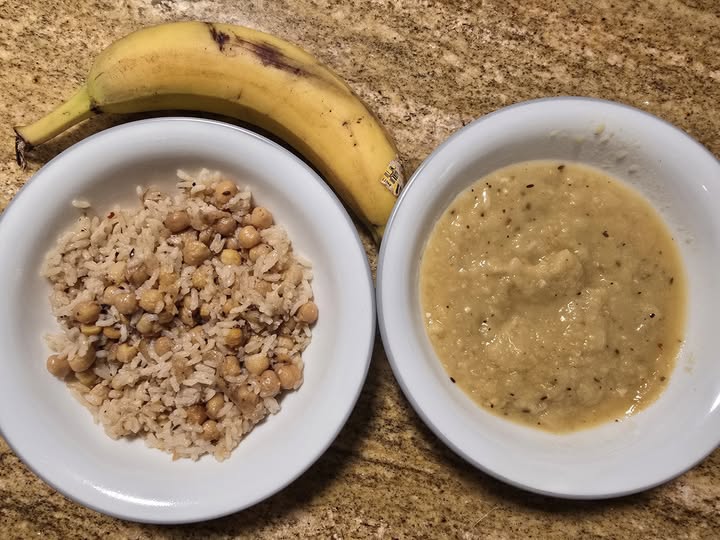
A cup of tea. Water. A banana. Rice and garbanzo beans. A few pieces of broccoli and some eggs.
Choosing to live on $6.20 a day, the average daily amount provided to SNAP recipients through federal assistance, this is all State Sen. Saud Anwar, co-chair of the state’s Public Health Committee, was able to purchase for a day’s worth of food.
With more than 360,000 state residents expected to lose their SNAP benefits Nov. 1 as the federal shutdown drags on, Anwar made the decision to live on a few dollars a day for several days to send an urgent message to the community, federal and state leaders to form a coordinated response to compel the U.S. Department of Agriculture to authorize a $5 billion SNAP contingency reserve to bridge the funding gap and strengthen community food response networks and efforts.
“These individuals in our state will be in a big health care crisis if they can’t afford food,” Anwar told the Courant. “This is one situation where the awareness I am hoping to raise includes not only the role of the state but the larger community’s role. This is a situation where we will be all hands on deck. We have so many people who are food insecure. That is going to increase people exponentially in far more actual trouble. The faith groups, the food banks and community groups will have to step up to this situation and avert a disaster.”
CT joins lawsuit demanding Trump administration fund SNAP: ‘They are weaponizing hunger’
The Trump administration has rejected using more than $5 billion in contingency funds to keep the SNAP program flowing into November.
SNAP helps about one in eight Americans buy groceries using debit cards normally loaded each month by the federal government. A memo from the U.S. Department of Agriculture, which administers the program, says states would not be reimbursed for temporarily picking up the cost.
Attorney General William Tong Tuesday joined a coalition of 21 other attorneys general and three governors in filing a lawsuit against the United States Department of Agriculture and its Secretary Brooke Rollins for suspending the SNAP program, which helps more than 40 million Americans buy food, according to the attorney general’s office.

“Trump is stealing food from hungry Connecticut families – it’s unconscionable, unlawful and we’re going to court today to free these funds,” Tong said in a statement. “There are billions of dollars in contingency funds, paid for by taxpayers and appropriated by Congress sitting there to help American families buy food at a time when grocery prices are already out of control.”
Gov. Ned Lamont said Monday that the state would provide $3 million on an emergency basis to partially fill the gap.
To distribute the food, the state is providing the money to Foodshare, the regional food bank supplier that provides meals around the state year-round.
While an encouraging gesture, Anwar said this is not enough to meet the needs of those in the community.
“It is a starting point,” Anwar said. “It is not an ending point. There is a lot of support that is needed.”
David Bednarz, spokesman for the governor, said in an email Tuesday that the $3 million the governor announced is “an initial step on this issue.
“This is an ongoing matter that is developing and the governor is exploring additional measures,” he said.
The United Way and Cornerstone Foundation, a faith ministry working to help feed and house people, both reported an unprecedented number of people seeking help.
Lisa Pepper Bates, president and CEO of the United Way of Connecticut, said in the last week the agency had more than 12,000 requests looking for emergency food resources, which is double the number of inquiries compared to the same period last year.
Further, 211 had more inquiries about emergency food resources in the last 48 hours than in the entire previous month.
Grace Boucher, executive director of the Cornerstone Foundation, said in its food pantry Tuesday they had 188 families, the largest number of families the organization has ever seen.
“We had 30 more families than we had previously,” Boucher said. ”All of our services are being used and we are happy to do what we can and hopefully we will be able to meet the needs of those in the community. It is growing so fast.”
Boucher said the need is growing due to numerous factors including the expected loss of SNAP benefits, the increase in grocery costs and measures in the Big Beautiful Bill which will cause 500 people to lose their SNAP benefits in the region.
Anwar said living on $6.20 a day made him realize that you can take things for granted such as food.
“$6.20 is nothing because sometimes a cup of coffee is more expensive than that,” he said. “You have very limited options.”
He said the challenge for those who are food insecure is that they can buy carbs but are not able to get enough protein with limited funds.
“When you have limited funds you can’t get fresh vegetables,” he said. “The reality is fresh vegetables are very expensive. You see health challenges in individuals who are food insecure.”
Previous reporting from Chris Keating is included in this article.
The Associated Press contributed to this article.