
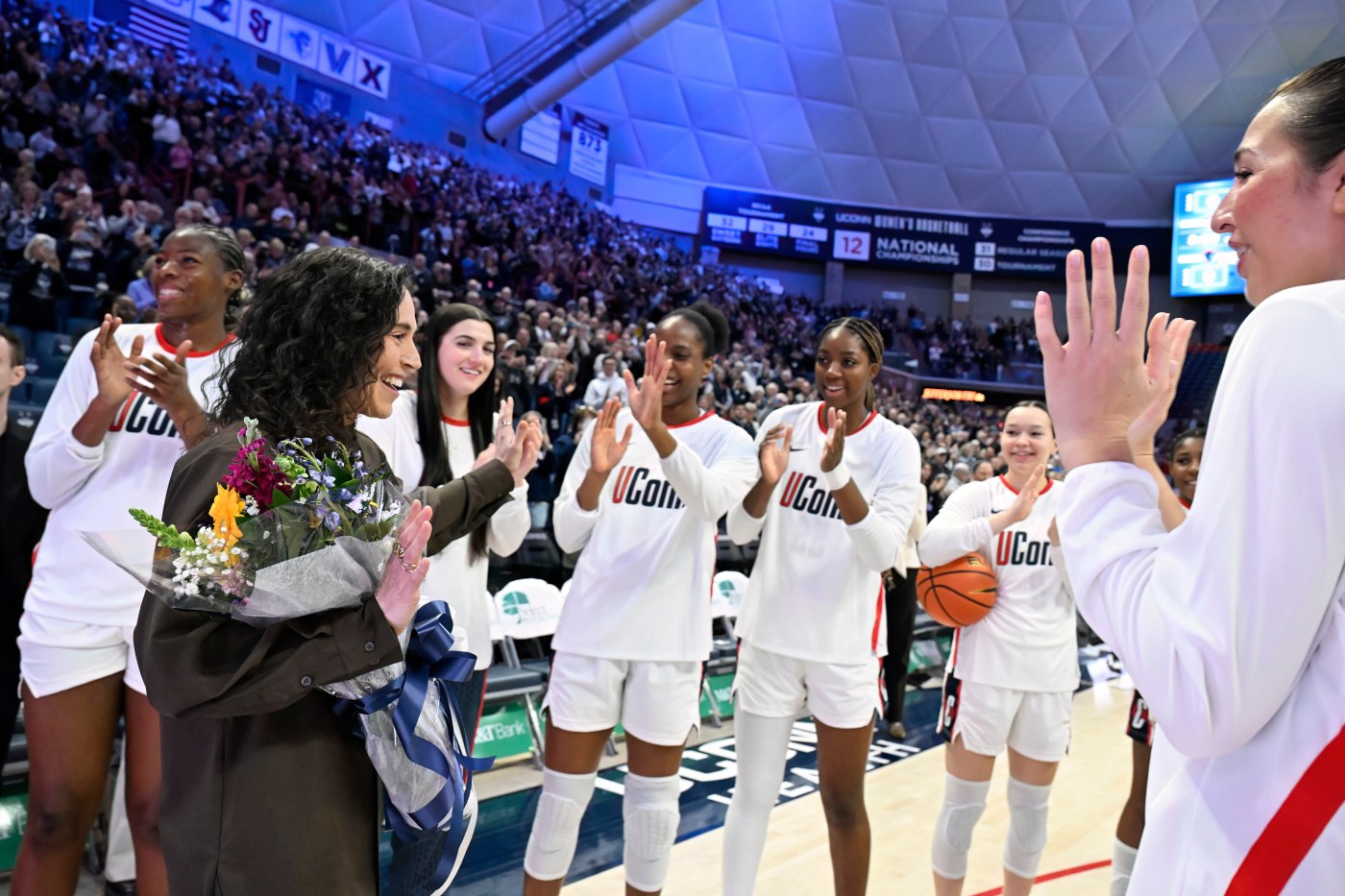
STORRS — It began innocently, randomly enough, as these indelible connections of athletes and uniform numbers sometimes do. Sue Bird’s sister wore No. 10, and as she followed her in youth sports, she naturally picked that number, too.
“My sister’s five years older, Jen, and she was born in October,” Bird said. “She was doing all the sports before me, so I was really just following her. She chose No. 10 because she was born in October, and I just stuck with it.”
Sue, 45, was also born in October, so it was a natural, and as the years, the decades, the assists and accolades rolled by, the No. 10 became more than something stitched into a basketball jersey, it became Bird’s signature. It fit her to a T, and vice versa. UConn, her alma mater, joined the Seattle Storm, her WNBA address, and retired the number in her honor on Sunday.
“So now it belongs to all of us,” she told the crowd at Gampel Pavilion, before UConn routed DePaul, 102-35.
The number hasn’t always been available, as Bird played in Syosset, N.Y., college, in the pros, overseas and in the Olympics five times.
Dom Amore’s Sunday Read: Killingly makes ruckus in CT’s ‘quiet corner;’ UConn ace joins Chisox, more
“I never had to pay anybody to get it,” she said. “There were times, in junior high school the No. 10 jersey was too small. There was an AAU team I joined, someone else had it and I had to wait it out. The only other time, Tamika Catchings, she joined the national team before me and she was wearing No. 10. So when I got there, I was like, ‘Soooo, how does this work?’ But it was locked in, so I wore No. 6 for USA Basketball. That was just given, I didn’t have a choice.”
Said Geno Auriemma: “You do get the feeling there is something special there. It was a weird coaching her on the Olympic team when she was No. 6.”
The more famous an athlete becomes, the more their uniform number becomes iconic. It can be overdone, some places retire too many and are running out of numbers. The UConn women only retire the numbers of Naismith Hall of Famers, a ridiculously high bar, Auriemma noted. This September, Bird and Maya Moore joined Rebecca Lobo and Swin Cash in Springfield, with quite a few more to follow, so at some future date UConn stars could be wearing numbers like 74, 83 or 91 on the court at Gampel.
“Everyone wanted to wear 10 because you wore it,” Lobo said, in her video message to Bird.
None will wear No. 10 again.
“Larry Bird wore 33,” Sue Bird said. “Michael Jordan, obviously anybody my age, it’s going to be Michael Jordan and 23. It slowly gets put on your radar, and for me, the No. 10. I wanted that to be, like, synonymous. I wanted that to be my basketball identity.”
Even Jordan experimented with other numbers, wearing No. 9 on the first Olympic Dream Team, and No. 45 when he played minor-league baseball, keeping it briefly when he returned to the NBA. Ultimately, though, No. 23 is his.
Jersey No. 10 became an icon in international soccer. The Great Pele wore it, and a succession of playmakers on the pitch have worn it through the years, like Diego Maradona and Lionel Messi. In the NFL, it’s closely associated with Fran Tarkenton or Eli Manning. The number is in the rafters — forever-afters — at Madison Square Garden for Walt Frazier.
“With Sue, I had no idea her picking No.10 was going to become iconic,” Auriemma said. “For me, one of the best ones was when Nykesha Sales visited (in the 1990s) and she asked me, ‘Could I wear No. 42?’ That’s when I knew she was coming here because her real number of 24 at Bloomfield (High), but she knew Kerry Bascom wore No. 24 here and she didn’t want to wear a former All-American’s number. So some people have tremendous respect for other people’s numbers.”
For generations of women’s basketball players and fans, Sue Bird represents the game’s growth and entry into the mainstream of sports in the U.S., and young kids often gravitate to point guards — they’re the ones with the ball in their hands, and doing something with it. And for them, wearing No. 10 will be the jersey of choice, just as young shortstops still ask for No. 2.
Dom Amore: UConn’s Sue Bird made pathways possible, made things happen along way to Hall of Fame
Like Derek Jeter and Jordan in their venues, Bird can see her number up with the tiles at Gampel Pavilion, Climate Pledge Arena in Seattle, where there is also a statue of her, and on the backs of young kids chasing all she achieved wearing No. 10.
Which gives her more satisfaction?
“Both,” she said. “Both can be true, both are true. It’s really such an honor. I mean, you look at all the names above me, all the plaques, so much history. Right now, I’ll just be the third. It’s really special. The further you get away from a career, the more you can really sit in it realize how special it is, what you achieved, and at the very same time knowing I was part of a generation that paved the way for other players.”
The UConn women were stamped on the map with Lobo and the undefeated 1995 team. Bird, who arrived in 1998, was part of the wave of players that came to Connecticut in the aftermath and launched a dynasty. No one was asking her, in those says, “legacy” questions. Numbers weren’t taken out of circulation back them, like they are now. Fun fact: Auriemma retired zero himself; he wouldn’t let Diana Taurasi, or any other player, wear it.

After the NFL Draft, top pick Abdul Carter asked the Giants for No. 56, and Lawrence Taylor offered some sage advice, to go make a name and a number for himself. Could there ever be a player, if she asked to honor Bird by wearing her number in Storrs or Seattle, who would be given blessing to do it?
“Now that’s it’s retired?” Bird said. “… Can I just enjoy today? I’m sure I’d consider it, but I haven’t thought about it.”
Auriemma never told a subsequent Husky she couldn’t wear No. 10, and a few have. But he calls Bird “one of one.” The jersey just won’t fit anyone else, not any more.