
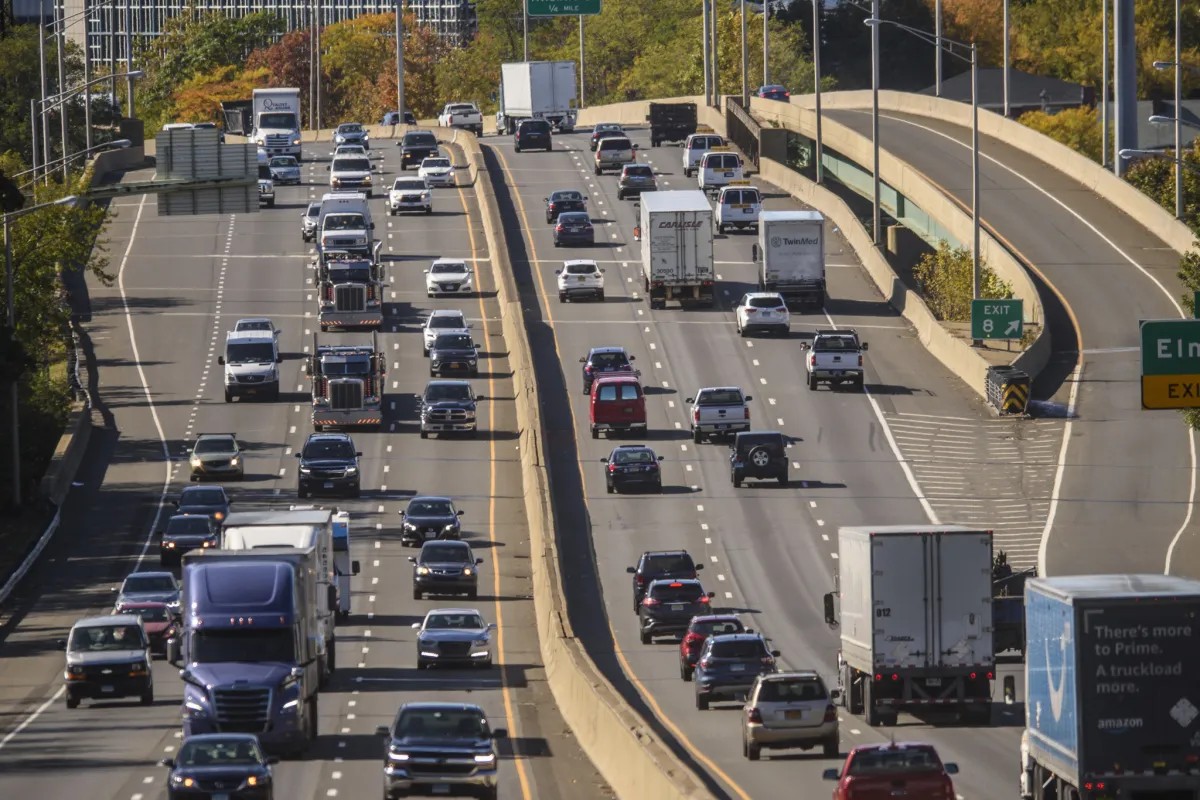
As part of an effort to alleviate traffic on one of the nation’s most congested stretches of interstate highway, the Connecticut Department of Transportation is weighing a fix that has roused local opposition: adding more highway.
In October, the agency delivered a presentation to a committee made up of Stamford residents, business leaders and other local groups unveiling several concepts for a planned overhaul of Interstate 95 through the city’s downtown. One option called for widening the interstate by a single lane in each direction. Another suggests putting up a “collector-distributor” road running parallel to the highway.
A third option presented by the DOT would avoid adding any new travel lanes, and focus instead on reconfiguring the highway’s exits and entrances, as well as adding wider shoulders.
Those proposals were pitched as part of DOT’s long-term study of ways to improve traffic and safety on I-95 between exits 6 and 9, a bottleneck that is well known to Connecticut drivers for producing chronic delays. In addition, the DOT is looking to replace a bridge carrying the highway over local roads and the Metro-North railroad tracks, which is outdated and in need of replacement.
But some local advocates who had been following the DOT’s work said they were caught off guard by the proposal to widen the highway, which they described as an outdated — and thoroughly debunked — solution to the city’s traffic woes.
“I basically told them that this was pretty bonkers to me,” said Angelo Bochanis, a resident of downtown Stamford who is a member of the local advisory committee that heard the DOT’s proposals in October.
“It felt very out of step with everything we were talking about and the direction I thought this project had been headed,” Bochanis said. “There’s been a national conversation around reconnecting communities that have been adversely impacted by highway construction. I thought CTDOT was really cognizant of that.”
In an interview Friday, DOT officials involved with the study cautioned that the concepts presented at the October meeting were only preliminary and that the agency has yet to settle on a specific plan for the highway.
“We’re early in the planning process for what is the future of I-95,” said Jonathan Dean, the project manager for the DOT’s study. The ideas under consideration at this point, he said, are “all being compared against each other, they’re being compared against, ‘What is the no-build alternative? What if we didn’t do anything other than what’s required just to maintain the highway as it is?’”
The agency has not conducted cost estimates for any of the proposals for I-95 in Stamford, Dean added, nor have detailed designs been produced showing which properties adjacent to the highway may need to be cleared for construction.
A DOT spokesman said that some additional information regarding costs and property impacts could come about as part of the next and final phase of the screening process, before the agency issues its final recommendations late next year. More details, however, won’t be known until those recommendations go through subsequent environmental reviews and design.
“Some will be long-term projects that may not begin for several years,” the spokesman, Josh Morgan, said in an email. “At the same time, we’re working to identify smaller, independent projects that can be done in the next five years.”
The agency will hold a pair of public meetings next week regarding the future of I-95, including an in-person forum on Dec. 10 at Stamford’s Ferguson Library.
The idea of widening the highway has attracted support from some drivers and businesses, including thousands of commercial truckers that traverse I-95 on a daily basis.
John Blair, the president of the Motor Transport Association of Connecticut, a group representing the trucking industry, pointed out that I-95 in Stamford is one of several locations in the state that perennially rank among the nation’s worst bottlenecks for truckers. (MTAC is also a part of the project advisory council for the I-95 study.)
In addition to the economic costs of having trucks stuck in traffic, Blair said that jams also make highways less safe for drivers.
“There’s a lot of breaking and swerving and traffic and congestion down there,” Blair said. “I think anything they can do to widen it and widen the other spots in Connecticut will help not only the trucking community, but certainly cars and automobiles and passenger vehicles.”
In its current configuration, I-95 has three travel lanes in each direction through Stamford. The DOT is currently constructing a pair of auxiliary lanes between exits 6 and 7 in order to allow drivers more time to merge onto the highway.
Traffic along I-95 is expected to worsen significantly over the next few decades, according to DOT. By 2050, peak travel times through the 3.2 mile stretch of downtown Stamford are expected to grow by nine minutes in each direction, assuming no major renovations to the highway are made.
Critics of highway widening, including multiple researchers who have studied the topic, argue that it does little to reduce congestion in the long term. The culprit, they say, is a phenomenon known as induced demand. Additional lanes may produce some temporary relief from traffic jams, the theory goes, but other drivers alter their routines to take advantage of the new space — and soon traffic becomes as bad, or worse, than it ever was.
“There are very few examples in this country, if any, where just one more lane solves that problem,” said Peter Harrison, the director of Connecticut programs at the Regional Plan Association, a nonprofit advocacy group focused on the tri-state area. “I think DOT is smart enough to know that.”
Harrison said that while the RPA has yet to take a position on the state’s proposals, the group generally favors other methods — such as public transit or congestion pricing — to reduce congestion. New York City rolled out the nation’s first congestion pricing program earlier this year, charging drivers a variable toll to enter the busiest sections of Manhattan.
Bochanis pointed out that it can take him more than 45 minutes to travel from his home in Stamford to Norwalk by bus, a distance of less than 10 miles. Bochanis said he does not own a car, which makes him more reliant on transit.
“Unless we start talking about creating viable alternatives to driving along the 95 corridor, there’s always going to be traffic along 95,” he said. “There’s no amount of expansion, no amount of homes you can demolish that will fix that.”
Zach Oberholtzer, another member of the project’s advisory committee, echoed those critiques of the DOT’s planning. Oberholtzer is also an organizer with People Friendly Stamford, an advocacy group that supports mass transit and efforts to reduce car dependency.
“The problem with I-95 traffic is that the trains run too slow,” Oberholtzer said. “If you want to move people efficiently, if you want to move stuff efficiently, you want to put people and stuff on rail… They have no new, insightful, creative solutions here. It’s just the same, ‘Well, what if we added another lane?’ and we know that doesn’t fix it.”
Mass transit options are not a part of the study looking at an overhaul of I-95 in downtown Stamford. But Dean, the project engineer, said DOT as a whole is considering all modes of transportation in its long-term planning for the area. In addition, he said the study will look at the design of local streets next to the interstate for ways to improve bike and pedestrian access.
“It’s a very built up area,” Dean said. “There are a lot of access points to and from the interstate, but that’s something that we’re looking at: How does it all work together, and what can we improve?”‘
Gov. Ned Lamont has pledged billions of dollars as part of an effort to speed up train service along Metro-North Railroad’s New Haven Line, though much of that work is unfinished and the results have only shaved a few minutes off commutes so far. Earlier this year, DOT had to raise rail fares in order to plug a budget shortfall and continue operating at existing levels. (Bus fares remained flat this year, at $1.75.)
Some lawmakers have also raised concerns that the state’s Special Transportation Fund — which covers some of the costs of highway and transit infrastructure projects — could run out of money by 2030, while the Lamont administration is arguing that the state needs to curtail its borrowing for transportation projects.
Morgan, the DOT spokesman, said that no funding has been dedicated to any projects that might arise from the ongoing study of I-95 in Stamford.
John Moritz is a reporter for the Connecticut Mirror. Copyright 2025 @ CT Mirror (ctmirror.org).