
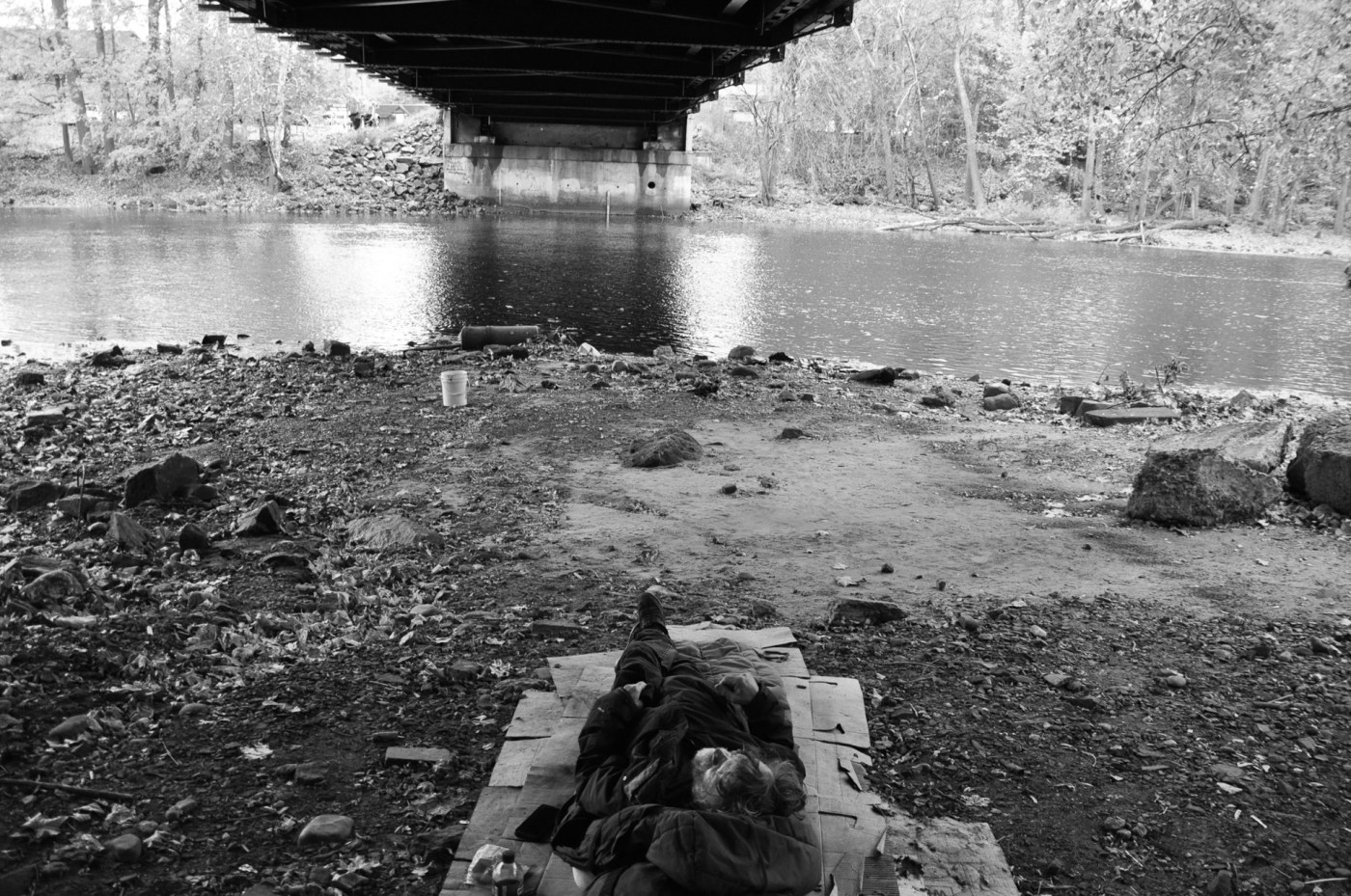
Phil Farnsworth has captured the most vulnerable — from victims of the Rwandan genocide to those in war torn countries in Bosnia, Chechnya, Haiti and Kosovo to homeless people in Hartford.
The award-winning photographer of more than four decades said he aspires to share his pictures with the world to spread empathy for the people who have suffered both in wars and life on the street.
Farnsworth began photographing the homeless in 1984 in Harford, winning acclaim for his book “Under the Bridge,” which profiled those who lived under the I-84 overpass behind the train station in downtown Hartford.
Now back in Hartford, he is again photographing unhoused people in a project he is working on with state Sen. Saud Anwar, co-chair of the Public Health Committee, to document the humanity of those suffering on the streets and call attention to the need for more resources and funding to fight homelessness.
“I want people to have more empathy and understand that this could be them,” he said. “I want them to feel, smell and see what it is like to be homeless and have the empathy to do something.”

Anwar, who has called for more funding for the homeless and 211, slept outside for one night last month in collaboration with the nonprofit Hartford Bags of Love to spotlight homelessness. This was his seventh year participating.
The collaboration with Farnsworth, Anwar said, is an important chance to humanize homelessness.
“I want to see the eyes and faces of the people, which humanizes the actual situation,” said Anwar. “If you spend enough time with individuals who are unhoused, anyone in society is vulnerable should a major challenge occur in your life.”
He spoke of a man who had a three-bedroom house in an affluent town when his son passed away.
“He was in deep shock and trauma and he could no longer work and no longer interact normally with individuals,” he said. “He lost his job and relationships and his house and started to live under a bridge.”
Homelessness in Connecticut has increased by 10% in the past year, with hundreds of children living in homeless shelters, people living in tents and cars and more seniors going without shelter. There are 3,735 people recorded as unhoused in the state.
What homelessness feels, smells and looks like
Farnsworth photographs unhoused people in numerous areas around the city including parks and under bridges.
He described what homelessness feels, smells and looks like.
“If you look at people’s eyes you can feel their tears and empathy,” he said. “I often go into tears myself.”
The smell around the homeless tents and encampments is damp and musty, Farnsworth said.
“The amount of trash under some of these bridges looks like someone pulled up and dumped 30 trucks of trash and people are living in that,” he said. “It reminds me of Port-au-Prince Haiti.
“There is trash everywhere. Anything you use is under those bridges such as computers and vacuums. Everything we all use as a society shows up in all shapes and forms from a dresser with deer antlers to a fence and kitchen table.”
Those living in the tents and encampments report gunshots at night from random cars which make them terrified, Farnsworth said. The tents and encampments also include dogs.
“I got chased by three pit bulls and thought I would be torn to bits,” he said.
There are also many who are struggling with mental illness, Farnsworth said, making it hard to communicate with them.
The faces of heartbreak
So far, Farnsworth has profiled eight people who are unhoused, describing their heartbreaking stories.
Living paycheck to paycheck, Geoff and Jillian were doing everything possible to make ends meet.

She worked at a department store and he was a mechanic. Together for 19 years, they are always together holding hands and long to be with their three children who are now with their grandmother.
Their lives were turned upside down when the landlord sold their building, giving them little notice and not enough funding to find a new home.
They were left homeless, Farnsworth explained. He photographed them recently living in a tent in Hartford.
One of the main themes he has seen in stories like Jeffrey and Gillian’s is immense hopelessness, Farnsworth said.
The couple, who were never drug users, were now surrounded by fentanyl and ended up using the drugs in desperation, Farnsworth said.
“It is really completely giving up,” he said, explaining that people surmise that they can’t get out of the situation so they begin using drugs.
“It is complete desperation,” Farnsworth said. “Once you are labeled homeless there is a whole attitude that they are there because they want to be.”
Compared to the 1980s, Farnsworth said, encampments where he once saw people drinking alcohol now there are now people using fentanyl and drug dealers lurk around.
“The fentanyl abuse is off the rails,” he said. “It is horrible. I am photographing people shooting fentanyl and smoking crack like it is nothing.”
He said there are also a lot of women and men living in tent encampments all around the city which he never saw before four decades ago.
Geoff and Jillian recently went to rehab for five days to overcome their addiction, Farnsworth said. He now wonders what happened to them.
The problem, Farnsworth said, is when people leave rehab, they have no place to go except back to the tents and right back to the fentanyl again.
Turning 63 and homeless
Kenny Nelson turned 63 on Black Friday living underneath a bridge by the Farmington River in Unionville, where photographed him. Farnsworth said that he had graduated high school with Nelson’s sister.

In 1986 Nelson became seriously injured in a construction accident and couldn’t sustain a living. He lived with his mother until she died in 2022 but there was a reverse mortgage on her home and the bank swooped it up, according to Farnsworth.
For the last three years Nelson lived under the bridge.
“Kenny isn’t a stranger to this community,” Farnsworth wrote in a Facebook post about Nelson. “He grew up here. He worked here. He knows half the people who drive over that bridge and they know him too. But somehow, he’s still out there alone, trying to make it through nights like this.”
After seeing Farnsworth’s photographs, shared on Facebook, Memorial United Methodist Church in Avon contributed money to get Nelson an apartment right across the street from where he used to live under the bridge. Nelson sleeps on a long cat bed and through the posts of Farnsworth’s photos on Anwar’s page, he has received additional furniture. Farnsworth worked this week to help paint Nelson’s new home.
Nelson told the Courant that he is relieved that he now has a home.
“I don’t have to worry about getting sick,” he said.
Increasing need and not enough funding
Sarah Fox, CEO of the Connecticut Coalition to End Homelessness, has said the state has seen a 45% increase in unsheltered homelessness, meaning more than 800 people are sleeping outside in freezing temperatures, often in tents or cars. The increase is from the 2024 point-in-time count, when volunteers each year count unsheltered people they can find outside, to the count in 2025.
Gov. Ned Lamont signed legislation last month to begin to address the state’s housing shortage, which has forced many into homelessness and made it more difficult for people to escape it.
The CT Mirror reported that the new law “expands fair rent commissions, eliminates most off-street parking requirements for smaller housing developments and requires towns to create housing growth plans, among other measures.”
But Anwar said the new law does not address the dire need for immediate housing for unhoused people. CCEH said the number of people who are homeless in Connecticut is projected to at least double under recent actions of the Trump administration.
“I was critical of the housing bill,” Anwar said. “It is not taking care of the situation right now. It is a move in the right direction but for the homeless situation it is not going to do anything in a meaningful manner.”
He said with the increasing number of people unhoused, it is critical to work with hotels and motels to provide shelter for those in need, similar to what occurred during the pandemic.
“It is quite clear that the existing resources will not be enough,” he said.
He also cited problems with 211, which he said has inadequate staff and not enough funding.
“They have staffing based on the historical need but the needs have been increasing,” he said. “They are just doing intakes. They don’t have a place or shelter or house they can transfer a person to. There is a problem where the people are calling and they can’t get a human to listen to their concerns and stories.”
David Bednarz, spokesman for the governor, said the “administration is currently reviewing funding requests from various agencies and providers.
“The governor will release his midterm adjustments for fiscal year 2027 in February, which will safeguard essential safety nets and fulfill his commitment to increasing affordability for all residents,” he said.
At the state level, investments have been made for in-person services for homeless people but not for long-term solutions that put people in housing.
Farnsworth said he wants to continue to profile the homeless people in Hartford and has started a gofundme page to help him continue the work; he has said he lives on Social Security while taking care of his 87-year-old mother.
“I am trying to make people aware that this is an issue that isn’t just here in the holidays,” he said. “This is an issue that goes on all year round.”