
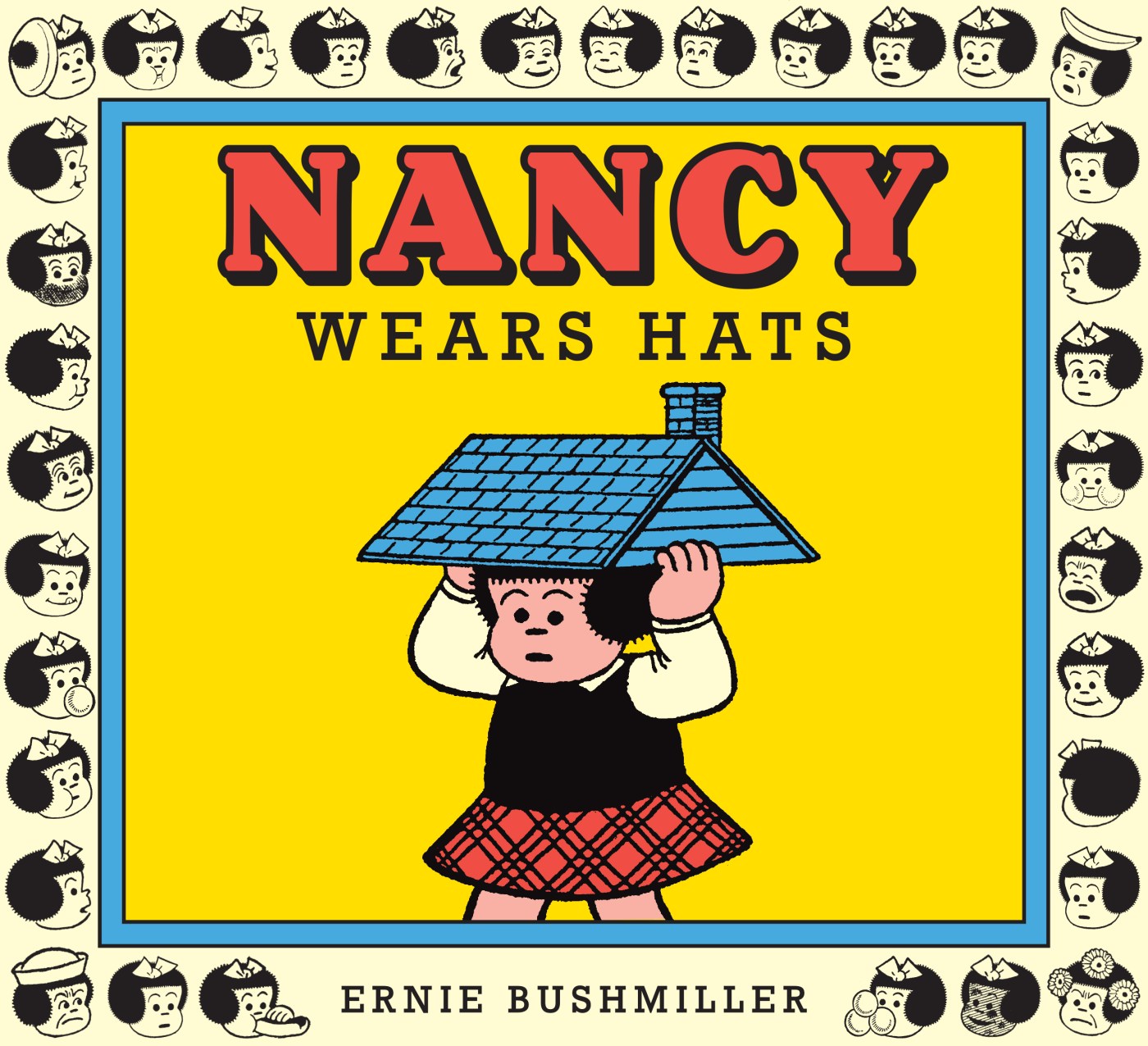
“Nancy” is back, and this time you don’t need to be a snooty scholar to dig into this American comics classic. Several momentous incidents have drawn fresh interest in the cartoon character who has been around since 1933.
The comic’s creator, Ernie Bushmiller, was born in the South Bronx of New York City but lived nearly half his life in Stamford as one of a large number of famous cartoonists who settled in Fairfield County in the mid-20th century.
Bushmiller, who took over a strip called “Fritzi Ritz” about an independent young woman in the big city, introduced Fritzi’s pesky niece Nancy as a supporting character then gradually let Nancy take over to the point where the strip’s title needed to be changed. As Nancy emerged as the star, the strip also switched from the ongoing adventures of Fritzi, her workplace and her love life to a straightforward uncomplicated joke a day.
In Bushmiller’s amusing world, we see Nancy innocently pointing a water pistol at her friend Sluggo, then notice that she has attached a garden hose to the toy for an unexpected assault. We see Nancy and Sluggo bring a bag of onions to a movie theater as a snack, then see patrons of the theaters rushing out the doors and leaping out the windows in olfactory panic mode. In some strips we don’t see Nancy at all because we’re told it’s a holiday and Bushmiller is too lazy to draw her. There are jokes about Sluggo’s poverty, Fritzi’s vanity and Nancy incessant desire to steal cookies and pie.
Bushmiller drew the “Nancy” comic strip for over 60 years. When he died in 1982, the strip was still so popular that it has been continued by other artists and writers right through the present day. A big factor in the recent resurgence of “Nancy” is Olivia Jaimes, who took over the strip seven years ago and redefined it by mixing Bushmiller’s simplicity with post-modern irony, lots of gags about science and psychology and a cool detached style.
The big “Nancy” news, announced in late September, is that the “Nancy” daily strip will have a new artist/writer starting on Jan. 1, 2026. Caroline Cash is an award-winning independent comics creator who has proven herself to be an excellent style parodist as well as skilled storyteller and joketeller in her regular comic “PeePee PooPoo.” Cash identifies as a huge “Nancy” fan. She subbed for a few weeks on the strip when Jaimes was on a hiatus last year.

A sample of the “Nancy” insanity from the collection of classic strips “Nancy Wears Hats” published by Fantagraphics Books. “Nancy” is experiencing a major resurgence, with a new artist set to continue the daily strip in the new year. (Courtesy of Fantagraphics Books)
Entrusting “Nancy” to young female cartoonists with indie credentials has thoroughly invigorated a character that debuted over 90 years ago in a strip that turned 100 this year.
Beyond the increased popularity and more diverse readership of the daily strip, “Nancy” was the subject of an extraordinary biographical graphic novel in 2023. One of the most notable comics-related books of the past few years, “Three Rocks: The Story of Ernie Bushmiller, The Man Who Created Nancy” is part biography, part comics anthology and part multiverse fantasy. “Three Rocks” was dream project for lifelong Nancy fan Bill Griffith, whose own comic strip “Zippy the Pinhead” has run for decades in the Hartford Courant. “Three Rocks” won one of the most prestigious awards in the comics field, an Eisner Award for Best Reality-Based Work. (Caroline Cash is also an Eisner winner.)
Griffith was one of the underground cartoonists and modern artists of the 1960s and ‘70s who spread the gospel of “Nancy” and helped raise an appreciation of Bushmiller’s disarmingly direct and uncluttered cartooning style. It was Griffith and fellow San Francisco underground cartoonist and “Nancy” enthusiast Art Spiegelman (now renowned for “Maus”) who popularized the phrase “three rocks” to express how Bushmiller uniformly drew background elements.
Griffith and Cash aren’t the only “Nancy” revivalists. Last year, Sunday Press Books published “The Nancy Show,” a book-length celebration of “Nancy” that served as the catalogue for an in-depth art exhibit at the Billy Ireland Cartoon Library & Museum in Ohio. “Nancy and Sluggo’s Guide to Life,” a reworking of several “Nancy” anthologies from the 1980s, was released last year by New York Review Books, a publishing company related to the New York Review of Books periodical.
Analyzing and studying the subtleties of the silliness of “Nancy” has been a hipster academic pastime since at least the 1960s, with the high-water mark being the 2017 publication a full-length book, “How to Read Nancy” by Mark Newgarden and Paul Karasik. The book was an expansion of an article Newgarden and Karasik contributed to the first major “Nancy” anthology, “The Best of Ernie Bushmiller’s Nancy” edited by Greenwich native Brian Walker in 1988.
Now there’s a new “Nancy” collection, “Nancy Wears Hats,” from one of the most important publishers of books of comics, Fantagraphics Books in Seattle, Washington. Fantagraphics, which also published the “How to Read to Nancy” book, was responsible for “The Complete Peanuts,” one of the most successful archival comics publishing projects ever.
The thought of publishing a new “Nancy” anthology has “been in the air” for years, said “Nancy Wears Hats” editor Eric Reynolds, who has worked at Fantagraphics for over three decades. Reynolds agreed that the Jaimes’ tenure on the strip, Griffith’s graphic novel and “How to Read Nancy” in particular have caused a flood of new interest in “Nancy.”
But while most of those projects have an edge to them — a sardonic attitude, artsy packaging, a pseudo-intellectual approach — Fantagraphics is attempting to get back to an only-nonsense, pure Bushmiller place.
“Nancy Wears Hats” is actually a carefully arranged chronological collection of strips from 1949 and 1950, but the book doesn’t mention that. Unlike a lot of comic strip reprints these days, there are no annotations or footnotes, no learned analytical articles or probing prefaces and no winking commentary.
In some ways “Nancy Wears Hats” is a continuation of a similar series that Fantagraphics released in 2012 and 2013. But “Nancy is Happy,” “Nancy Loves Sluggo” and “Nancy Likes Christmas” had a different style and feel than “Nancy Wears Hats.” The earlier books had modern art design flourishes, introductions by noted contemporary comics artists such as Griffith, Dan Clowes and Ivan Brunetti and each collected three full years of daily “Nancy” strips. The new one is trimmer, with just two years of strips and gets right down to the business of making you laugh.
When compiling the book, Reynolds was fine with leaving out a handful of strips he deemed offensive to present-day readers. There is no mention in the book of these omissions.
“Nancy Wears Hats,” Reynolds said, is “different from the series we did 15 years ago. This time we tried not to make it this complete, archival, stuffy book. We wanted something parents could give to their kids.
“I have a 17-year-old daughter. Kids love ‘Nancy.’ It’s right up there with ‘Peanuts’ and ‘Calvin & Hobbes.’ We can do this without the stuffy essays from scholars. There’s nothing here but the strips, other than a slightly cheek bio in the back.”
That biographical page, titled “Ernie & Nancy,” ends with the phrase “Who’s lit now, Sluggo?” — a reference to a hilarious strip Jaimes did in reaction to readers’ fears that she’d ruin “Nancy” with updates and modernizations. In the strip, Nancy is shown riding a hoverboard and holding a selfie stick in one hand and an iPod in the other while exclaiming “Sluggo is lit.”
Reynolds is a great admirer of the other “Nancy” projects and calls Griffith’s biography “amazing,” part of what he feels is “one of the great later stage careers a cartoonist has ever had.” He saw Fantagraphics’ previous “Nancy” anthologies lose their luster and wanted to push the upbeat aspects of the strip.
“The time just wasn’t right,” he said of the earlier attempt. The third book sold pretty poorly.” In recent years however, he says that volume, “Nancy Likes Christmas,” became one of the top titles fans were imploring Fantagraphics to reprint.
“We should reboot ‘Nancy,’” Reynolds recalled the publishers deciding. “The syndicate was open to it. This first one has done pretty well.” The next book in the series, “Nancy for All Seasons,” is due to be published in June and a third in early 2027. Then the initial contract for three books is done and the project will be reassessed.
Fantagraphics is sticking with the simplified, unencumbered, jokes-first format for the next two volumes. It’s a concept that’s very much in keeping with Bushmiller’s strips, not to mention the simple lifestyle he maintained at his Stamford home and studio. “We didn’t want to overwhelm,” Reynolds said. This is not too daunting. The books are not too thick. They’re in paperback so it’s not too ostentatious, something you can throw around.”
After all, Reynolds argued, “reading ‘Nancy’ in a collected book form is not necessarily the best way to do it.”
“Nancy” is back but works best in small doses.