
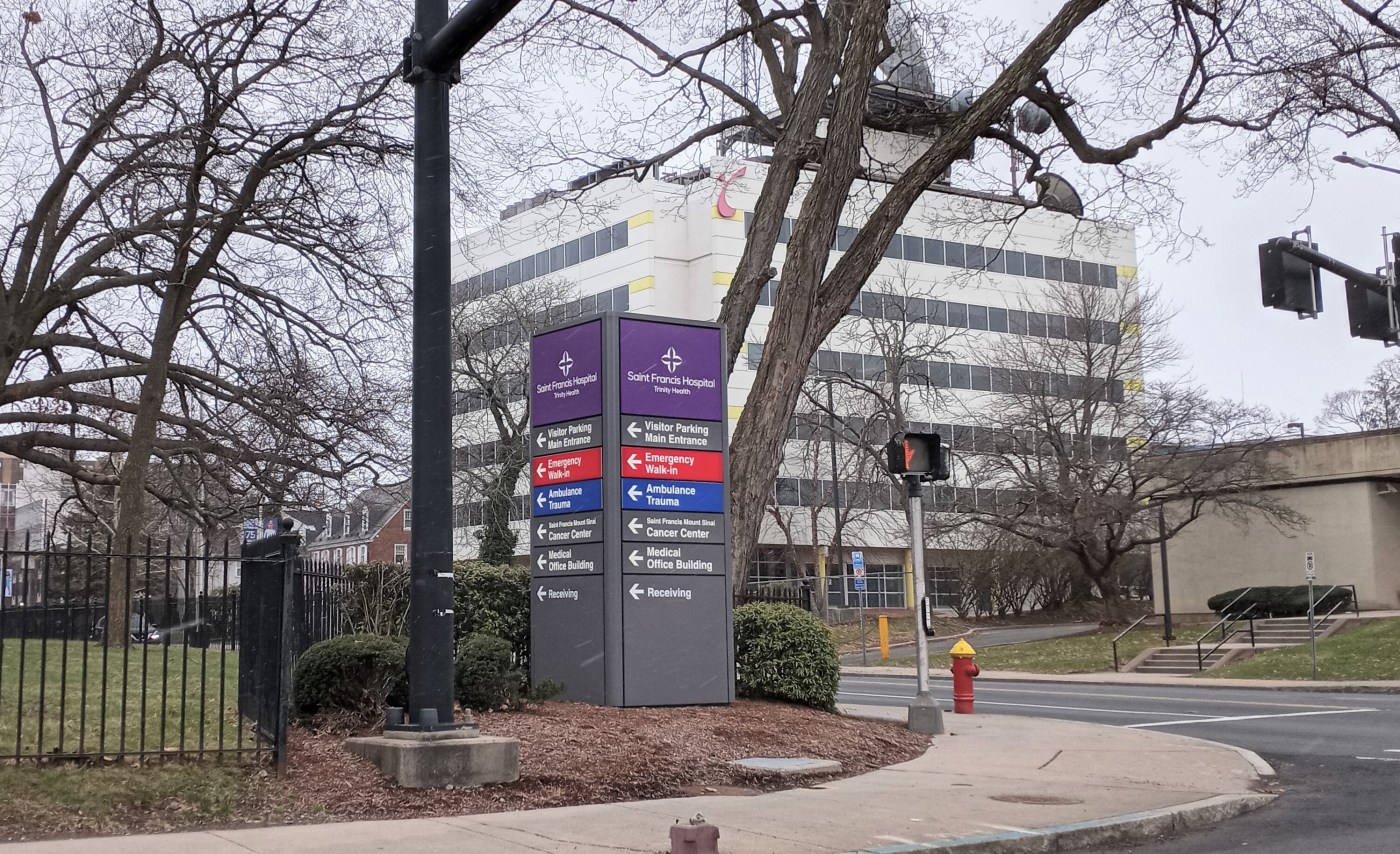
More than a dozen reports from an independent monitor overseeing Saint Francis Hospital spotlight serious issues concerning patient care, including two patient deaths, related to inadequate staffing at the hospital.
The reports reviewed by the Hartford Courant were made available through a Freedom of Information request. More than 150 pages of reports spanning the year illustrate how the hospital struggles at times to keep staffing in line with its plan as required by the state’s hospital staffing law. The reports detail alleged challenges in the hospital from lapses in patient care to medication errors.
The Hospital Staffing law, signed by Gov. Ned Lamont in 2023, requires hospitals to comply with a minimum staffing plan of nurse to patient ratios and assistant staff to patient ratios. The hospital must be in compliance with the staffing plan 80% of the time, according to the law. DPH may review violations that are filed and can assess fines of $3,500 for the first violation and $5,000 for each subsequent violation.
State Sen. Saud Anwar, co-chair of the Public Health Committee, said the bill is only “good if it is implemented.
“If any hospital is not following the law there should be penalties as has been written in the law,” said Anwar. “We have to do what needs to be done to provide the best care to patients in the state. I would expect DPH to pay great attention if the urgent information is not being required to the independent monitor and the expectation that they would be transparent around the data and information.”
State Rep. Cristin McCarthy Vahey, D-Fairfield, co-chair of the Public Health Committee, said the Hospital Staffing law was implemented after learning from nurses about what they were facing on the ground concerning staffing shortages.
“It is my expectation that they make every effort to work with the independent monitor and provide the kind of transparency and access that will allow patients and the public to feel confident that they are getting the care they need and deserve,” she said.
Brittany Schaefer, spokesman for the DPH, said Saint Francis’ last submission concerning its hospital staffing plan was in July 2025 and that the hospital “reported they compiled with the requirement to have a nurse staffing plan and were in compliance with at least 80% of the nurse staffing.”
Questions on staffing plans
DPH did not answer questions from the Courant about whether it was enforcing the hospital staffing law in fining Saint Francis Hospital for incidents in which the independent monitor found the hospital was not adhering to staffing levels as required by the law. Further, it did not answer questions of whether DPH verifies hospital staffing itself or accepts hospital reports.
According to the independent monitor reports from June 20 to Aug. 18, the monitor states that the hospital has made improvements in the staffing levels “within the critical care units but that there continue to be shifts and units where staffing levels are not met according to staffing plan.”
“It was noted in discussion with managers and supervisors that they were not familiar with the staffing levels as required by the staffing plan submitted to the CT Department of Health,” the independent monitor stated in its report in July. “One individual who stated that they were ‘in charge’ of staffing noted that all units were being staffed at the required levels. When questioned they were not aware of the appropriate levels.”
Julia Williams, regional director of marketing and communications for Trinity Health of New England, which owns Saint Francis Hospital, said in an email that Saint Francis Hospital “produces prospective nurse staffing plans semi-annually to the DPH by January 1 and July 1.
“In addition to meeting these requirements, Saint Francis maintains a structured cadence for reviewing staffing levels in partnership with our Independent Expert Compliance Consultant,” Williams added, referring to the independent monitor.
Williams continued: “We deeply value our collaborative relationship with both the DPH and our IECC, and we remain steadfast in our commitment to delivering the highest standard of care to our patients and community.”
Trinity Health did not answer questions from the Courant about whether the hospital had staffing shortages and whether its hospital staffing plan was in compliance 80% of the time as required by law. Further, they did not answer questions concerning the hospital’s staffing levels.
The State Department of Public Health made the decision in August to continue oversight of Saint Francis Hospital with keeping an independent monitor in place after inspections uncovered “serious violations of patient safety regulations and protocols at the hospital,” this past summer, according to DPH.
More than 100 pages of inspections from DPH over the last year that were also reviewed by the Hartford Courant highlighted alleged violations of health regulations, including instances in which staff failed to follow physician orders of continuous monitoring of patients’ cardiac rhythm; nursing staff administered oxygen without a physician; patients did not receive medications as directed by a doctor; staff failed to ensure isolation precautions in patients with illnesses that required such protocols; among others.
Nurses concerned
Several nurses who spoke on condition of anonymity have contacted the Courant with concerns about staffing levels and the impact on patient care at Saint Francis. They said numerous nurses have resigned over the last few months, leaving the hospital short staffed and not adhering to the staffing plan.
A former nurse at Saint Francis said many patients in need of one-on-one care did not receive it because nursing assistants were frequently pulled away to monitor other patients. She said there was incidents when there was one nursing assistant to 16 patients, causing challenges.
“I have come upon patients that are short on breath and in respiratory distress and the call bell is going off and nobody is there to assist them,” she said.
“It’s been so bad that one shift we had four nurses for 15 patients,” one nurse who currently works at Saint Francis said.
In April, an estimated 30% of hospitalists left Trinity Health of New England, which operates Saint Francis Hospital, Saint Mary’s Hospital in Waterbury, Johnson Memorial Hospital in Stafford Springs and Mount Sinai Rehabilitation Center in Hartford.
Those physicians, with the majority of the 15 from Saint Francis Hospital, left Trinity after the health system required them to shift their employment to California-based Vituity within 90 days or risk losing their jobs. Several previous physicians at Saint Francis expressed concerns to the Hartford Courant this past winter about patient safety, explaining that the hospital was already suffering from a staff shortage.
Shortages noted in the report
In numerous reports, the independent monitor notes incidents with staffing shortages.
During the timeframe of March 24 through April 17 the department did not meet its “defined staffing levels for 22 four-hour shifts and 27 eight-hour shifts, the independent monitor found.
Further, from March 24 through April 11, the hospital did not meet its “defined staffing levels for 11 four-hour shifts in the ED. The independent monitor notes this is an improvement from previous staffing levels in the ED.
The independent monitor also cites incidents when the “staffing levels did not match the staffing plan.” In several of the reports, the independent monitor notes that the hospital has met its target for the ICU but continued to be short in other departments.
The independent monitor also cites issues with high patient to nurse ratios. In its July 14 report, it states: “No delays in care at this time, but nurses will have six patients each until the next scheduled shift time slot arrives.”
In the independent monitor’s July 15 report, “charge nurses reported it is a struggle to plan for who will take the next three admissions when there is no staff available, especially for emergencies.”
In its July 14 report, the monitor notes that ambulation of patients is limited due to staffing except for those seen by physical therapy. There were no breaks possible and “limited staff had the ability to get off the floor for meal breaks and often just ate and worked at the same time.
“The charge nurse was also conducting an interview of an RN candidate while caring for six patients with a manager on the floor,” the report notes.
On several occasions in the report in the fall, the independent monitor was unable to access the ED staffing data.
“ED staffing data were, again, unavailable for review,” the report stated.
Patient care
The independent monitor reports cite two patient deaths among other issues related to medication errors and patient care.
On April 27, the independent monitor report states that a patient in the Emergency Department did not have a nursing assessment from 7 p.m. to 7 a.m. on April 26 and from 7 a.m. to 7 p.m. on April 28. The report further states that from 4:48 to 9:42 p.m. there was no evidence “in the medical record that the patient had been seen by a member of the hospital staff until 21:42 when the nurse entered the room to give the 21:00 medications and found the patient covered emesis and appeared to have aspirated.”
A rapid response was called and the “patient was intubated and later made ‘comfort measures only’ and passed away,” the report stated.
“The unit was not short on nurses but was short on nursing assistants starting at 19:00,” the report stated.
In another noted patient death, a “patient exhibited a sustained rhythm change with no notification to the nurse or provider,” according to the report, referring to the incident that occurred on Jan. 31.
When the patient’s heart rate decreased, a rapid response was called and the patient was transferred for more intensive monitoring, according to the report. The next day the patient passed away, the report stated.
“There were no vital signs documented from 12:01 to 9:50 on Jan. 31” and there were no nursing assessments or safety rounds documented from 6:30 to 11:16,” the report noted.
In another incident concerning patient care, a patient was admitted on May 8 for “sepsis due to a venous ulcer on the lower right leg,” the report stated.
“The first full wound assessment of the venous ulcer was not documented until 5/15 at 06:00,” the report stated. “On May 19 when the wound nurse saw the patient she documented deep tissue injuries to multiple places on the right foot.”
In another incident, a CT scan was ordered for a patient at 4 a.m. and as of 9 p.m., the CT chest scan had still not been completed, the report stated.
“The patient deteriorated and was transferred to intermediate care,” the report stated.
The organization also did not report to The Joint Commission or DPH a sentinel event, regarding the patient in July experiencing “an unintended retained foreign object,” when a piece of “drill bit broke off in the patient’s right femur.”
And on July 21, a patient was in the ED and the provider placed an order for a ventilator. The report states the ventilator known as a BiPap was not applied until several hours later.
“The patient’s acidosis worsened as a result of the delay in applying the BiPap,” the report stated.
The report also notes medication errors such as insulin not given in a timely manner to a patient in June and other delays in medications.