
It’s not a new problem.
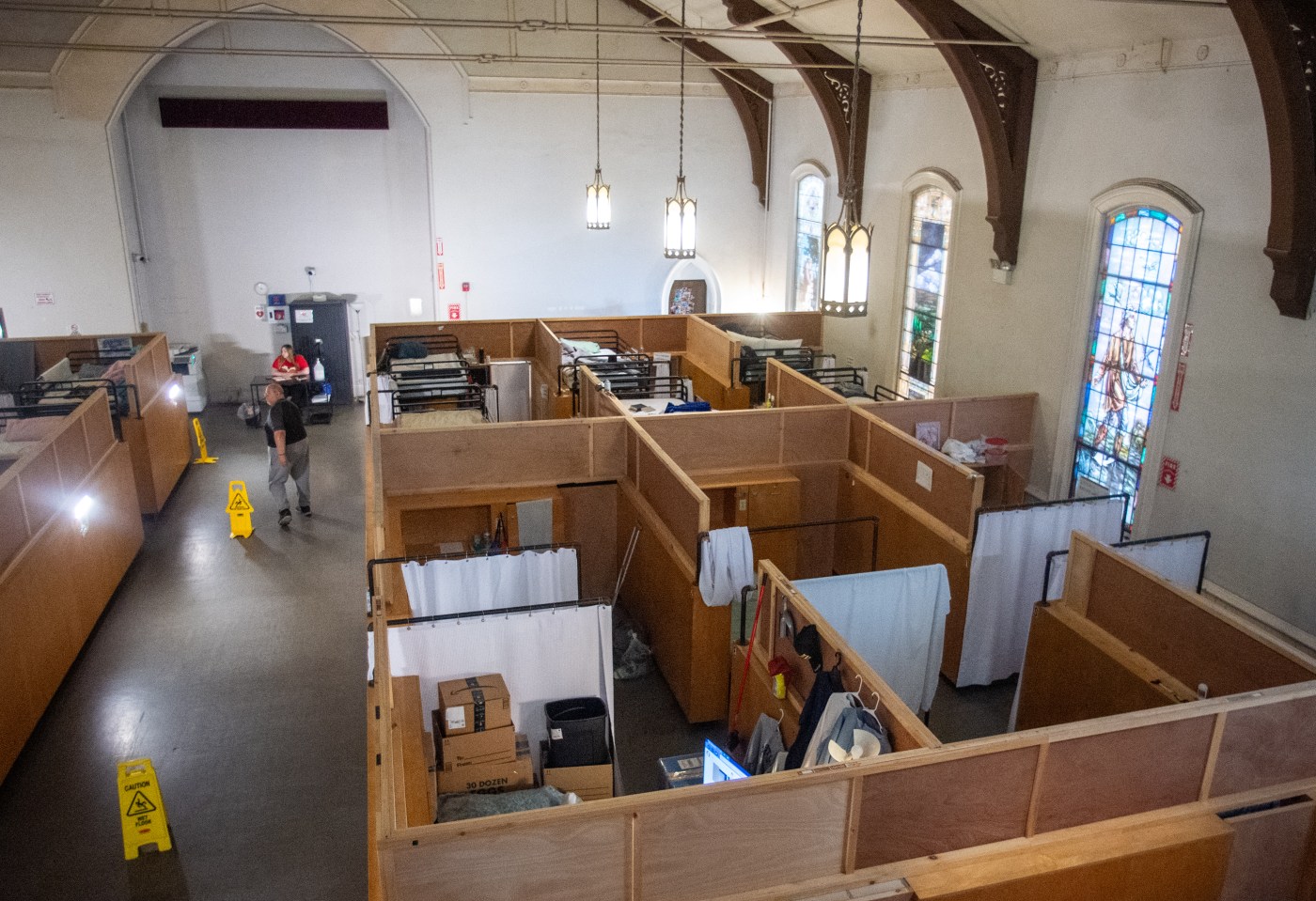
For more than three years, a Hartford shelter for people experiencing homelessness — a fixture on Main Street since 1984 in a former church — has looked for a new location to combine all its services in one building and evolve beyond its dormitory-style of sheltering.
So far, South Park Inn has come up short in its search, even as it and other shelters face rising numbers of homelessness.
But a plan is emerging that might open up new relocation options for the seven shelters across the city.
Hartford is seeking to expand where shelters can be located in Hartford, easing restrictions that they be located solely in industrial zones. Shelter operators say industrial zones are too far away from bus lines, grocery stores and other social services.
The city is developing a proposal that would potentially allow shelters in areas that now allow a lower density mix of residential, office and institutional uses that are compatible with nearby historic neighborhoods.
Those areas are most often clustered around major thoroughfares in the city such as Farmington Avenue, Asylum Avenue, Wethersfield Avenue, Washington Street and Broad Street. Relocating a shelter to these areas would not be a permitted use but would require a variance, which can only be approved by the city’s zoning board of appeals.

Most of the shelters in the city are not industrial zones, having been established prior to current zoning regulations. But now, they must comply with the latest rules should they want to relocate or expand.
“Being in an industrial zone means limited transportation,” Theresa Nicholson, executive director of South Park Inn, said. “It means limited access to food, such as grocery stores, bodegas, any place to pop in and get something to eat. People have to travel. So we really welcome a less restrictive set of rules for shelters.”
Nicholson said, “The current zoning really discriminates against our most vulnerable populations, and we’ve been talking to city officials for years.”
But the plan also is sparking controversy.
The city already has narrowed down the areas of the city that would be covered by the proposal and has been hit by significant push back from leaders of some of Hartford’s neighborhood revitalization zones. Those leaders say they haven’t been adequately part of the process of the developing a change that could affect them directly. They also argue that they have the right under state law to sign off on any development that impacts them.
In a strongly-worded letter to the city’s Planning and Zoning Commission, which must approve any change in zoning, the Asylum Hill Neighborhood Association urged the proposed change be rejected. Asylum Hill extending into the city’s West End is heavily concentrated with areas that could be affected by the proposed change.

“We firmly believe the state NRZ statute requires NRZ review and approval of all proposed housing in our neighborhood, regardless of whether it is a shelter, group living or apartment building,” says the letter that the Asylum Hill NRZ’s executive director David MacDonald wrote.
“Asylum Hill has a long and negative history with rooming houses, and Asylum Hill already has several supportive housing sites, and we currently have one temporary shelter,” MacDonald wrote.
The city has withdrawn an initial proposal for further study, and it expected to come under consideration again by February.
‘Fabric of our neighborhoods’
City officials say the proposal is not aimed at any one shelter because the city has been approached by several seeking to relocate or expand. But they acknowledge threading the needle on the issue will be a challenge.
“We have to do it in a way that values the input of neighborhoods, but that allows for shelter space to be created in the city that’s dignified and allows for those who are homeless in our city to find shelter,” Hartford Mayor Arunan Arulampalam said.
Arulampalam said, “I believe so deeply that we can construct shelters that respect the fabric of our neighborhoods that I am working on moving forward on a site that is just blocks away from my own home.”
The mayor declined to identify the property. Arulampalam lives in the Frog Hollow neighborhood.

Matthew Morgan, executive director of Journey Home, a nonprofit involved in shelter service planning in the capital region, said there have been numerous attempts to relocate shelters within Hartford over the years.
“That has always been very difficult because of the neighborhoods that feel like they would be harmed by — and understandably so — the concentration of people with complex service needs,” Morgan said. “So it always has been very difficult to relocate emergency shelter services within the city.”
Arulampalam said the zoning proposal is not specifically aimed at the 133 “warming center” beds at three locations that are expected to open Dec. 1 and remain active until March 31. The number of beds is up from 96 last year, and the city’s budget for that service increased $46,000, to $276,000 in the current fiscal year from $230,000 a year ago.
But the warming centers are a signal of the on-going need in the city.
“This is an emergency stop-gap measure for residents who would want to be in shelter beds during the other months of the year, but we just don’t have capacity for it,” Arulampalam said.. “We create this stop-gap measure so that those residents don’t freeze to death in the winter months.”
Demands on shelters rising
Nationally, the experience of homelessness rose to a record high in 2024, up 18% to 771,480 individuals from 653,104 a year earlier, according to a recent report from the National Alliance to End Homelessness, a nonpartisan organization. The report also noted that resources are simply inadequate to meet the demand, largely driven by the housing affordability crisis.
In Connecticut, the state’s homeless population rose nearly 10% in 2025 from a year earlier, the fourth year in a row of growth, the state’s latest one-night “point-in-time” annual census of homelessness found.
According to the count, there were 3,735 people living in shelters or outside in January 2025, compared to 3,410 in January 2024.
In Hartford, there were 334 beds in year-round shelters across the city in 2024, down slightly from 348 a year earlier, according to Journey Home. The number for 2025 is now being compiled, Morgan said.

The city of Hartford has 90% of the permanent, year-round shelter beds, but only 10% of the population of 1.2 million people in the greater Hartford area, Arulampalam said. The city shoulders a heavy burden when it comes to sheltering people experiencing homelessness, the mayor said.
“But when others don’t step up, it’s important for us to do everything we can as a city to ensure that people don’t die simply because they don’t have access to shelter,” Arulampalam said.
South Park Inn’s Nicholson said she sees the demand for beds rising 25% in 2026, noting that her 70-bed shelter program is consistently full. In addition, there are 18 beds for veterans and 15 for a medical respite program, Nicholson said.
Demand is similar at other shelters in the city.
“People call us every day, multiple times a day,” Marilyn Rossetti, chief executive officer at 130-bed, The Open Hearth on Charter Oak Avenue, said. “I get texts. The minute someone leaves, it’s full. There’s a waiting list. There is no opportunities. That’s the sad part.”
Rossetti, also a city council member, said, “We’re a city that we want to serve an underserved population well and humanely and in a good way. Because what we ultimately want to do is have them become housed. And that takes a little time and effort.”
Nicholson said South Park Inn has been able to maintain its consistently high standards, even at full capacity. But the shelter also has been actively looking for a new site, some have shown more promise than others, but she declined to identify specific properties.
The shelter has not reached the stage of negotiations, Nicholson said.

The difficulty in relocating a shelter is illustrated by South Park Inn’s failed efforts in 2022 to move to Homestead Avenue in the city’s North End.
The plan, pursued prior to Nicholson’s tenure, collapsed under the pressure of neighborhood opposition. Local neighborhood leaders argued the area had accommodated significant investment in social services. They saw Homestead Avenue — and the Salvation Army building — as key to the neighborhood’s economic revitalization.
“The problem here is very pressing, and it’s very human,” Jeff Auker, Hartford’s director of development services, said. “The solution, no matter what we do, is going to be highly technical — are we changing zones? are we doing variances? — and those pieces will all add up to a solution. But you’re doing it all within a very human context of those that need the services and then, the residents and business owners that are in the areas that we are putting them.”
Kenneth R. Gosselin can be reached at [email protected]