
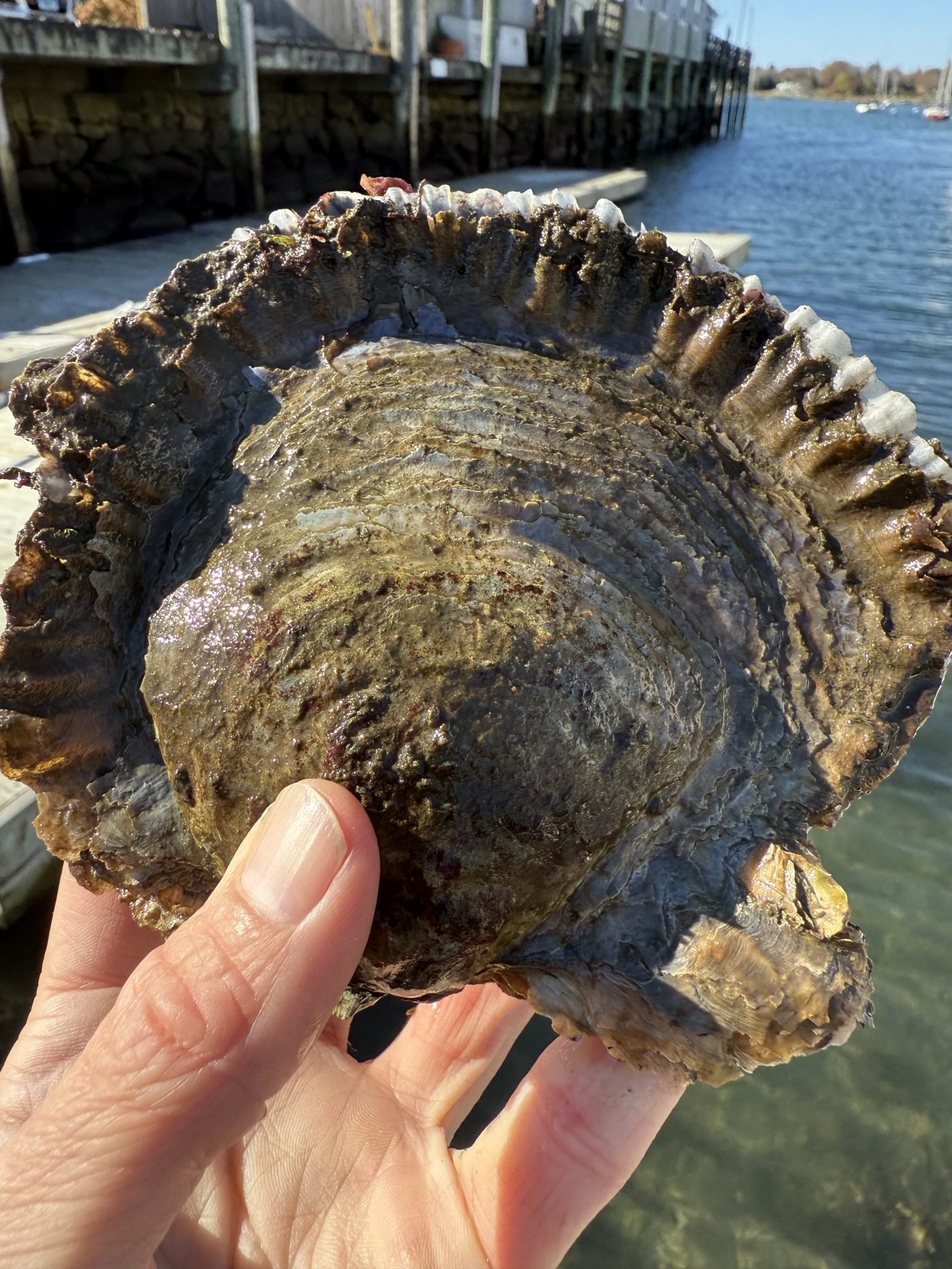
Krystal Rose, the director of collections and curatorial affairs at the Mystic Seaport Museum, made a once in a lifetime discovery in the Stonington Harbor earlier this month.
“I looked over and thought I saw a large scallop,” Rose said. “I scallop recreationally and have a scalloping license, so I was very excited to see this large scallop. Because it was low tide, I was able to roll up my sleeve and get on my belly and grab it with my fingers. I pulled it up and immediately realized it wasn’t a scallop. It was a giant oyster that didn’t look like the ones we have here.”
What she found was later confirmed to be the European flat oyster or ostrea edulis.
The large oyster, which can grow to over five inches across, is native to European waters and is commonly eaten throughout Europe, she said. The species, which was introduced to New England in the 1950s, is known to also thrive along the coastlines of Maine all the way down to Cape Cod. Before this month, there were no known verified sightings of the oyster in the Long Island Sound.
Rose, along with Dr. James Carlton, professor of marine sciences emeritus at Williams College, were out looking for non-native sea squirts on Nov. 2, as part of the Williams-Mystic program, when they came across the unusual looking oyster. The two had teamed up to look for a particular introduced sea squirt during low tide as part of a study on non-native species.
She said that when she found the oyster, Carlton immediately recognized it as the European flat oyster.
“It’s not lost on me how ironic it was to find this, especially since we were looking for non-native sea squirts,” Rose said.
“Dr. Carlton immediately knew what it was when I pulled it up, and he was immediately excited. You actually have to shuck it to determine if it’s the European flat oyster as it has little bumps on the hinge of its shell. That’s the tell-tale sign that its a European flat oyster. When we saw that, we both got very excited.”
There were unconfirmed reports of the oysters in the Long Island Sound around 20 years ago, but they were never verified, according to Carlton. This marks the first time the oyster has been identified this far south along the East Coast.
The oyster Rose found was estimated to be around 4 to 5 years old.
“It is common to see them up around the southern and lower parts of the Cape, as far down as Buzzards Bay,” Carlton said. “I think they are largely overlooked on the bottom and not easily seen. They also probably could be confused with the common Eastern oyster, but these ones are bigger and very round. Once you know what to look for, you can spot them.”
The European flat oyster was introduced to Boothbay, Maine in the 1950s where they have continued to thrive in the freezing waters of the Atlantic. Over the decades, they have continued moving southward down to Cape Cod, where there is now a thriving wild population. Carlton said he thinks he knows how they may have arrived off the Connecticut coastline.
“My guess is it arrived on the underside of a boat from Cape Cod,” Carlton said. “They could well be in Rhode Island as well in the Narangansett Bay. I think it’s probably much more common than we think it is. Because this oyster was 4 to 5 years old, that tells me we will most likely find more.”
The oyster, while non-native, is not considered a destructive invasive species in Maine or along the Cape, Carlton said. But he said it’s too early to tell if its presence in the Long Island Sound will have any impact on native oyster species. The oyster is edible and considered a delicacy for its taste and texture. In fact, the oyster has been a popular food source across Europe for thousands of years, he said.
“The edulis in its scientific name actually stands for edible,” Carlton said. “The oyster has been eaten across Europe since ancient times and is harvested in Maine and around the Cape. It’s considered a very desirable oyster. So if there are a lot more in the Sound, it will be interesting to see if there will be regulations on catching them. There are regulations in place in Maine and Massachusetts, but there are none in Connecticut.”
“This is a good example of what citizen science can do for us, I tell my students all the time you will never meet a marine biologist when you go the seashore,” Carlton said. “The public are our eyes on the coast and the role of the public will be really critical in establishing where the oyster is and how abundant it is.”
Carlton is asking the public to report any sightings of European flat oysters in the Long Island Sound to better understand their population. Anyone who thinks they may have found one is encouraged to take a photo of the oyster and submit it to inaturalist.org. The website has a dedicated page for sightings of the oyster in Connecticut.
“I think this is a lesson to put down your phone and open your eyes to all the magnificent creatures all around,” Rose said. “There are so many amazing things people walk by everyday. As a Mom and someone who enjoys the outdoors, I encourage people to look around and be curious about the world. You never know what you might find.”
Connecticut is known for its oysters and has a dedicated Oyster Trail with dozens of restaurants, stores and oyster farms. A complete list of oyster sellers and restaurants in the state can be found here.
Stephen Underwood can be reached at [email protected].