
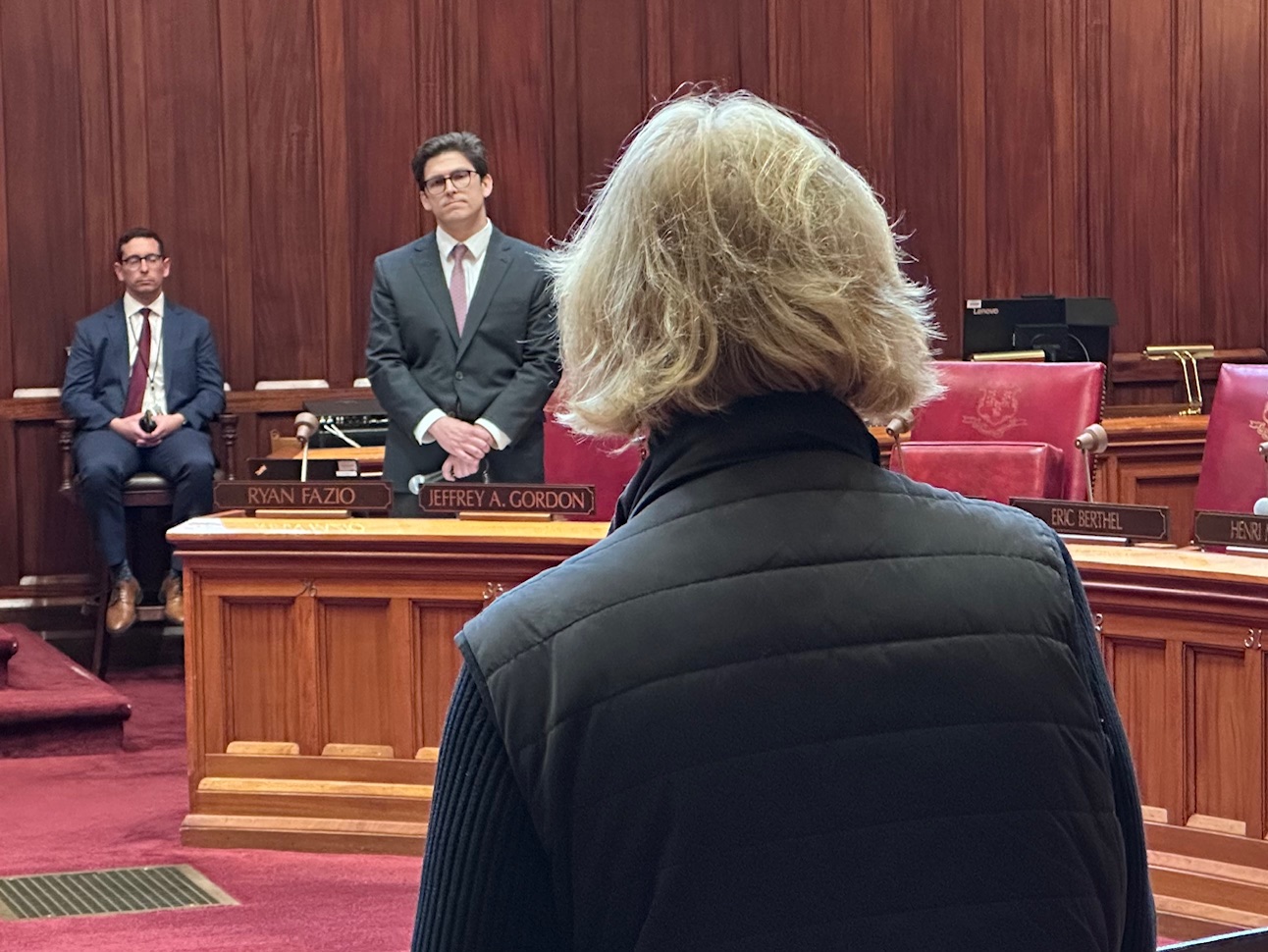
The state Senate gave final approval in special session Thursday afternoon to bills to safeguard human services from federal cuts and was expected to adopt a bill to enable UConn Health to purchase financially imperiled Waterbury Hospital.
The Democratic-controlled Senate voted 27-8, largely along party lines, to designate $500 million from state reserves to potentially backfill federal cuts to nutrition, health care, heating assistance and other human service programs for the remainder of this fiscal year, which wraps June 30.
The measure, which the House of Representatives approved on Wednesday, now heads to Gov. Ned Lamont, who is expected to sign it.
“The things that matter most to me are feeding people and making sure they’re warm,” said Sen. Cathy Osten, D-Sprague, co-chairwoman of the Appropriations Committee, said of the response fund, which would be created using one-fifth of last fiscal year’s $2.5 billion state budget surplus.
Connecticut has used more than $10 billion in surplus to whittle down its considerable pension debt since 2020, on top of the more than $3 billion in required pension contributions it makes annually through the budget. Analysts project the state will continue to make billions in surplus contributions over the rest of the decade.
“This bill builds on that momentum” while ensuring vulnerable residents aren’t left hungry or cold in the coming months, Osten said. “It’s about discipline and compassion.”
According to the bill, Lamont has sole authority to propose expenditures from that $500 million pool. But a 6-member panel of state legislative leaders — which includes the House and Senate majority and minority leaders along with the House speaker and Senate president pro tem — could block any spending with a simple majority vote.
Any dollars not spent by June 30 would be used to pay down state pension debt.
That plan appealed to Republicans and Democrats alike in the House, where majorities from both parties overwhelmingly approved the fund Wednesday.
But eight of 11 Senate Republicans opposed the response fund as unnecessary and a tool to finance Democrats’ pet projects.
“I do believe this is a slush fund,” state Senate Minority Leader Stephen Harding, R-Brookfield, said during a press conference just prior to Thursday’s session. “The language that’s written is so ambiguous I don’t know what they’re going to spend this money on.”
The federal government shutdown, which began Oct. 1, stalled federal funding for the Supplemental Nutrition Assistance Program, or SNAP, starting Nov. 1. Gov. Ned Lamont ordered November SNAP benefits paid out beginning Nov. 8, even if the state had to bear the roughly $72 million monthly bill.
“We do not want to see interruptions to basic programs like food stamps or WIC [Special Supplemental Nutrition Assistance for Women, Infants and Children] for those who are most in need,” said Sen. Ryan Fazio, R-Greenwich. “That premise, I think, has gone by the wayside.”
Fazio was referencing a decision by the U.S. House of Representatives last Monday to give final approval to the temporary funding measure needed to end the shutdown.
But Connecticut Democrats have been talking since President Donald Trump took office in January, long before the shutdown began Oct. 1, about using the state’s huge resources to backfill impending federal cuts in human service programs.
The Trump administration since last spring has used a host of legal maneuvers to block health care, education, nutrition and other federal aid to Connecticut.
And the One Big Beautiful Bill Act that Trump and the GOP-led Congress adopted in July ordered more than $1 trillion in cuts to health care and social services over the next decade to help finance roughly $4.5 trillion in tax relief — breaks aimed chiefly at high-earning households.
“We have what we’re seeing, and we have seen, since Jan. 20, is just chaos and confusion and cruelty to the American people and also to the people of the state of Connecticut,” Senate Majority Leader Bob Duff, D-Norwalk, said during a press conference prior to Thursday’s debate.
“I’m baffled about the secret mission some people think we have here,” said Sen. Gary Winfield, D-New Haven, who recalled lines of desperate residents seeking help at emptied food pantries once SNAP benefits stopped on Nov. 1. “I’ve heard the conversation, both in this chamber and the other chamber: ‘What is it you’re trying to do?’
“Health care? Yes. Food? Yes. Heat? Yes. That’s the ‘secret mission’.”
Sen. Matt Lesser, D-Middletown, co-chairman of the Human Services Committee, said the state response fund is badly needed because the bill Trump signed in July will cause immediate pain for significant numbers of Connecticut residents.
The measure could remove about 36,000 immigrants, young adults, veterans and people experiencing homelessness from SNAP eligibility in Connecticut between Dec. 1 and March 31.
Starting Jan. 1, Washington will cancel subsidies that help people afford health coverage through through state-based insurance exchanges like Access Health CT. The cost to consumers here is projected at almost $300 million per year.
“To me that seems like an emergency because there is no federal action to reverse that decision,” Lesser said.
Sen. Rob Sampson, R-Wolcott, countered that if Connecticut residents need help, the General Assembly should return those dollars to households as a credit against state income taxes rather than creating a $500 million fund to bolster certain programs.
“These are excess dollars that belong to the people of Connecticut, that we have taxed as a state,” he said, offering an amendment to order the relief and estimating it would save households $300 to $400.
The Senate voted to reject the amendment 24-11 along party lines.