
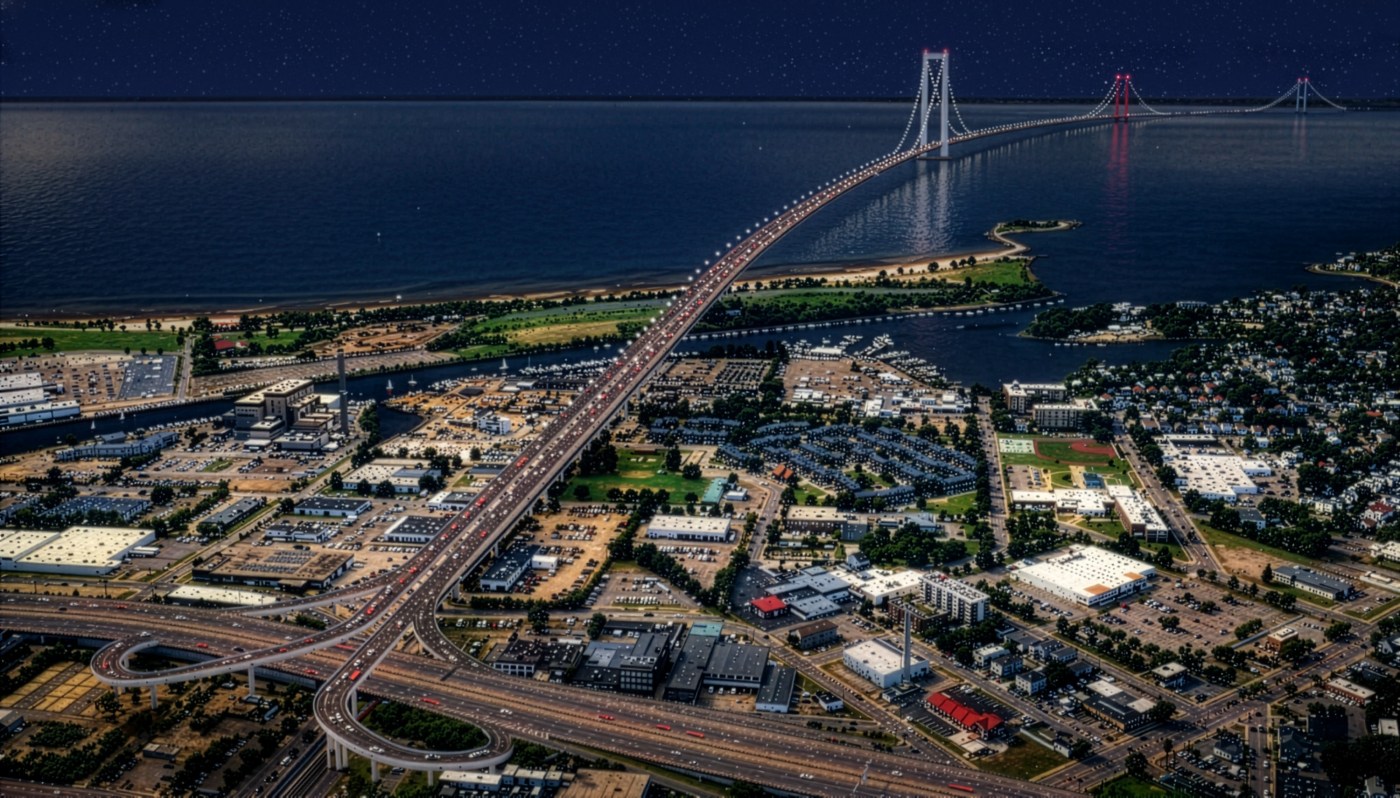
A controversial proposal to construct a new bridge from Bridgeport to Long Island is either a bold, visionary step into the future or an unaffordable boondoggle that could cost more than $50 billion.
State legislators are battling over a plan to build the 14-mile-long bridge across Long Island Sound that would divert traffic from two other bridges and two cross-Sound ferries. The idea has been floated in the past, but an Easton developer now has a specific plan that he says would ease traffic in two states.
A bill to study — not immediately build — the potential bridge is being considered by the legislature’s commerce committee, which has a committee deadline of March 24 to take action. The idea is being pushed by two veterans at the state Capitol: the lobbying team of former House Speaker James Amann and Michael Rell, the son of the former governor, on behalf of developer Stephen Shapiro.
“I always thought it was a good idea,” Shapiro told The Courant in an interview. “It has just exploded with the press [coverage]. I never give up no matter what I do in life.”
A housing developer, Shapiro concedes that he is not an engineer and has never built a bridge. But he has the vision to push a project that he says could take five to 10 years to construct.
“The two main benefits are traffic — we have the worst traffic in the United States on I- 95 — and the economy of Bridgeport,” Shapiro said. “Not just Bridgeport, but the whole region. This is a viable solution.”
At 14 miles, the bridge would be the longest in the immediate metropolitan area. The George Washington Bridge, by contrast, is less than one mile long. The Verrazzano-Narrows Bridge, which connects Staten Island and Brooklyn, is less than three miles long. The two closest bridges to the Long Island proposal are the Whitestone and Throgs Neck bridges that have been handling millions of travelers collectively for more than 60 years each.
The engineering in the year 2026, Shapiro said, would not be a problem in constructing the mammoth structure across the water.
“It’s shorter than the Chesapeake Bay Bridge,” Shapiro said, adding that a bridge that opened in 2018 in China is 34 miles long. “It’s definitely possible.”

Governor’s race
Skeptics of the long-running idea say that the costs make it a bridge too far. The price tag of $50 to $60 billion would be double the entire state budget for the 2027 fiscal year that is projected at $28.7 billion.
The financing is still uncertain, and officials said they did not know how much money would be contributed by Connecticut, New York, and the federal government. Some skeptics view the idea as a pipe dream in tough fiscal times when the federal government is spending billions on Immigration and Customs Enforcement and the war in Iran.
Gov. Ned Lamont, who grew up on the north shore of Long Island near where the bridge would be built, has been cool to the idea — calling it “very, very, very expensive.”
Known as a fiscally moderate Democrat, Lamont placed the state on a “debt diet” when he first took office in 2019. Since then, he has sometimes angered liberal Democrats for refusing to raise taxes on the wealthiest residents and resisting changing the state’s fiscal guardrails to allow additional spending that some lawmakers seek.
The state transportation department, which Lamont oversees, says the bridge is not in their construction plans.
“We remain focused on ways to improve safety and mobility for all travelers with continued investments in our existing infrastructure and public transportation services,” said Josh Morgan, the department’s chief spokesman. “Over the next few decades, we are committed to advancing the various projects emerging from our ongoing long-range transportation plans and studies.”
State economic development commissioner Daniel O’Keefe told legislators that money has not been set aside for a study, whose costs have not been identified and would depend on the depth of the study.
“This initiative was not built into the governor’s budget, so funding would have to be identified for such a study,” he said in written testimony.
Former New Britain mayor Erin Stewart, who is running for governor against Lamont, agrees that the project is expensive but says the study is necessary to obtain answers.
“It would demand careful, transparent evaluation of environmental impacts, engineering challenges, and long-term economic implications,” Stewart said. “But that is precisely why we must authorize a study: because bold ideas deserve rigorous examination, not reflexive dismissal.
“For too long, Connecticut’s transportation policy has been defined by incrementalism—by working within existing modes, existing corridors, and existing assumptions. Our infrastructure planning has too often centered on maintaining what we have, rather than envisioning what we could become. HB 5320 represents something different. It represents big, bold thinking.”

State Sen. Ryan Fazio, a Greenwich Republican who is running against Lamont, Stewart and others for governor, said the project is simply cost prohibitive.
“The governor says it would be very, very, very expensive,” Fazio told The Courant. “I disagree: I believe it would be very, very, very, very expensive! We should prioritize limiting spending and cutting taxes for Connecticut residents who are overtaxed already.”
Former New York Lt. Gov. Betsy McCaughey, a Greenwich Republican who is running for governor, told The Courant that “I’d like to keep that $50 to $60 billion in the pockets of Connecticut taxpayers. That’s why I am going to axe the income tax.”
State Rep. Josh Elliott, a liberal Democrat from Hamden who is running against Lamont from the left, said that expense is not the only consideration.
“It has been decades since Connecticut has made serious, forward-looking investment in our infrastructure,” Elliott told The Courant on Saturday. “The real question is what kind of return could we expect, and how are we building a 21st century transportation network. Of course we should be looking into this.”
During the commerce committee’s hearing last week, state Rep. Sarah Keitt of Fairfield said a better idea would be exploring more ferry ports to reduce the number of cars on the roads.
“I’m just hesitant to increase our traffic in Fairfield County, as well as pollution,” Keitt said, noting the potential influx of Long Island cars into Bridgeport and beyond.
Former Bridgeport Mayor Bill Finch, who also previously served as a state senator, has multiple perspectives on the bridge.
After leaving the state senate in Connecticut, Finch got a job as the executive director of the New York State Thruway Authority, which replaced the well-known Tappan Zee Bridge with a second bridge that was built parallel to the original one and largely avoided traffic disruptions during construction. The structure, now known as the Cuomo Bridge, cost $4 billion and took about five years to construct.

The Governor Mario M. Cuomo Bridge, formerly known as The Tappan Zee Bridge, is lit blue on April 09, 2020 in Tarrytown, New York during the Light It Blue initiative, supporting first responders and essential workers during the coronavirus pandemic.
“The massive investment by New York State approved by their State Assembly was truly visionary and transformative,” Finch told lawmakers in written testimony. “Not only did the bridge create thousands of good jobs for the skilled trades but it enhanced the regional economy, improved car, truck, and bus traffic, and created the option for the Cuomo Bridge to accommodate rail in the future. New York showed us how much a project like this can improve our State and create jobs for our citizens. You can do the same.”
Today, Finch represents electrical contractors who work on transportation projects and says both the study and the bridge are good ideas.

Former Bridgeport Mayor Bill Finch favors a bridge from Bridgeport to Long Island. Here, he is shown in his speech in September 2015 after losing the primary election to former mayor Joe Ganim, who is still serving as mayor.
Long Island history with Robert Moses
Various proposals for a bridge to Long Island have been percolating in different iterations for decades.
The plan that appeared to have the best chance was pushed by master builder Robert Moses, a powerhouse in his heyday who was responsible for constructing most of the bridges in New York City. Those include the Whitestone and Throgs Neck bridges that connect Queens and The Bronx, along with the gigantic, 2.7-mile Verrazano-Narrows Bridge that connects Staten Island and Brooklyn.
In his heyday, no politician was able to stop Moses in New York. But he eventually met his match in then-Gov. Nelson Rockefeller, a future vice president who was the most powerful player in New York in the 1960s. Rockefeller initially favored the bridge that would have connected the affluent areas of Oyster Bay on Long Island and Rye in Westchester County, but the tide turned as opposition grew. With some residents against the project at both ends of the bridge, Rockefeller saw that the idea was a political loser and pulled the plug.
But Moses had already started constructing the Seaford-Oyster Bay Expressway as he planned ahead. To this day, the wide expressway suddenly ends in northern Long Island because the construction in 1973 was halted.

Then-New York Gov. Nelson Rockefeller favored a bridge across Long Island Sound in the 1960s, but then opposed the plan after intense local opposition at both ends of the proposed bridge. He is shown here with his wife, Happy Rockefeller. Rockefeller later served as Vice President under President Gerald Ford.
Sen. Heather Somers, a Groton Republican, said she is concerned about the environmental impacts and predicted that the opposition to the bridge would grow.
“Remember when we tried to put a cable under Long Island Sound?” Somers asked, referring to the years-long battles before the electric power cable was eventually allowed to operate. “We’re struggling to maintain the bridges we have now. How long did the Q bridge take to complete? It took forever. The Gold Star Bridge, in my backyard, will be another four years of repairs.”
The various complications of a 14-mile bridge, along with the uncertain price tag, should make officials cautious, she said.
“There are a lot of unanswered questions,” Somers said.
Christopher Keating can be reached at [email protected]