
It seems that for every show at one of Connecticut’s major regional theaters, there’s a unique story about how the cast came together. This is remarkable because in many ways the casting process is formalized, regimented and geared to the specific requirement of the Actors Equity union. Magic and serendipity, however, always seem to be in the mix.
The Courant spoke to three theater organizations in the state — Hartford Stage, TheaterWorks Hartford and Goodspeed Musicals — about how they each cast shows. Their stories have been enhanced with some of the countless tales recounted by actors and directors that have been shared over the years.
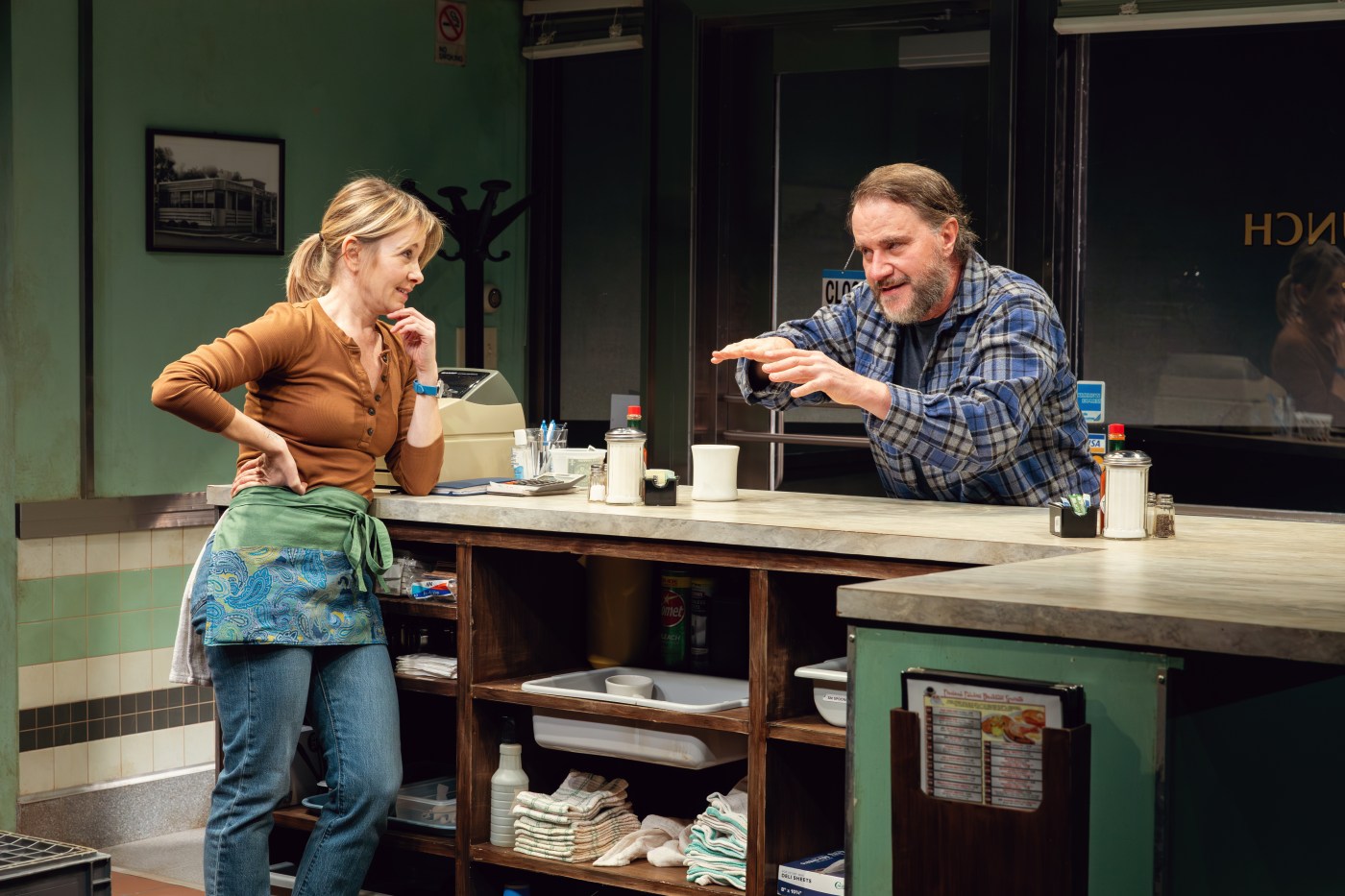
For its current production of the breakfast diner drama “The Counter,” TheaterWorks Hartford was looking for another project they could do with Tim DeKay, who co-starred in last season’s hit production of “Fever Dreams.” DeKay wasn’t sure the role was for him, so an informal reading of the script was held at the theater. TheaterWorks’ producing artistic director Rob Ruggiero asked Justis Bolding, who had recently moved to the Hartford area and served on the TheaterWorks board, to read the other main role in the script. There’s a third character in the play who appears for just one scene, so Ruggiero asked Erika Rolfsrud, who has been in half a dozen shows at the theater over its long history, to read the role.
The reading was a success. DeKay was able to hear himself in the role, and “The Counter” was confidently scheduled for the 2025-26 TheaterWorks season. When it came time to cast it, Ruggiero and DeKay had admired Bolding’s work in the reading so much that she was offered the part in the full production. Rolfsrud was asked to take part as well, as Ruggiero particularly liked that someone who had been in so many past shows at the theater could return during TheaterWorks Hartford’s 40th anniversary season. “The Counter,” which opened Feb. 12, has been extremely well received and its run has been extended through March 22.
For Hartford Stage’s long-awaited production of “Death of a Salesman,” director Melia Bensussen (who is also the theater’s artistic director) had some special themes she wanted to explore, so she reached out to an actor she remembered as a fellow student during her student days at Brown University, Peter Jacobson, to play Willy Loman. Jacobson has had a wealth of experience as an actor in the four decades since he was in school, including a regular role in the series “House,” but the connection with Bensussen was a big part of what got him this job. As Loman’s wife Linda, Bensussen enlisted someone she’d worked with numerous times before, Adrianne Krstansky. Her familiarity with Jacobson and Krstansky allowed Bensussen to leap into rehearsals more readily than if she were just getting to know her cast. Several other members of the cast, however, were new to her, drawn from open call auditions.

Hartford Stage’s casts are often a mix of actors who have worked with a director there before, well-known theater artists and new faces. The process is partly guided by Actors Equity rules, casting directors and theater agents. (Christopher Arnott/Hartford Courant)
Open calls for actors
Open auditions, known in the regional theater realm as Equity Principal Auditions, are a reality of being a professional theater. EPAs are governed by the Actors’ Equity Union.
Zoe Golub-Sass, the associate artistic director of Hartford Stage, was the director of “The Cottage,” “Hurricane Diane” and “2.5 Minute Ride” in recent seasons. Tellingly, the casts for those three shows all came about in different ways. She had done a production of the one-person show “2.5 Minute Ride” in New York state with the same actor who was suggested to her by a colleague. When the opportunity to reprise the show in Hartford came about, she was eager to revisit it with the same performer at a different phase in their careers. With “Hurricane Diane,” its lead performer had reached out to Hartford Stage when they heard the theater was doing the play. The actor was unable to audition in person due to another project but “radiated a charm through the Zoom screen” that won them the role.
Golub-Sass said Hartford Stage’s casting process is dictated by the specific union agreement it has as a member of League Of Resident Theatres. The Equity rules can vary based on the size, potential or location of a given theater.
At Hartford Stage, Golub-Sass said, “First we write character descriptions, in collaboration with the show’s directors, about what the production will be like. We audition the whole season at once, then start on the individual shows.”
After the EPAs, Hartford Stage looks at actors who were submitted by agents. TheaterWorks Hartford’s Rob Ruggiero said “if you’re an actor, having an agent can give you a bit of a leg up. Agents submit ideas to the casting directors we work with.”
Casting directors are part of the process all along. Most regional theaters have maintained decades-long relationships with casting directors, who are duly credited in the theater playbills. One example of an agent submission that netted an actor a starring role was when the accomplished stage and screen actor Michael Gaston informed his agent that he would like to play the role of Joe Keller in Arthur Miller’s drama “All My Sons.” When Hartford Stage announced it was doing the play, Gaston’s agent got in touch and the theater offered him the role, having already arranged for the movie star Marsha Mason to play to Keller’s wife Kate.

For Goodspeed Musicals, casting can involve seeing hundreds of people for a single musical. (Christopher Arnott/Hartford Courant)
“We sit through 1,500 auditions a season,” said Adam Souza, the music director of Goodspeed Musicals. “We had 800 to 900 just for ‘Ragtime,” the season-opening show at the Goodspeed Opera House this past May. The Goodspeed’s variation on the EPAs is the ECC, or Equity Chorus Call, which specifically looks for performers for the chorus or ensemble in a musical.
Souza said at the ECCs, basically “whoever shows up, we have to see.” If an Equity union member does not appear for their scheduled slot at the ECCs or EPAs, the theater holding the auditions is asked if it is willing to see a non-Equity member at that time. Ruggiero said TheaterWorks always agrees to that and that everyone benefits from widening the process and seeing more actors.
Even when a theater already has a cast in mind, as with TheaterWorks’ “The Counter” or Hartford Stage’s “2.5 Minute Ride,” it still holds auditions, partly due to Equity’s insistence and partly to be prepared for emergency cast changes.
At some casting sessions, a wide range of people from the theater do the casting, plus casting directors and others might be there. “Who’s in the room depends on the call,” Souza said. “If it’s a musical call, to see how well they sing, the only person required to be there is me.”
Golub-Sass, Souza and Ruggiero all said that these “cattle call” auditions can be immensely helpful and that while they tend to be most helpful in filling small roles (or in Goodspeed’s case chorus or ensemble parts), lead roles have gotten cast from these auditions. The star of the Goodspeed revival of “Thoroughly Modern Millie” came from these auditions.
“The union requires us to do these calls, but they can be the most fun days,” Souza said. While there is often not a strict requirement to hold in-person auditions, Zoom calls and video submissions have become the primary way actors can get seen by those doing the casting, though all of the theaters the Courant spoke to insisted that live in-person encounters can be crucial. “Tapes allow us to see more people,” Golub-Sass said, “but it’s always good to have people in the room.”
Ruggiero agreed. “In person tells you a lot,” he said.
Theaters also hold local auditions for professional actors based in Connecticut. As a style concept, early in the development of the original piece “Circus Fire,” which will be staged later this year, TheaterWorks Hartford decided that it wanted to cast this story, based on a real-life tragedy that happened in Hartford, entirely with local actors. “We wanted to honor our connection to this community,” Ruggiero said. “I made the decision that I wanted everyone in that show to be Connecticut-based.”
In the regional theater where a whole season of shows can be announced at once, those involved in casting one show can have other shows in mind as well. This can be a boon to the auditioners. “People who come to that audition might not be right for that show but they may be right for a different show in the season,” Souza said. “We make a note of that.”
Nathan Darrow, who starred in Hartford Stage’s “Doctor Jekyll & Mr. Hyde” last year, came to the theater’s attention when he auditioned for William Shakespeare’s “A Winter’s Tale.”
Needs can change from show to show. Goodspeed Musicals does new works but also reverent revivals of theater classics and re-workings of shows that need to be updated for modern times. “Ragtime” the first show of last season, “needed to be delivered in a full-voiced way,” Souza said. The first show of this season, “Jesus Christ Superstar,” needs “an appropriate rock sensibility.”
Directing the castings
Directors, who generally have the final say in casting, can work differently from each other, and their personal work methods may affect casting decisions. Souza said the famous New York director John Doyle, who directed the world premiere of “The 12” at Goodspeed two seasons ago, “treats auditions like job interviews. He’ll have long quiet conversations with the people auditioning for him. He wants to sniff out a vibe.” Some directors may build a show around certain key performers, while others will encourage an ensemble feel where everyone is of equal performance.
“As a director who’s worked at many theaters, I’d say it’s rare that an artistic director will insist that show’s director has to use someone,” Ruggiero said. “They make suggestions, and there are occasions where I’ve taken a job where a role is pre-cast, but generally I’m the one who decides the cast.”
Michael Wordly, the actor who played the key role of Coalhouse Walker in the Goodspeed production of “Ragtime,” had been wanting to play that role since he was a child. “Ragtime” was one of the first musicals he knew and made him want to be an actor. The show’s director, Christopher Betts, had worked with Wordly before and knew of his passion. “Finding someone who’s pre-loaded like that, or where there’s a pre-existing relationship with the director, can save time in rehearsals,” Souza said.
Theaters may also be thinking about whether cast members will get along with each other or are aware of the special nature of each theater. “Here at Goodspeed, you’ve got to come and live with us for three months,” Souza said. The theater is located in a small town a good distance from a major city and owns the properties where it houses its actors.
“We’re always asking ‘How do all these people fit together with this director?,’” Golub-Sass said.

Michael Wordly, who played Coalhouse Walker Jr. in “Ragtime” at the Goodspeed Opera House in 2025, had wanted to play that role since he was a child. The show’s director, Christopher Betts, had worked with Wordly before and knew of his passion. (Diane Sobolewski)
Souza noted that when doing musicals with relatively small casts, all the performers have to be “true triple threats,” capable of acting, singing and dancing equally well. “In the past 30 years, the weight placed on the performer is pretty great.”
Goodspeed typically starts its casting process in December for all the shows in the season, which starts in April and runs through December. This year, the process started a little later because the director of “Jesus Christ Superstar,” Tatiana Pandiani, was having a child in December.
One of the shows in the season, an adaptation of the Paul Gallico novella “The Snow Goose,” is a world premiere. This can make a difference at auditions since the performers won’t be familiar with new work. But there are other variables working in the favor of new work. In the case of “The Snow Goose,” Goodspeed has been deeply involved in the show’s development for years. Souza said he has been part of three presentations of it. There’s also a type of performer who embraces new works and knows how to approach such challenges.
Sometimes the people auditioning may have the wrong idea about a show. Those who saw audition notices for Goodspeed’s “Anne of Green Gables” a few years ago couldn’t be expected to know that this was a modern youthful take on the classic children’s book with LGBTQ overtones. When auditioning for the play “Hurricane Diane,” which Hartford Stage staged last year, it may not help to know that the play is loosely based based on Euripides’ “The Bacchae,” since it’s a frantic farce set in the 21st century, far from its Greek tragedy origins. When actors may be heading in the wrong direction stylistically in their auditions, theaters have an opportunity to suggest a change in approach.
The people doing the casting can also learn from unexpected interpretations. “There are times when we say ‘That’s not how it normally is, but why can’t it be that way?,’” Souza said. “Actors are endlessly surprising.”
As for star casting, it happens but often in unexpected ways. Ruggiero said situations like this are a good reason for budding directors to learn their trade at graduate school programs, because of the number of actors they meet and work with there.
Golub-Sass said that some established TV or movie or Broadway actors work in regional theaters because those theaters do shows “that are not being done in New York.” Ruggiero said TheaterWorks got Richard Dreyfuss to star in the play “Relativity” because the famed actor was “obsessed with Albert Einstein” and was specifically looking to play him.
In any case, Golub-Sass suggested that a celebrity name may not carry the weight it once did. “There’s a lot more media out there. I’ll mention what I think of as a famous name to someone else at the theater and they might have never heard of them.”
After the auditions happen, deep discussions begin. “My favorite part of the process is when you clear the floor, spread all the headshots on the floor and talk about it,” Souza says. “I might comment on the musicality. I sometimes offer a letter grade. But the final decision is the director’s.”
Each type of theater has its own special needs and processes and advantages. The Yale Repertory Theatre and the University of Connecticut’s Connecticut Repertory Theatre are both professional theaters affiliated with graduate theater programs at large universities. When casting shows, they like to make room for both student actors and illustrious alumni. The current Yale Rep production of “Rhinoceros” stars three accomplished Yale School of Drama grads: Reg Rogers, Elizabeth Stahlmann and Tony Manna, several current students in the drama school and several actors without a direct Yale connection. Connecticut Repertory Theatre’s current production of “Three Musketeers: 1941” is cast entirely with current students in UConn’s graduate and undergraduate acting programs.
Even when a cast appears to all set, the process may not be over. “You may lose someone to another job in the middle of a project,” Ruggiero said. “Or we may have been very clear about the money, but then they want more money and we can’t do it. Or you think you’ve got them and they suddenly say ‘no.’
“But everything happens for a reason,” Ruggiero said. “The universe usually has a way of working it out.”