
Death Valley National Park is exactly what the name implies. It is one of the driest, hottest and most desolate areas in the world, with summer temperatures in the desert region reaching well into triple digits for days and sometimes weeks.
The national park, which straddles the California-Nevada border, is one of the lowest in elevation, of all the parks, according to the National Park Service website, and is a “land of extremes.” The steady drought and record summer heat lead to that.
But those extremes give way to rare beauty, as is the case now.
Desert sunflowers, yellow cups, brittlebush, gravel ghosts and desert five-spot are just some of the wildflowers now in bloom in the lowest regions of the park, including the Badwater Basin at 282 feet below sea level.
Blooms are visible from Jubilee Pass, at the southern end of the park, up to Furnace Creek in the north.
This is the “best bloom year” since 2016, according to the National Park Service, stopping short of declaring this year’s expanse of blooms a “superbloom,” at least thus far. Superblooms occurred in 2016, 2005, and 1998.
-
 A desert five-spot, which is only the size of a quarter, blooms near Sidewinder Canyon in Death Valley National Park on Saturday Feb. 28, 2026. Low-elevation flowers are blooming throughout the park and will likely persist until mid-late March, depending on the weather. Higher elevations will have blooms April-June according to the National Park Service. Thus far it is the best bloom in the park since 2016. (Photo by Will Lester, Inland Valley Daily Bulletin/SCNG)
 -
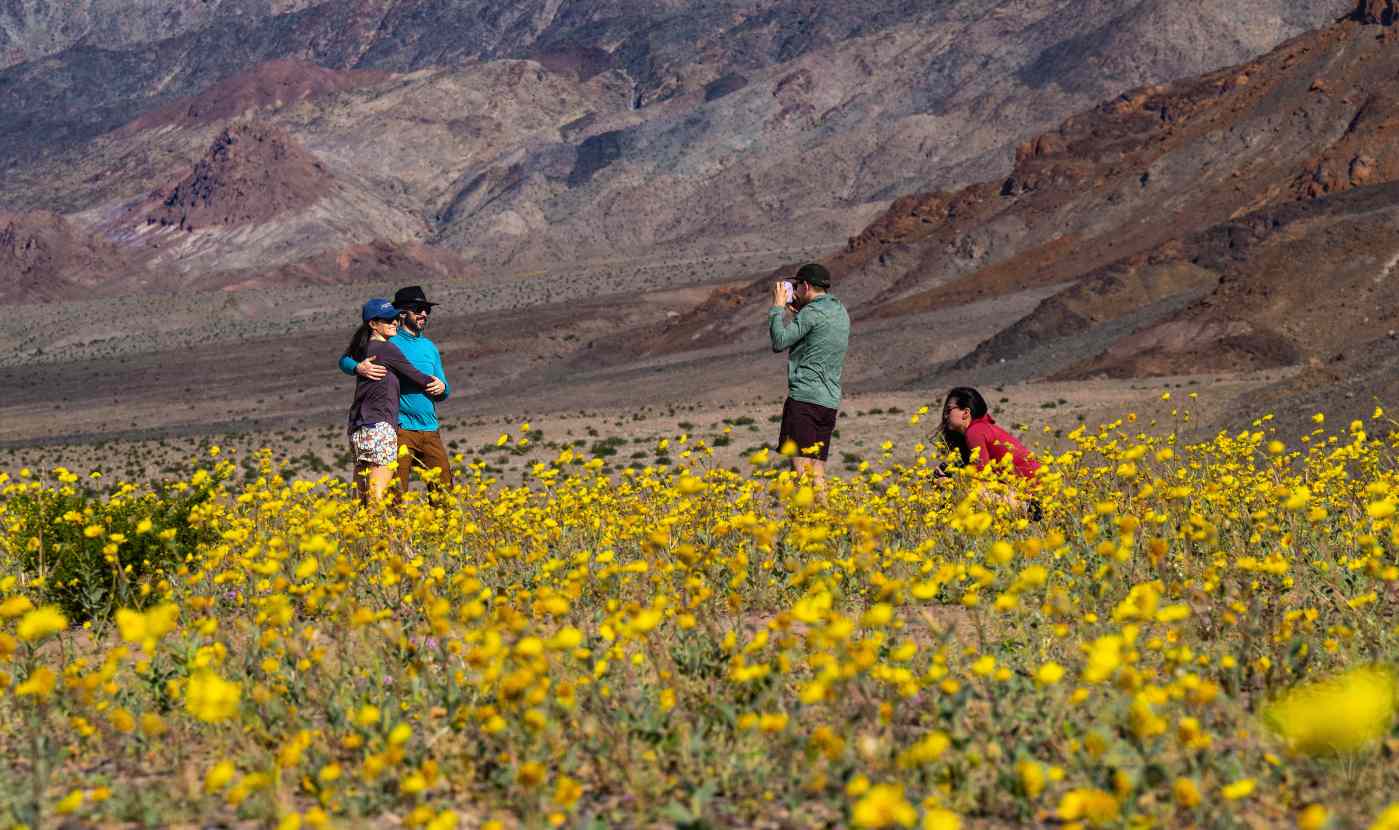
 Sarah Phillips, from Houston, Texas, poses for her husband Keith Phillips as he takes a photograph amongst a cluster of desert gold wildflowers blooming near Ashford Junction at the southern end of Death Valley National Park on Saturday Feb. 28, 2026. Low-elevation flowers are blooming throughout the park and will likely persist until mid-late March, depending on the weather. Higher elevations will have blooms April-June according to the National Park Service. Thus far it is the best bloom in the park since 2016. (Photo by Will Lester, Inland Valley Daily Bulletin/SCNG)
 -
 A lone desert sunflower appears to tower over a cluster of desert sand-verbena near Ashford Junction at the southern end of Death Valley National Park on Saturday Feb. 28, 2026. Low-elevation flowers are blooming throughout the park and will likely persist until mid-late March, depending on the weather. Higher elevations will have blooms April-June according to the National Park Service. Thus far it is the best bloom in the park since 2016. (Photo by Will Lester, Inland Valley Daily Bulletin/SCNG)
 -
 Visitors walk in ankle deep water adjacent to the Devil’s Gof Course in the Badwater Basin area of Death Valley National Park on Saturday Feb. 28, 2026. Low-elevation flowers are blooming throughout the park and will likely persist until mid-late March, depending on the weather. Higher elevations will have blooms April-June according to the National Park Service. Thus far it is the best bloom in the park since 2016. (Photo by Will Lester, Inland Valley Daily Bulletin/SCNG)
 -
 A caterpillar crawls along the stock of a wildflower near Sidewinder Canyon south of the Badwater area of Death Valley National Park on Saturday Feb. 28, 2026. Low-elevation flowers are blooming throughout the park and will likely persist until mid-late March, depending on the weather. Higher elevations will have blooms April-June according to the National Park Service. Thus far it is the best bloom in the park since 2016. (Photo by Will Lester, Inland Valley Daily Bulletin/SCNG)
 -
 Yellow cups bloom along Jubilee Pass Road in the southeast area of Death Valley National Park on Saturday Feb. 28, 2026. Low-elevation flowers are blooming throughout the park and will likely persist until mid-late March, depending on the weather. Higher elevations will have blooms April-June according to the National Park Service. Thus far it is the best bloom in the park since 2016. (Photo by Will Lester, Inland Valley Daily Bulletin/SCNG)
 -
 A group of gravel ghosts bloom in Death Valley National Park on Saturday Feb. 28, 2026. Low-elevation flowers are blooming throughout the park and will likely persist until mid-late March, depending on the weather. Higher elevations will have blooms April-June according to the National Park Service. Thus far it is the best bloom in the park since 2016. (Photo by Will Lester, Inland Valley Daily Bulletin/SCNG)
 -
 A couple sit in chairs in the middle of ankle deep Lake Manly at 282 feet below sea level, the lowest point in North Amerida, at Badwater Basin in Death Valley National Park on Saturday Feb. 28, 2026. Low-elevation flowers are blooming throughout the park and will likely persist until mid-late March, depending on the weather. Higher elevations will have blooms April-June according to the National Park Service. Thus far it is the best bloom in the park since 2016. (Photo by Will Lester, Inland Valley Daily Bulletin/SCNG)
 -
 A desert sunflower blooms south of the Badwater area of Death Valley National Park on Saturday Feb. 28, 2026. Low-elevation flowers are blooming throughout the park and will likely persist until mid-late March, depending on the weather. Higher elevations will have blooms April-June according to the National Park Service. Thus far it is the best bloom in the park since 2016. (Photo by Will Lester, Inland Valley Daily Bulletin/SCNG)
 -
 Visitors walk and take photographs amongst a cluster of desert gold wildflowers blooming near Ashford Junction at the southern end of Death Valley National Park on Saturday Feb. 28, 2026. Low-elevation flowers are blooming throughout the park and will likely persist until mid-late March, depending on the weather. Higher elevations will have blooms April-June according to the National Park Service. Thus far it is the best bloom in the park since 2016. (Photo by Will Lester, Inland Valley Daily Bulletin/SCNG)
 -
 A couple has their picture taken as they and others walk amongst a cluster of desert gold wildflowers blooming near Ashford Junction at the southern end of Death Valley National Park on Saturday Feb. 28, 2026. Low-elevation flowers are blooming throughout the park and will likely persist until mid-late March, depending on the weather. Higher elevations will have blooms April-June according to the National Park Service. Thus far it is the best bloom in the park since 2016. (Photo by Will Lester, Inland Valley Daily Bulletin/SCNG)
 -
 Desert gold wildflowers grow through the branches of a bush at the Ashford Mill ruins in Death Valley National Park on Saturday Feb. 28, 2026. Low-elevation flowers are blooming throughout the park and will likely persist until mid-late March, depending on the weather. Higher elevations will have blooms April-June according to the National Park Service. Thus far it is the best bloom in the park since 2016. (Photo by Will Lester, Inland Valley Daily Bulletin/SCNG)
 -
 Gravel ghosts bloom along Jubilee Pass Road in the southeast area of Death Valley National Park on Saturday Feb. 28, 2026. Low-elevation flowers are blooming throughout the park and will likely persist until mid-late March, depending on the weather. Higher elevations will have blooms April-June according to the National Park Service. Thus far it is the best bloom in the park since 2016. (Photo by Will Lester, Inland Valley Daily Bulletin/SCNG)
 -
 Desert sunflowers bloom below sea level south of Badwater in Death Valley National Park on Saturday Feb.28, 2026. Low-elevation flowers are blooming throughout the park and will likely persist until mid-late March, depending on the weather. Higher elevations will have blooms April-June according to the National Park Service. Thus far it is the best bloom in the park since 2016. (Photo by Will Lester, Inland Valley Daily Bulletin/SCNG)
 -
 Desert sunflowers grow out of volcanic rock along Artists Drive in Death Valley National Park on Saturday Feb. 28, 2026. Low-elevation flowers are blooming throughout the park and will likely persist until mid-late March, depending on the weather. Higher elevations will have blooms April-June according to the National Park Service. Thus far it is the best bloom in the park since 2016. (Photo by Will Lester, Inland Valley Daily Bulletin/SCNG)
 -
 Visitors walk amongst bunches of brittlebush blooming in large clusters in a wash along Jubilee Pass Road in the southeast area of Death Valley National Park on Saturday Feb. 28, 2026. Low-elevation flowers are blooming throughout the park and will likely persist until mid-late March, depending on the weather. Higher elevations will have blooms April-June according to the National Park Service. Thus far it is the best bloom in the park since 2016. (Photo by Will Lester, Inland Valley Daily Bulletin/SCNG)
 -
 Wildflowers bloom along Highway 190 south of Badwater in Death Valley National Park on Saturday Feb. 28, 2026. Low-elevation flowers are blooming throughout the park and will likely persist until mid-late March, depending on the weather. Higher elevations will have blooms April-June according to the National Park Service. Thus far it is the best bloom in the park since 2016. (Photo by Will Lester, Inland Valley Daily Bulletin/SCNG)
 -
 A desert five-spot, which is only the size of a quarter, blooms at Ashford Mill in Death Valley National Park on Saturday Feb. 28, 2026. Low-elevation flowers are blooming throughout the park and will likely persist until mid-late March, depending on the weather. Higher elevations will have blooms April-June according to the National Park Service. Thus far it is the best bloom in the park since 2016. (Photo by Will Lester, Inland Valley Daily Bulletin/SCNG)
 -
 A visitor drives through Artists Drive in Death Valley National Park on Saturday Feb. 28, 2026. Low-elevation flowers are blooming throughout the park and will likely persist until mid-late March, depending on the weather. Higher elevations will have blooms April-June according to the National Park Service. Thus far it is the best bloom in the park since 2016. (Photo by Will Lester, Inland Valley Daily Bulletin/SCNG)
 -
 Visitors to Death Valley National Park stand in a field of gold near Furnace Creek on Saturday Feb. 28, 2026. Low-elevation flowers are blooming throughout the park and will likely persist until mid-late March, depending on the weather. Higher elevations will have blooms April-June according to the National Park Service. Thus far it is the best bloom in the park since 2016. (Photo by Will Lester, Inland Valley Daily Bulletin/SCNG)
 -
 Visitors walk out towards ankle deep Lake Manly located 282 feet below sea level at Badwater basin in Death Valley National Park on Saturday Feb. 28, 2026. Low-elevation flowers are blooming throughout the park and will likely persist until mid-late March, depending on the weather. Higher elevations will have blooms April-June according to the National Park Service. Thus far it is the best bloom in the park since 2016. (Photo by Will Lester, Inland Valley Daily Bulletin/SCNG)
 -
 A visitor climbs the massive Mesquite Flat Sand Dunes near Stovepipe Wells in Death Valley National Park on Saturday Feb. 28, 2026. Low-elevation flowers are blooming throughout the park and will likely persist until mid-late March, depending on the weather. Higher elevations will have blooms April-June according to the National Park Service. Thus far it is the best bloom in the park since 2016. (Photo by Will Lester, Inland Valley Daily Bulletin/SCNG)
 -
 A lone desert sunflower blooms out of the sand near a cluster of desert sand-verbena near Ashford Junction at the southern end of Death Valley National Park on Saturday Feb. 28, 2026. Low-elevation flowers are blooming throughout the park and will likely persist until mid-late March, depending on the weather. Higher elevations will have blooms April-June according to the National Park Service. Thus far it is the best bloom in the park since 2016. (Photo by Will Lester, Inland Valley Daily Bulletin/SCNG)
 -
 Visitors stand amongst a cluster of desert gold wildflowers blooming near Ashford Junction at the southern end of Death Valley National Park on Saturday Feb. 28, 2026. Low-elevation flowers are blooming throughout the park and will likely persist until mid-late March, depending on the weather. Higher elevations will have blooms April-June according to the National Park Service. Thus far it is the best bloom in the park since 2016. (Photo by Will Lester, Inland Valley Daily Bulletin/SCNG)
 -
 Desert Wildflowers bloom along Highway 190 north of Badwater in Death Valley National Park on Saturday Feb. 28, 2026. Low-elevation flowers are blooming throughout the park and will likely persist until mid-late March, depending on the weather. Higher elevations will have blooms April-June according to the National Park Service. Thus far it is the best bloom in the park since 2016. (Photo by Will Lester, Inland Valley Daily Bulletin/SCNG)
 -
 A notch-leaf scorpion weed wildflower blooms south of the Badwater area of Death Valley National Park on Saturday Feb. 28, 2026. Low-elevation flowers are blooming throughout the park and will likely persist until mid-late March, depending on the weather. Higher elevations will have blooms April-June according to the National Park Service. Thus far it is the best bloom in the park since 2016.(Photo by Will Lester, Inland Valley Daily Bulletin/SCNG)
 -
 Visitors gaze at the massive Mesquite Flat Sand Dunes near Stovepipe Wells in Death Valley National Park on Saturday Feb. 28, 2026. Low-elevation flowers are blooming throughout the park and will likely persist until mid-late March, depending on the weather. Higher elevations will have blooms April-June according to the National Park Service. Thus far it is the best bloom in the park since 2016. (Photo by Will Lester, Inland Valley Daily Bulletin/SCNG)
 -
 Bunches of brittlebush bloom in large clusters along Jubilee Pass Road in the southeast area of Death Valley National Park on Saturday Feb. 28, 2026. Low-elevation flowers are blooming throughout the park and will likely persist until mid-late March, depending on the weather. Higher elevations will have blooms April-June according to the National Park Service. Thus far it is the best bloom in the park since 2016. (Photo by Will Lester, Inland Valley Daily Bulletin/SCNG)
 -
 A visitor walks amongst a cluster of desert gold wildflowers blooming near Ashford Junction at the southern end of Death Valley National Park on Saturday Feb. 28, 2026. Low-elevation flowers are blooming throughout the park and will likely persist until mid-late March, depending on the weather. Higher elevations will have blooms April-June according to the National Park Service. Thus far it is the best bloom in the park since 2016. (Photo by Will Lester, Inland Valley Daily Bulletin/SCNG)
 -
 Desert gold wildflowers bloom near Ashford Junction at the southern end of Death Valley National Park on Saturday Feb. 28, 2026. Low-elevation flowers are blooming throughout the park and will likely persist until mid-late March, depending on the weather. Higher elevations will have blooms April-June according to the National Park Service. Thus far it is the best bloom in the park since 2016. (Photo by Will Lester, Inland Valley Daily Bulletin/SCNG)
 -
 Visitors walk through a field of gold south of the Badwater area in Death Valley National Park on Saturday Feb. 28, 2026. Low-elevation flowers are blooming throughout the park and will likely persist until mid-late March, depending on the weather. Higher elevations will have blooms April-June according to the National Park Service. Thus far it is the best bloom in the park since 2016. (Photo by Will Lester, Inland Valley Daily Bulletin/SCNG)
 -
 Desert sunflowers bloom along Highway190 south of Badwater in Death Valley National Park on Saturday Feb. 28, 2026. Low-elevation flowers are blooming throughout the park and will likely persist until mid-late March, depending on the weather. Higher elevations will have blooms April-June according to the National Park Service. Thus far it is the best bloom in the park since 2016. (Photo by Will Lester, Inland Valley Daily Bulletin/SCNG)
 -
 Bunches of brittlebush bloom in large clusters in a wash along Jubilee Pass Road in the southeast area of Death Valley National Park on Saturday Feb. 28, 2026. Low-elevation flowers are blooming throughout the park and will likely persist until mid-late March, depending on the weather. Higher elevations will have blooms April-June according to the National Park Service. Thus far it is the best bloom in the park since 2016. (Photo by Will Lester, Inland Valley Daily Bulletin/SCNG)
 -
 A visitor to Death Valley National Park walks through a cluster of blooming flowers near Ashfor Junction at the soutern end of the park on Saturday Feb. 28, 2026. Low-elevation flowers are blooming throughout the park and will likely persist until mid-late March, depending on the weather. Higher elevations will have blooms April-June according to the National Park Service. Thus far it is the best bloom in the park since 2016. (Photo by Will Lester, Inland Valley Daily Bulletin/SCNG)
 -
 Bunches of brittlebush bloom in large clusters in a wash along Jubilee Pass Road in the southeast area of Death Valley National Park on Saturday Feb. 28, 2026. Low-elevation flowers are blooming throughout the park and will likely persist until mid-late March, depending on the weather. Higher elevations will have blooms April-June according to the National Park Service. Thus far it is the best bloom in the park since 2016. (Photo by Will Lester, Inland Valley Daily Bulletin/SCNG)
 -
 Visitors walk out upon ankle deep Lake Manly located 282 feet below sea level at Badwater basin in Death Valley National Park on Saturday Feb. 28, 2026. Low-elevation flowers are blooming throughout the park and will likely persist until mid-late March, depending on the weather. Higher elevations will have blooms April-June according to the National Park Service. Thus far it is the best bloom in the park since 2016. (Photo by Will Lester, Inland Valley Daily Bulletin/SCNG)
 -
 Visitors walk out upon ankle deep Lake Manly located 282 feet below sea level at Badwater basin in Death Valley National Park on Saturday Feb. 28, 2026. Low-elevation flowers are blooming throughout the park and will likely persist until mid-late March, depending on the weather. Higher elevations will have blooms April-June according to the National Park Service. Thus far it is the best bloom in the park since 2016. (Photo by Will Lester, Inland Valley Daily Bulletin/SCNG)
 -
 A lone desert sunflower blooms amongst a cluster of desert sand-verbena near Ashford Junction at the southern end of Death Valley National Park on Saturday Feb. 28, 2026. Low-elevation flowers are blooming throughout the park and will likely persist until mid-late March, depending on the weather. Higher elevations will have blooms April-June according to the National Park Service. Thus far it is the best bloom in the park since 2016. (Photo by Will Lester, Inland Valley Daily Bulletin/SCNG)
 -
 A lone desert sunflower appears to tower over a cluster of desert sand-verbena near Ashford Junction at the southern end of Death Valley National Park on Saturday Feb. 28, 2026. Low-elevation flowers are blooming throughout the park and will likely persist until mid-late March, depending on the weather. Higher elevations will have blooms April-June according to the National Park Service. Thus far it is the best bloom in the park since 2016. (Photo by Will Lester, Inland Valley Daily Bulletin/SCNG)
 -
 Bunches of brittlebush bloom in large clusters along Jubilee Pass Road in the southeast area of Death Valley National Park on Saturday Feb. 28, 2026. Low-elevation flowers are blooming throughout the park and will likely persist until mid-late March, depending on the weather. Higher elevations will have blooms April-June according to the National Park Service. Thus far it is the best bloom in the park since 2016. (Photo by Will Lester, Inland Valley Daily Bulletin/SCNG)
 -
 A desert sunflower blooms south of the Badwater area of Death Valley National Park on Saturday Feb. 28, 2026. Low-elevation flowers are blooming throughout the park and will likely persist until mid-late March, depending on the weather. Higher elevations will have blooms April-June according to the National Park Service. Thus far it is the best bloom in the park since 2016. (Photo by Will Lester, Inland Valley Daily Bulletin/SCNG)
 -
 Desert sunflowers see the last of sunshine for the day as the sun sets south of Badwater in Death Valley National Park on Saturday Feb. 28, 2026. Low-elevation flowers are blooming throughout the park and will likely persist until mid-late March, depending on the weather. Higher elevations will have blooms April-June according to the National Park Service. Thus far it is the best bloom in the park since 2016. (Photo by Will Lester, Inland Valley Daily Bulletin/SCNG)
 -
 Desert sunflowers see the last of sunshine for the day as the sun sets south of Badwater in Death Valley National Park on Saturday Feb. 28, 2026. Low-elevation flowers are blooming throughout the park and will likely persist until mid-late March, depending on the weather. Higher elevations will have blooms April-June according to the National Park Service. Thus far it is the best bloom in the park since 2016. (Photo by Will Lester, Inland Valley Daily Bulletin/SCNG)
 -
 Desert sunflowers and desert sand-verbenas bloom as the sun sets near Ashford Junction at the southern end of Death Valley National Park on Saturday Feb. 28, 2026. Low-elevation flowers are blooming throughout the park and will likely persist until mid-late March, depending on the weather. Higher elevations will have blooms April-June according to the National Park Service. Thus far it is the best bloom in the park since 2016. (Photo by Will Lester, Inland Valley Daily Bulletin/SCNG)
 -
 A lone desert sunflower blooms amongst a cluster of desert sand-verbena near Ashford Junction at the southern end of Death Valley National Park on Saturday Feb. 28, 2026. Low-elevation flowers are blooming throughout the park and will likely persist until mid-late March, depending on the weather. Higher elevations will have blooms April-June according to the National Park Service. Thus far it is the best bloom in the park since 2016. (Photo by Will Lester, Inland Valley Daily Bulletin/SCNG)
 -
 Desert sand-verbena bloom out of sand near Ashford Junction at the southern end of Death Valley National Park on Saturday Feb. 28, 2026. Low-elevation flowers are blooming throughout the park and will likely persist until mid-late March, depending on the weather. Higher elevations will have blooms April-June according to the National Park Service. Thus far it is the best bloom in the park since 2016. (Photo by Will Lester, Inland Valley Daily Bulletin/SCNG)
 -
 Visitors climb the massive Mesquite Flat Sand Dunes near Stovepipe Wells in Death Valley National Park on Saturday Feb. 28, 2026. Low-elevation flowers are blooming throughout the park and will likely persist until mid-late March, depending on the weather. Higher elevations will have blooms April-June according to the National Park Service. Thus far it is the best bloom in the park since 2016. (Photo by Will Lester, Inland Valley Daily Bulletin/SCNG)
 -
 Desert sunflowers and desert sand-verbena bloom south of the Badwater area of Death Valley National Park on Saturday Feb. 28, 2026. Low-elevation flowers are blooming throughout the park and will likely persist until mid-late March, depending on the weather. Higher elevations will have blooms April-June according to the National Park Service. Thus far it is the best bloom in the park since 2016. (Photo by Will Lester, Inland Valley Daily Bulletin/SCNG)
 -
 Desert sunflowers and desert sand-verbenas bloom as the sun sets near Ashford Junction at the southern end of Death Valley National Park on Saturday Feb. 28, 2026. Low-elevation flowers are blooming throughout the park and will likely persist until mid-late March, depending on the weather. Higher elevations will have blooms April-June according to the National Park Service. Thus far it is the best bloom in the park since 2016. (Photo by Will Lester, Inland Valley Daily Bulletin/SCNG)
 -
 Desert gold wildflowers grow through the branches of a bush at the Ashford Mill ruins in Death Valley National Park on Saturday Feb. 28, 2026. Low-elevation flowers are blooming throughout the park and will likely persist until mid-late March, depending on the weather. Higher elevations will have blooms April-June according to the National Park Service. Thus far it is the best bloom in the park since 2016. (Photo by Will Lester, Inland Valley Daily Bulletin/SCNG)
 -
 A visitor walks amongst a cluster of desert gold wildflowers blooming near Ashford Junction at the southern end of Death Valley National Park on Saturday Feb. 28, 2026. Low-elevation flowers are blooming throughout the park and will likely persist until mid-late March, depending on the weather. Higher elevations will have blooms April-June according to the National Park Service. Thus far it is the best bloom in the park since 2016. (Photo by Will Lester, Inland Valley Daily Bulletin/SCNG)
While the average annual rainfall is very low, less than 2 inches, there are years — sometimes 10 and 20 years apart — where the area experiences above average rainfall, as it has in recent months, according to the park’s website.
The flowers take off during years of more frequent rainstorms.
The growth process starts with an early-winter rain. And steady rain through the winter, like what the desert areas receive during el niño years, bring out the flowers, the park’s website says. That moisture and lack of wind allow the seeds to germinate, which in turn have created fields of gold in the lower portions of Death Valley National Park.
Blooms in the lowest areas of the park could last into mid- to late-March, of course that depends on weather. With blooms migrating into the higher elevations into May and possibly into June.
This time of year, desert travelers are also drawn to Lake Manly at Badwater Basin. The lake is created by the rainwater, that settles into the basin area, after rains fall on the region. The water there does not seep into the ground, it only evaporates, due to it being at the top of the water table.
Visitors can walkout into Lake Manly’s ankle-deep water, which stretches for hundreds of yards.
For those making the drive to Death Valley National Park, be sure to bring plenty of water and snacks, along with a full tank of gas. Services are limited in the area.
And while temperatures have been warm throughout Southern California in recent days, they can reach into the mid 90s in Death Valley at this time of year, as they have in recent days.