
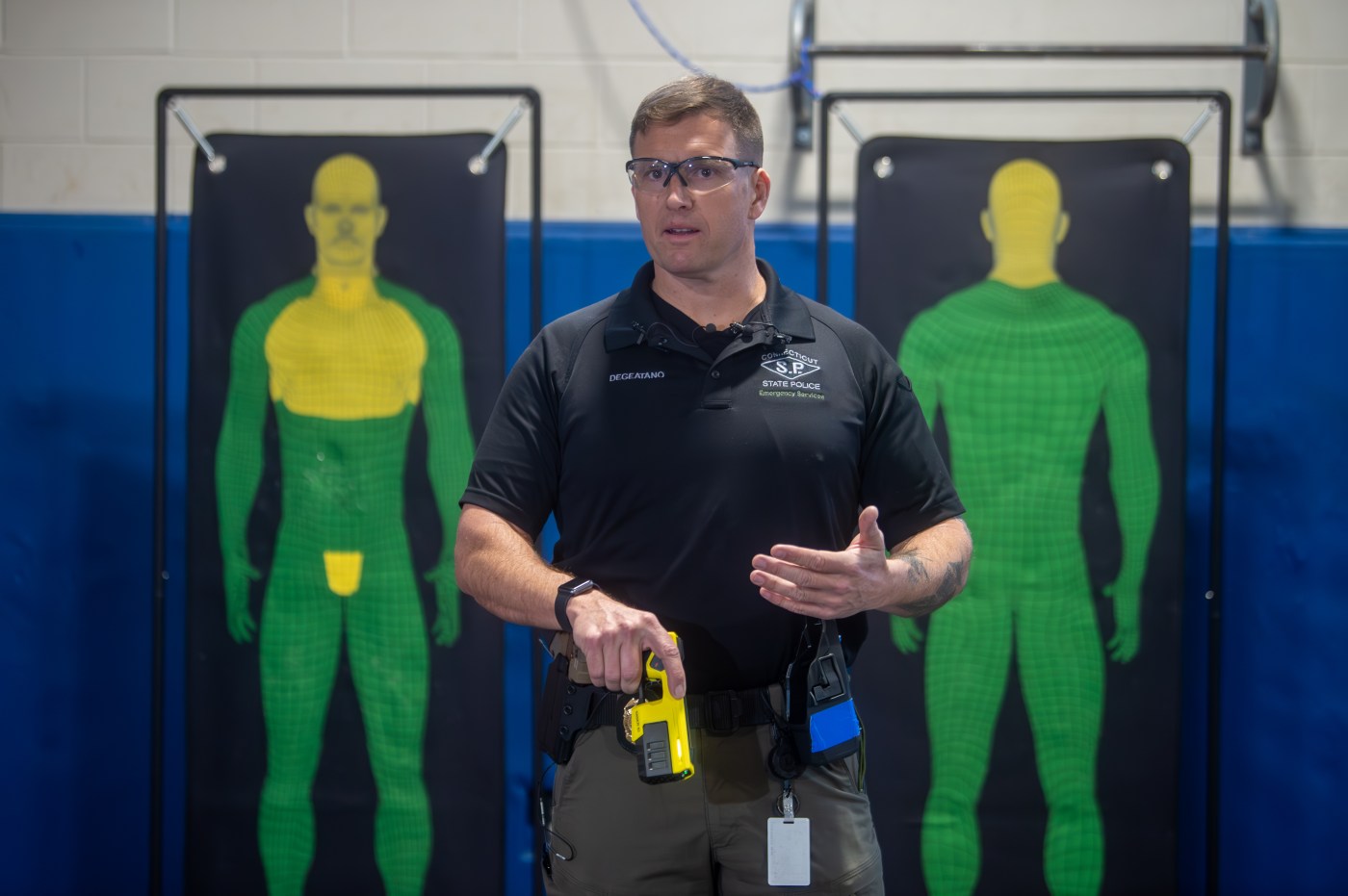
Connecticut State Police have moved to a new type of Taser they say could help reduce the need for lethal force, which comes at a time when law enforcement has come under increased scrutiny to resolve more situations without a gun.
The new Taser, an Axon T10, was purchased as part of a new technology package that will cost $120 million over 10 years. It will be paid year-to-year using $10 million from the current state police budget and funds from future proposed budgets, according to Department of Emergency Services and Public Protection spokesperson Rick Green. The package also includes virtual reality training equipment and body cameras that can currently translate up to 50 languages at an active scene.
The biggest difference between the new Taser and the older style is that the newer model shoots one probe at a time and can be loaded with as many as 10 probes. The older version troopers used had a total of four probes that had to be fired as a pair, giving police only two chances to land a suitable connection to their target.
“So after that first probe, I get nine chances,” said Trooper First Class Dale DeGaetano.
DeGaetano demonstrated the new equipment for media members on Wednesday at the state police academy in Meriden where he said it took about three months to get nearly every trooper around the state — between 800 and 900 from the various barracks — trained on the new devices.

The T10 uses noise and side lights to alert other police and potentially any civilians in the area that the device has been activated and is ready to use, which DeGaetano said can be a deterrent to get individuals under control.
“This by itself may be a de-escalation point,” DeGaetano said.
Single probes are ejected with the use of a green dot laser aiming system. The new device increases the distance from where police can fire probes at a target from about 20 to 25 feet to as much as 45 feet, DeGaetano said.
“I’ve seen it work where other Tasers wouldn’t have,” DeGaetano said.
Firing individual probes makes it much easier for police to establish a two-probe connection without worrying about the distance between them and the subject, as double-probe Tasers separate when they are fired and get farther away from each other with more distance.
“There’s no more geometry involved,” DeGaetano said, adding that a “fair” number of municipal police departments have also started moving to the newer style.
“I think it’s just going to continue to grow,” he said.
The T10 is also “significantly safer,” DeGaetano said, as it administers 1,000 volts that are “more effective” at incapacitating an individual than the 40,000 to 50,000 volts the older style models used.
The rollout of the new Tasers comes as advocates in Connecticut have called on law enforcement to resolve situations without having to fire their guns, particularly those involving individuals experiencing a mental health issue. The demonstration at the police academy was given as advocates were protesting in Hartford following the death of 55-year-old Steven Jones.

Jones was shot by Hartford police Officer Joseph Magnano on Feb. 27 during an incident on Blue Hills Avenue, according to a preliminary report from Connecticut Inspector General Eliot Prescott. Officers had responded to the area after a family member of Jones called 911 and said he was experiencing a mental health crisis, Prescott said.
Four officers who responded to the scene repeatedly called for Jones to drop the knife he was holding before Magnano fired nine shots at him as he advanced toward the officer in the street, according to Prescott. Jones was rushed to a hospital in critical condition and died from his injuries on Tuesday, Prescott said.
During the incident, the first officer at the scene had tried to deploy a Taser multiple times but it was not effective, according to Prescott’s report and body camera footage that was released.
The shooting of Jones followed the fatal shooting of 53-year-old Everard Walker on Feb. 19 after his family called 211 and said he was experiencing a mental health issue. Two social workers responded to Walker’s Capitol Avenue apartment and requested assistance from police.
Following an hour-long exchange, police entered the apartment when Walker tried to close the unit’s door as he was being physically restrained by his son, Prescott wrote in his preliminary report. During a physical scuffle between police, Walker and his two children, Walker raised what Prescott said was a knife and was shot by Officer Alexander Clifford, the report said. He was rushed to a hospital and pronounced dead.
Both incidents remain under investigation and have put renewed attention on situations involving mental health issues and how police handle them.

A probe attaches to a target as Connecticut State Trooper First Class Dale DeGaetano demonstrates the Axon TASER 10 at the Connecticut State Police Academy in Meriden on Wednesday, March 4, 2026. (Aaron Flaum/Hartford Courant)
Since state police moved to a newer style Taser, DeGaetano said it’s been used in the field somewhere between six to 12 times.
“So far for us it’s been great,” DeGaetano said. “There’s been no bad outcomes yet.”
The T10 is equipped with software that records every movement from police, including when it is drawn, raised, activated and deployed. The older style only recorded when they were turned on and fired and required an “arduous process” using a flash drive to transfer the data to somewhere it could be reviewed, according to DeGaetano. The new style uploads the “breadcrumbs” it collects from an incident wirelessly using a 5G signal to a collection system where it can be reviewed.
“It helps paint a picture of what went down,” DeGaetano said, adding that the data it collects “meshes well” with the accompanying body camera footage of the incident.
To get each trooper up to speed on the new devices, state police used virtual reality training aids that take police through scenarios simulating potential real-life situations that can rise to the level of a Taser being used or those that may require lethal force. Some scenarios can be negotiated without using any force at all.
“We all know that’s the preferred outcome,” DeGaetano said.
“It’s fairly limitless,” he said of the number of scenarios that can be recreated, adding that police can also design their own custom situations.
The virtual reality devices were part of the same technology upgrade that also included new Axon body cameras, which use A.I. to translate as many as 50 different languages. The available languages can be expanded over time with firmware upgrades.
State police Capt. Ryan Maynard said troopers previously had to call in to a police “language line” and hope someone was available for translations or try to use a cell phone app.
The new body cameras can translate a trooper’s statements from English into someone’s native tongue, and their statements can also be translated for the trooper, allowing for a back-and-forth dialogue between two people who don’t speak the same language, Maynard said.
“It is incredibly more streamlined,” Maynard said.
The body camera feature, he said, makes it more feasible to navigate an active scene without the distraction of taking out a cell phone for translations. The device still records what is going on like a normal bodycam and can provide a transcript of what was said.
The new cameras are slowly being put into use in the state through a “soft rollout,” according to Maynard. Every trooper in Connecticut should be equipped with one by the summer, he said.