
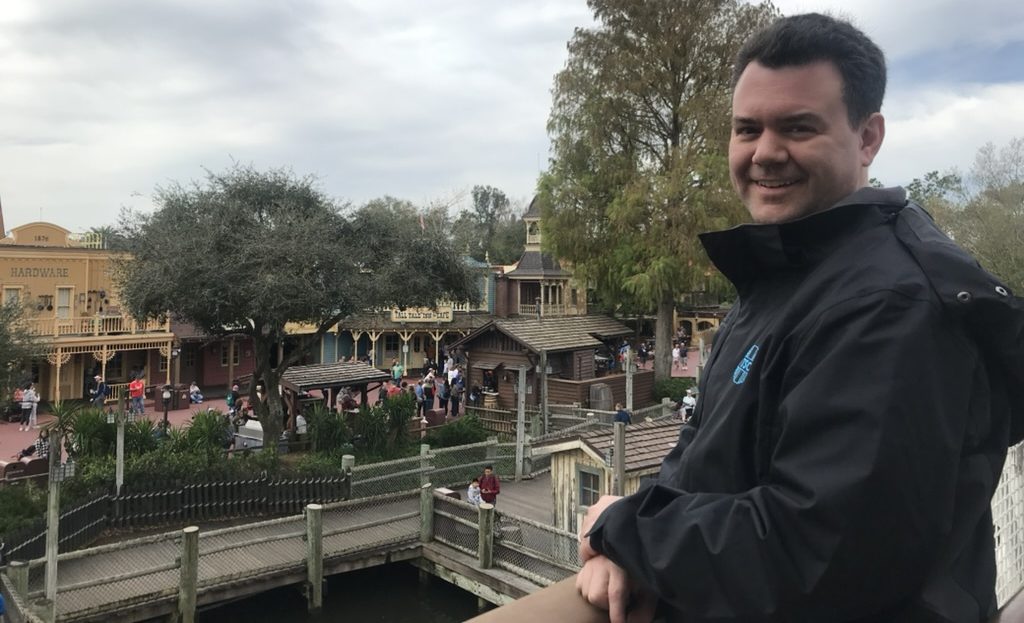
Connecticut resident Mark Malinovsky says that on one Monday he was “perfectly fine, leading a normal life.”
The next day, he went home “half way through the day,” as he was not feeling well.
Then, “on Wednesday, Dr. Selter saved my life,” the Trumbull resident said.
Malinovsky is referring to Dr. Jared Selter, a cardiologist at St. Vincent’s Medical Center in Bridgeport and in Trumbull.
Malinovsky ended up at St. Vincent’s, part of Hartford Healthcare, only because his wife, Jill, insisted he go. Her insistence also is part of what saved Malinovsky’s life.
“Luckily, I listened,” Malinovsky said.
Malinovsky said it all started when he had awoken with a bad cough, and, thinking he had bronchitis, he and Jill went to a walk-in clinic near his office. He was told he may have bronchitis and his blood oxygen level was probably a little low, and it might be a good idea to get checked and some oxygen at the emergency room, he said.
He said he didn’t want to go, but he acquiesced to Jill’s insistence.
In the emergency room, Malinovsky said, he was having “a normal conversation with the” staff there.
“Then I went ahead and coded,” he said, estimating his heart stopped working for 17 minutes.
Malinovsky, an engineer, said his memory of the next few hours are somewhat clouded.
“This is probably something I would not want to remember as a patient either,” said Selter, who credits an enormous team at St. Vincent’s for Malinovsky’s survival. “I have to give our ER credit for thinking beyond an outside diagnosis” [of possible bronchitis]. “It is very hard to shake that diagnosis.”
Selter said testing showed that “it really looked like he [Malinovsky] had a heart attack the day before” and had not realized it. Many people do not have “classic symptoms” of heart attacks, he said.
Over the course of the next 24 hours or so, with a damaged and weakened heart, Malinovsky developed heart failure, or cardiac arrest, Selter said.
Malinovsky required prolonged CPR and resuscitation, medication and more to revive him, Selter said.
“It was all hands on deck,” he said, noting the survival rate for heart failure, or cardiac arrest, outside of a hospital setting is less than 10 percent.
Further, it is the kind of circumstance “where we have to get in right away … We want to get an artery open and help preserve the heart muscle,” Selter said.
In Malinovsky’s case, that was not immediately possible.
The EKG shows the kind of heart issue Malinovsky was having, and it is “the kind we have to get in there,” quickly, an ST-segment elevation myocardial infarction, Selter said.
An ST segment elevation myocardial infarction is a severe emergency as it “arises from the occlusion of 1 or more coronary arteries,” according to the National Institute of Health.
As the team worked to get Malinovsky to the angioplasty suite and the point where they could fix his heart, and “we anticipated he would need mechanical supports,” another cardiac arrest occurred and more CPR was needed. “This was a whole hospital village helping him here,” Selter said.
Selter noted Malinovsky had artery problems, with plaque present, and one had ruptured. The team was able to put an Impella device in place through Malinovsky’s femoral artery. The device “takes over a lot of the work of his heart,” Selter said.
When the team was able to get Malinovsky to the ICU, with the support of the Impella device, “at the time then he was doing pretty well,” Selter said.
Until the next day.
Malinovsky had the Impella device in place, had an open artery with the angioplasty and stent, and the team was hoping that with “all we have done, his heart will heal,” but “the next day, Mark’s numbers were not looking great…,” Selter said.
Over the course of a few hours, Malinovsky “very subtly was starting to drift down,” and that was “a general trend not in the way we wanted,” Selter said. “His heart was struggling so much.”
The decision was then made to upgrade him to a surgically implanted, different impella device, “the same general concept” but a more supportive version, Selter said.
But “at a point in time he just sort of stalled,” the cardiologist said.
A decision had to be made.
“This is how we drill this … joint meetings with how to expedite this — we hit our limit,” for supporting Malinovsky’s heart, and it was time to talk transplant, Selter said.
Following discussions with the transplant team at Hartford Hospital, Malinovsky was moved up to Hartford cardiac ICU, Selter said. Malinovsky noted he went by Lifestar from Bridgeport to Hartford.

That’s when Hartford Hospital cardiac surgeon Dr. Suguru Ohira comes in.
“The patient was dying; Dr. Selter saved his life,” Ohira said. “Again the patient was so ill; the initial care is really tough — some people are not able to make it to the hospital.”
But Malinovsky’s heart function didn’t recover, as sometimes medical management “doesn’t work anymore, sometimes it does,” Ohira said. For Malinovsky, that was a result of the extent of the damage, and for him that meant a need for a heart transplantation, Ohira said.
Malinovsky was placed on a list for transplantation and had to wait for a suitable donor, which can take weeks, Ohira said.
When they did the transplant, the new heart started working right away, Ohira said. They were able to remove the heart lung machine in the OR, he said.
Ohira said there is a long history of heart transplants and “in 2026 we know most of the time the heart starts working.”
Ohira, who has done more than 200 transplants, said he recognizes how dramatic it is to save lives, and “everybody did a great job.”
“Every surgeon has a different approach,” and he tries not to be emotional, Ohira said. “I do this every day.”
Malinovsky said of this experience and his joy to be alive, “I am certainly grateful they are so prepared. It was unbelievable.” He said he is very thankful for what every Hartford Healthcare staff member did for him, and the list of those people is long.
“My wife saved my life,” Malinovsky said, then the medical team did too.

“You knew everybody had you covered,” he said. “The fact that I got through all of that … it was just incredible, it has been an amazing experience; it helps you prepare your next step to getting better.”
Selter again lauded the work of the entire team at St. Vincent’s, and at Hartford Hospital.
“This does not happen by one provider, it is not just the docs … it is everybody … all had a hand in getting him through it,” Selter said. “From the beginning to his ultimate discharge, so many people were helping him.”
“We drill this, we practice this, we know each other, we have a common language,” Selter said. “We all trust each other.”
Selter said he wanted to recommend that as many people as possible learn hands-only CPR, an ability that could save more lives if lay people learn it.