
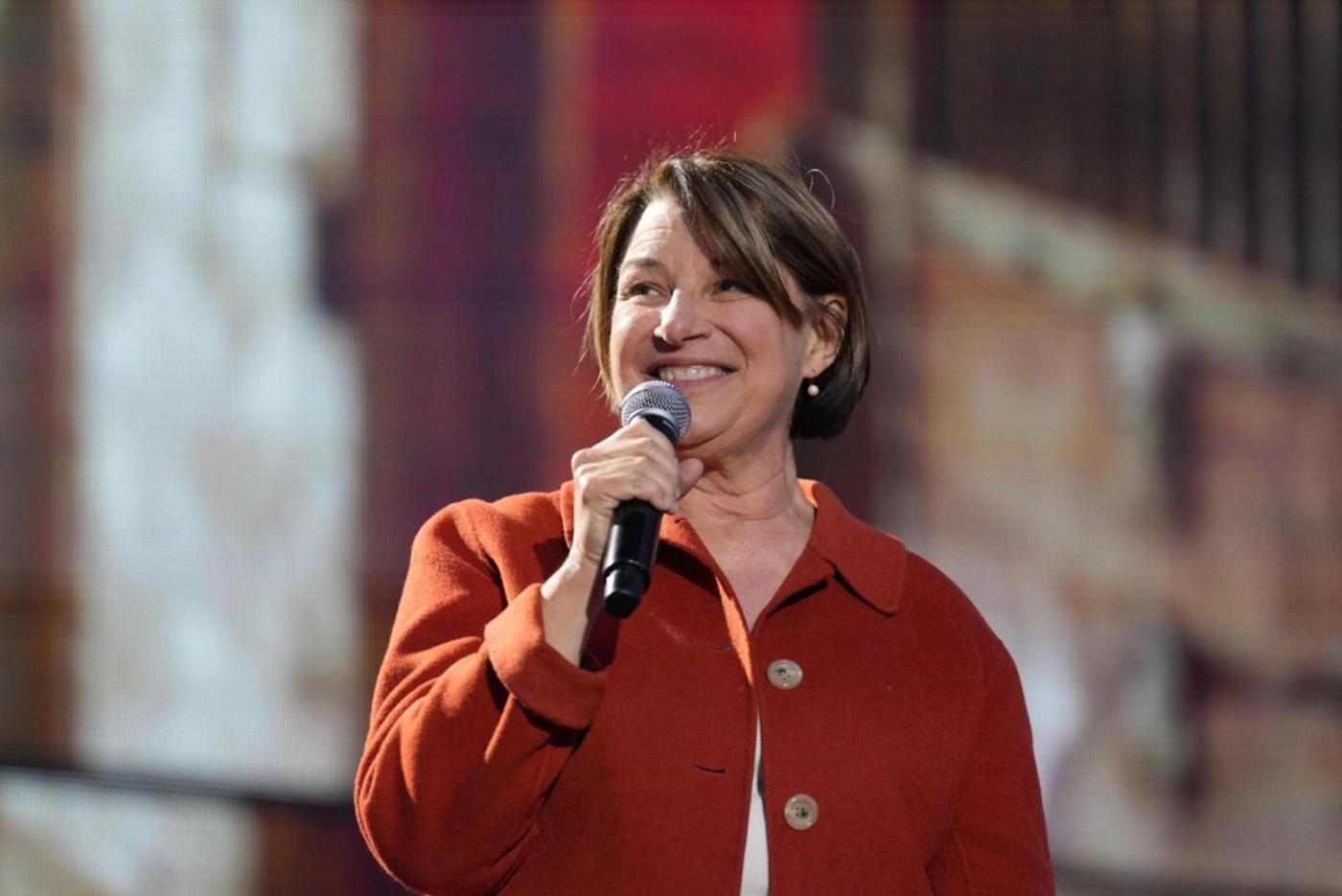
By Chloe Johnson, Star Tribune
Sen. Amy Klobuchar has never hesitated to mention her mining heritage.
When she launched an ultimately unsuccessful presidential run in 2019, she told supporters during her speech in a snowy Minneapolis, “My grandpa worked 1,500 feet underground in the mines up north on the Iron Range. … He saved money in a coffee can in the basement to send my dad to college.”
Klobuchar often has referred to that heritage as she has supported the state’s taconite industry, historically an economic lifeline on the Iron Range. It is credited with bolstering her appeal to northern Minnesota voters.
But the senator has said little on copper-nickel mining, a long-discussed but still unrealized industry in Minnesota — until recently.
Through a spokesperson, Klobuchar said she plans to vote against a U.S. Senate resolution that would remove a 20-year ban on mining in an area next to the Boundary Waters Canoe Area Wilderness. The ban is effectively blocking the Twin Metals project, which would extract copper, nickel and other metals in a region where water flows to the protected wilderness.
As she pivots away from the Senate and toward her bid for Minnesota governor, the statement is one of few clues about where she’d stand as the state’s chief executive on an issue that has driven bitter divisions between mining interests and environmentalists.
Hardrock mining projects like Twin Metals could serve to revitalize the Iron Range, proponents say, but conservationists warn they could irreparably damage the environment, including in the protected Boundary Waters.
Other than the expected vote, however, Klobuchar has rarely commented on this newer type of mining — which carries different environmental risks from iron mines because of the potential for toxic pollution from sulfide ores being exposed to air and water.
“She has not taken a public position on this,” said Chris Knopf, executive director of the conservation group Friends of the Boundary Waters and an opponent of copper nickel projects. “There’s just nothing out there.”
In a statement, Klobuchar wrote that “I have always supported science-based environmental review, and I have long said that I have serious concerns about a project this close to the Boundary Waters.”
There’s little independent polling on the project. In 2020, a Star Tribune/MPR News poll found that 60% of registered voters in Minnesota oppose new mines near the Boundary Waters, while 22% support them. A poll commissioned last year by the advocacy group Save the Boundary Waters found almost identical results.
Klobuchar’s stance on the upcoming vote has left some frustrated.
Republican Rep. Pete Stauber, who represents the Iron Range and is championing the effort to reopen mining next to the Boundary Waters, said in an email that Klobuchar “will be voting against the Iron Range’s proud mining heritage, which her own family has benefited from.” He added that Rangers “will not forget this betrayal as she runs for Governor.”
Klobuchar and Republican Minnesota House Speaker Lisa Demuth are their respective parties’ leading candidates for the governor’s race. A spokesman for Demuth said she supports the Twin Metals project and other copper-nickel mining. In a written statement she said, “Minnesota mining will come roaring back under my administration.”
Klobuchar repeatedly has pushed to support taconite mining operations, most notably in 2015. That year, she successfully lobbied the Obama administration for support as roughly 2,000 iron workers lost their jobs, arguing for protective tariffs to offset the effects of cheaper foreign steel.
“Sen. Klobuchar has always stood up for our miners, from fighting against steel dumping to making sure workers are taken care of in tough times to supporting new projects like Mesabi Metallics,” said state Sen. Grant Hauschild, DFL-Hermantown.
Carlisle Ford Runge, a professor and natural resources economist at the University of Minnesota, said Klobuchar clearly is sensitive to the long-term job loss on the Iron Range as taconite operations have shrunk and workers were laid off.
Although the senator grew up in the metro area, Runge said, “she still has a foot back in northern Minnesota, and that’s important to her both personally and politically.” But he added that she is likely also “quite sensitive to the environmental risk” of sulfide mining.
Because of those risks, the debate over extracting these metals has persisted for roughly the past half-century in Minnesota.
The state’s history is tied to iron oxide ores, first the red-rock hematite that helped to supply the country during World War II, and now lower-grade taconite that is turned into pellets for blast furnaces.
But copper, nickel and platinum group metals are bound up into sulfide ores, which in extreme cases create sulfuric acid — or acid mine drainage. In the 1970s, Minnesota briefly implemented a statewide moratorium on copper and nickel mining to study the risks, and afterward it implemented several rules to counter the potential pollution problems. But no new copper or nickel mine has ever been opened in the state, despite three proposals at various stops on the road to development.
One of those projects is the NorthMet mine near Hoyt Lakes, which originally was proposed by the company PolyMet and isn’t in the Boundary Waters watershed. In 2008, Klobuchar introduced a bill in Congress that would allow NorthMet’s owners to swap private land with federal property in the Superior National Forest, something several Democratic colleagues also supported at the time. Some environmental groups sued a decade later to try and stop the swap.
In 2016, Klobuchar wrote an email to then U.S. Secretary of Agriculture Tom Vilsack, excoriating him for the decision to block mineral leases for the Twin Metals project.
“Trump will reverse this. When you guys leave and are out talking about a job message for rural America, I will be left with the mess and dealing with the actual jobs,” Klobuchar wrote.
She also wrote then that she “was not for or against” the Twin Metals project but wanted it to be assessed by environmental regulators.
Julie Lucas, the executive director of the copper-nickel industry group MiningMinnesota, wrote in an email, “We appreciate (Klobuchar’s) recognition of how vital our taconite industry has been to communities across northern Minnesota and to our state’s economy. Minnesota’s next opportunity lies in the responsible development of our critical minerals.”
Lucas did not comment on Klobuchar’s pledge to vote to retain a mine ban on federal lands next to the Boundary Waters, where the Twin Metals mine would be. But she said that “mining should not be reduced to a political litmus test.”
A representative of Twin Metals declined to comment for this story.
Whether Republicans are successful in reopening federal land next to the Boundary Waters for mining, the question of how to deal with copper and nickel proposals isn’t going away.
If Klobuchar is elected governor, she would oversee the state as it makes multiple complex permitting decisions for hardrock mines.
State Rep. Roger Skraba, R-Ely, said that with Klobuchar’s intended vote on the mine ban, “She is essentially then saying that copper-nickel mining in northern Minnesota isn’t something she wants.”
“We still need good-paying jobs,” he said. “And mining is a good-paying job, and it can be done responsibly and it can be done safely.”
Klobuchar has not said she wants to stop any copper-nickel project, but she wrote to the Minnesota Star Tribune that “I oppose any effort to move projects forward without thorough, transparent, and objective environmental review, especially under (a presidential) administration that has disregarded science and critical environmental studies for multiple projects across the nation.”
If Klobuchar remains in the Senate, anti-mining advocates likely will look for a new champion in their effort to make the mine ban permanent through legislation, currently carried by retiring U.S. Sen. Tina Smith.
Klobuchar has not taken a public position on that legislation but wrote in her statement that the “Boundary Waters is a national treasure and must be protected.”
Ultimately, some in the environmental movement say they would like Klobuchar to stake out a clearer position on the matter.
“We’re hoping to see much stronger leadership from her and look forward to learning more about how she would approach environmental protection and clean water in her upcoming (gubernatorial) campaign,” said Margaret Levin, state director of the North Star Chapter of the Sierra Club.
But with such a consequential vote looming on the future of mining next to the Boundary Waters, others are simply happy she’s taken the position they’re fighting for.
With Klobuchar saying she’ll vote against the ban, “That’s good enough for me,” said Ron Monson, chair of Sportsmen for the Boundary Waters. “You know she does what she says.”
_____
©2026 The Minnesota Star Tribune. Visit startribune.com. Distributed by Tribune Content Agency, LLC