
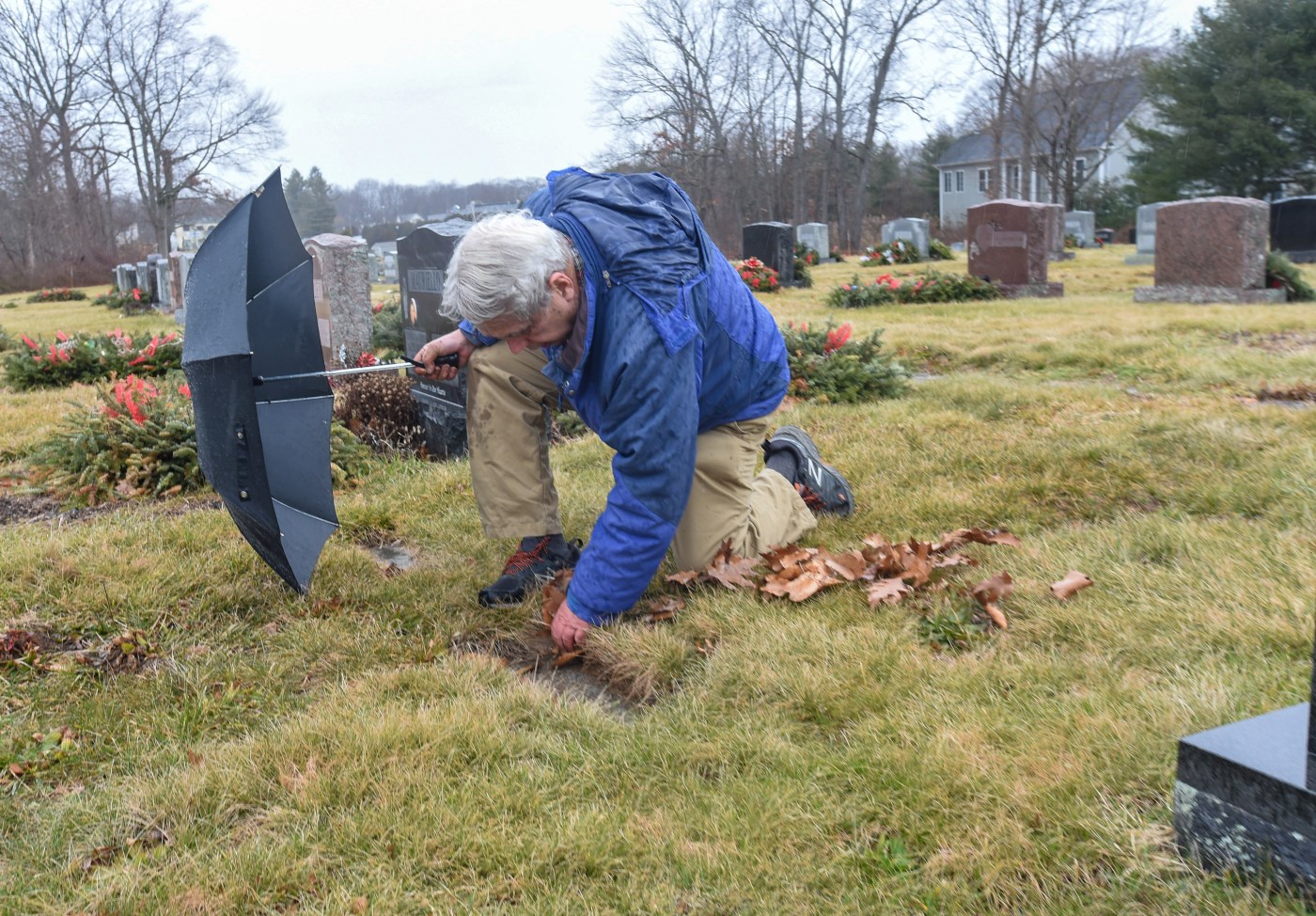
Ed Zack Jr. of Branford was outraged when he found overgrown and sunken graves of veterans at a Connecticut cemetery.
He did not stay quiet about it, calling it a disgrace to the memory of veterans and “unconscionable” that the graves were not cared for, even in cases when perpetual care had been paid for and set in place.
“These veterans have sacrificed,” Zack has said. “They served the country. They had to fight … They sacrificed when they came back. Now they have to fight just to have their markers clear.”
So Zack did what a veteran might do: He fought for change.
His fight grabbed the attention of state Sen. Christine Cohen, D-Guilford, who championed a bill that created a Veterans’ Graves Upkeep Working Group in Connecticut. The working group was tasked with looking at the upkeep of veterans’ graves and finding ways to make sure their graves are properly kept and not neglected.

The working group has submitted its report and recommendations.
It found, in part, that many Connecticut cemeteries, “including veterans graves within those cemeteries, are maintained” in a “satisfactorily to excellent” way. This includes the State Veterans Cemetery in Middletown and the Cemetery of the Connecticut State Veterans Home in Rocky Hill.

However, the report said, “there are cemeteries or sections of cemeteries that are not cared for well for various reasons, most of which is lack of funds to properly mow, trim, and maintain the grounds or a lack of leadership in setting high standards of care.” The group did not name specific cemeteries that lack care.
Further, the working group found, “there is also a statute that requires all cemeteries are subject to an annual financial statement reporting requirement to the probate court in the district they are located to show the income and expenses of maintenance and financial health of those cemeteries. This requirement has not been kept up as there is no state agency charged with its compliance.”
The recommendations of the Working Group include:
- Moving the authority for the graves from probate court to municipality; with the municipality applying for any grant funding available to cemeteries.
- Having each town appoint three veterans to ensure the care of wartime veterans’ graves within the town. The town must appropriate funds for the maintenance costs if private persons or cemetery trustees do not pay for the upkeep.
- Three veterans appointed by each town would handle complaints regarding municipally owned cemeteries, with an enforcement mechanism to ensure towns appoint three veterans, with an established time frame.
- Having the Department of Consumer Protection handle complaints regarding non-municipally owned cemeteries (private and ecclesiastical cemeteries); this could require additional staff for DCP.
- Establishing grants for municipalities regarding cemetery upkeep for all municipally operated cemeteries; specifically for veterans’ graves
- Requiring notification to all cemeteries about updated statute, likely disseminated through municipalities. Would come from DCP and or OPM.
Now a bill has been introduced in the current legislative session to adopt the recommendations of the Working Group.
Cohen has submitted testimony in support of the bill, which is SB 282. It was referred to the Veterans’ and Military Affairs Committee.
“This proposal stems directly from concerns raised by constituents who struggled to find recourse when veterans’ graves in certain cemeteries fell into neglect,” her testimony says. “While many municipalities, cemetery associations, and volunteers across Connecticut do an excellent job preserving burial sites, the working group found that the current system lacks clarity, consistency, and a reliable pathway for families seeking assistance.”
Cohen said she commends the committee’s work, the volunteers who served on the Working Group, and the many constituents who provided feedback.
“This bill takes a constructive and solution-oriented approach to protecting veterans’ graves by strengthening local oversight, creating a clear and accessible complaint process for families, providing municipalities with financial tools to address maintenance needs, and improving transparency for cemetery associations,” she wrote. “Together, these measures close the gaps identified by the working group while preserving local control and supporting the many communities already doing this work well. Most importantly, this proposal helps ensure that no veteran’s final resting place is forgotten and that families can trust their loved one’s service will be honored with the dignity, care, and respect they earned.”
Cohen noted Connecticut “has a long and proud tradition of honoring those who served in our nation’s armed forces. Caring for veterans’ final resting places is one of the most visible and meaningful ways we uphold that tradition.”
The senator said she doesn’t think the bill would impose “an overly burdensome mandate”; but would create “a clear structure for communication, responsibility, and support so that no family is left without recourse when a veteran’s grave falls into disrepair.”
Alison Weir, executive director of the Connecticut Veterans Legal Center, in West Haven, also said in testimony that the organization supports SB 282, as “our veteran population is aging, and there is not enough room in the state cemetery. I don’t know how much time you spend in municipal cemeteries, but the one where my father is buried has veterans from every war from the Revolution through the Gulf War, with each veteran’s grave marked by a simple marker or medallion.
“It is a reminder that our military is drawn from the civilian population and once you leave military service, you rejoin civilian society. That said, the markers recognize that the person buried in that plot willingly served our country, and should be honored in death as well as in life,” Weir testified. “These individual graves are monuments to their service as much as the veteran cemetery is a moment to the service of all veterans. I am very sad when I see the neglected grave of a veteran, because it is a break in the trust and the honor we owe those who served.”
Zack, who is not a veteran, but whose dad was, said this week that he is pleased and “extremely grateful” to Cohen and working group chairmen North Haven First Selectman Michael Freda and John Carmon, for their “superb work.”
“It is a strong message,” about respecting the memory of veterans, Zack said.
Freda said while the group worked on the recommendation for almost two years, it was done so in collaboration with many others, including lawmakers. He said the bill is now part of the General Assembly process’s “beginning stages.”
Freda said his dad was a World War II veteran of the U.S. Navy and his uncles were Army veterans. He noted North Haven has three cemeteries and the town would work to make sure veterans’ graves and stones were cared for, pruned up and always made to look “respectable.”
Freda noted there is a sometimes “striking contrast” in how well veterans’ graves in Middletown and Rocky Hill are tended, “versus the private cemeteries that may not have the resources.”
Cohen has noted in the past that she had discussed the issue with the state departments of Veterans Affairs and Consumer Protection and the attorney general’s office and all were aware of the concern.
She has said they discovered agencies and departments were fielding requests for procedures or complaints and there isn’t that proper procedure in place.
Cohen has said, “I was surprised to learn that each one of these individuals that I had spoken to within our government system was familiar with the issue and recognized that we needed to establish a path forward.
“These are brave men and women who served our country, and perhaps they have living relatives or close ties and perhaps they don’t have those living relatives anymore,” she has said. “In either case, we want to be sure that the upkeep of their resting place is maintained out of respect.”
The bill would require, not later than Jan. 1, 2027, for each city or town to create an electronic mail account for the receipt of complaints regarding the care and maintenance of veterans graves and situated in a cemetery that is owned and operated by such city or town, it says.