
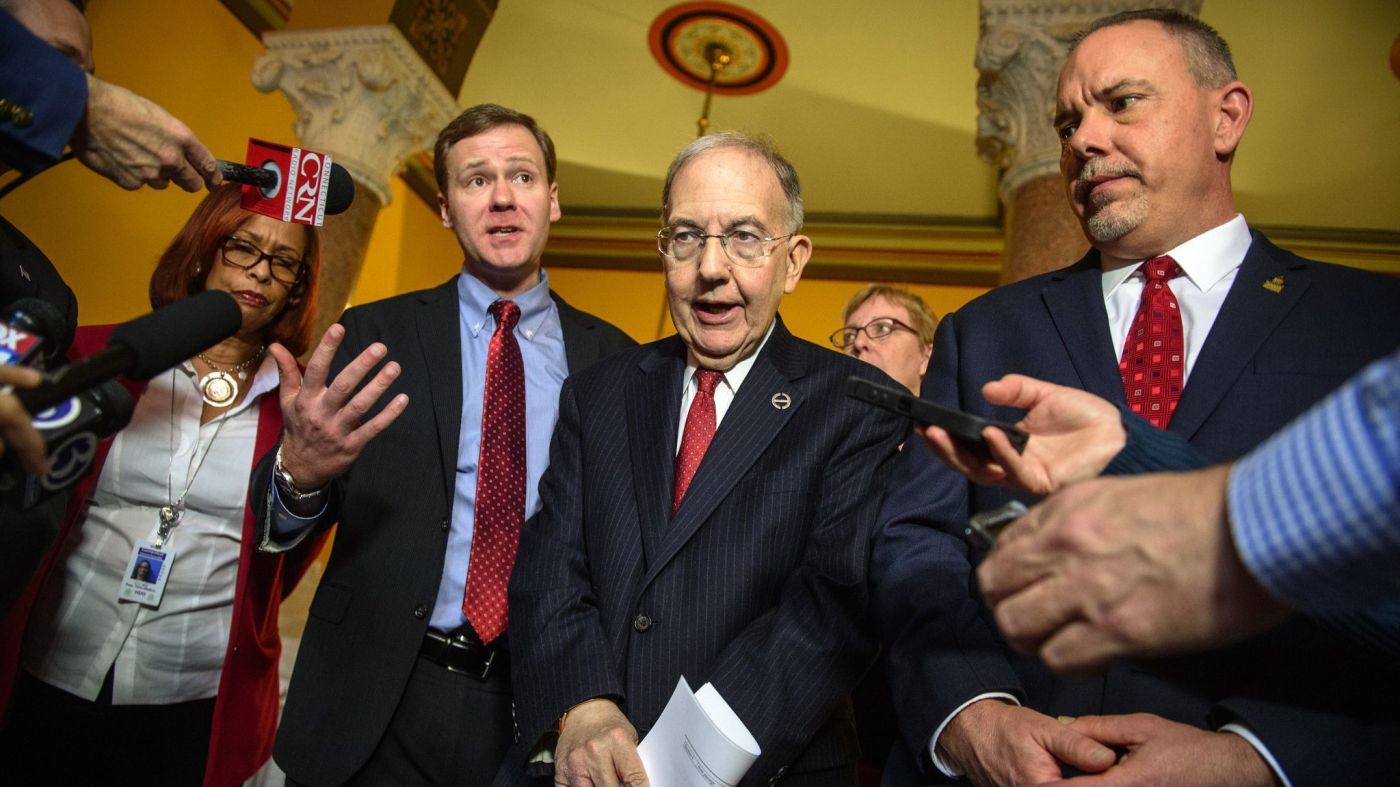
Senate Republicans and Democrats clashed Wednesday at the state Capitol before passing emergency legislation on a wide variety of subjects, including warehouse workers, voter data, and funding for nonprofits.
After a brief debate on a separate bill, the state Senate voted 35-1 to increase the penalties against the violators of the state’s bottle bill that currently requires a deposit of 10 cents. Citing a recently growing problem, legislators said that out-of-state residents have been driving truckloads of bottles to Connecticut in order to make money from the deposits of 10 cents.
Since consumers in Massachusetts and New York pay 5 cents per bottle and those in New Jersey and Rhode Island pay nothing, residents of all the surrounding states make profits by traveling to Connecticut.
The biggest concern, lawmakers said, is with the huge volume arriving in trucks. As a result, the Senate voted to change the law so that the maximum number of containers that a person can redeem per day at a redemption center is 4,000 containers. Currently, the maximum is 5,000. Exceptions are made for nonprofit organizations and certified fundraisers.
In addition, the bill says a person must show identification if they redeem 1,000 bottles or cans, rather than the current limit of 2,500 containers.
The fines for violating the law will jump to a maximum of $750 for a first offense, up from the current $100 and up to $2,000 or more for a third offense, up from the current maximum of $500. Those who violate the bottle bill three times can be arrested and charged with a misdemeanor.
The bill was sent to the state House of Representatives, which is scheduled to vote Thursday.
In an all-day marathon, the Senate also voted 26-10 on mostly party lines for an omnibus, 121-page bill on a series of issues that were unrelated to each other. Sen. Tony Hwang of Fairfield was the only Republican who broke with his party and voted with the Democrats.
After a somewhat contentious afternoon, applause broke out briefly when the omnibus bill passed at 6:23 p.m.
Republicans said that Democrats who control both chambers of the legislature were abusing their powers to rush through bills that would normally not be debated until the end of the legislative session. Democrats countered that the issues included some priority measures that had been derailed last year when Republicans staged filibusters as time ran out at the end of the session – thus killing the legislation.
“Today is a sad day in the legislature,” said Senate Republican leader Stephen Harding of Brookfield. “None of these issues … has anything to do with an emergency … They are usurping the entire legislative process.”
Democrats, though, plowed ahead with the two major bills on an “emergency certified” basis that requires approval by the leaders of both chambers. The largest legislation was Senate Bill 298, which has 98 sections on multiple topics.
“We will not apologize for passing legislation that has had a public hearing and has the support of a majority of the General Assembly,” said Senate President Pro Tempore Martin M. Looney of New Haven.
On the Senate floor, Looney said that lawmakers were operating under the joint rules that both he and House Speaker Matt Ritter of Hartford believe fit the requirements for emergency certified status.
“I don’t believe this is an emergency,” Harding countered. “I think it comes down to what the definition of an emergency truly is. We should take that seriously. … Just because you have the majority, and a large majority, doesn’t mean that people should be taken out of the process. … Regardless of who is in power, we should have more respect for the institution.”
In his wrap-up speech, Looney said many of the issues being debated were not new.
“Every single element of this bill has been considered,” Looney told colleagues. “It is not that matters are being sprung as a surprise. … We are attempting to be responsive to public need.”
He cited protections for warehouse workers as “the duty of state government to step in and protect workers.”
The measure was sent to the state House of Representatives, which is scheduled to debate Thursday.
Affordability crisis
The real emergency, Republicans countered, is the state’s affordability crisis as residents struggle with high taxes and electricity bills while living paycheck to paycheck.
“Let’s talk about affordability,” Harding said. “That’s the real emergency.”
Harding sought a point of order to say that the bill did not constitute an emergency, but Lt. Gov. Susan Bysiewicz, who presides over the Senate, said that the tenets of the rules and the statutes had been met. As a result, the debate continued.
Sen. Ryan Fazio, a Greenwich Republican who is running for governor, said the Senate needs to provide relief for working people across the state.
“There’s a Connecticut outside the Capitol … where people are paying the third highest tax rates in the country,” Fazio said. “That is the real emergency in Connecticut.”
Fazio offered an amendment that he said would provide $1,600 in tax relief for families earning about $100,000 per year. The measure would also eliminate licensing fees that are paid by electricians, heating and air conditioning professionals, teachers, real estate agents, and others. The amendment would also cut the payroll tax that is currently deducted from paychecks for the paid family and medical leave act. The overall relief in the Republican plan was estimated at $1.5 billion.
“This proposal addresses the true emergency,” Fazio said on the Senate floor.
In his wrap-up remarks on the amendment, Senate majority leader Bob Duff, a Norwalk Democrat, opposed the measure. Duff blamed rising prices in Connecticut and nationwide that he said were caused by “these illegal tariffs that have come through the federal government” as pushed by President Donald J. Trump’s administration.
The Republican amendment failed, 25-11, on strict party lines.
Another Republican amendment would have eliminated the state’s 6.35% sales tax on school supplies, such as paper and pencils, that would cost $13 million per year in an overall annual state budget of $28.7 billion.
“This is actually one of their measures that we agree with,” Harding said of Democrats. “It’s a common-sense measure to address the real emergency, and that is affordability.”
The amendment failed after Duff said the tax cut is already included in Senate Bill 1 that will be subject to a vote before the 2026 session ends on May 6. He said he hopes for a bipartisan vote in the coming months.
Nonprofits
Questions were also raised about money being awarded in the omnibus bill to various nonprofits, which has been a key issue at the Capitol recently.
Sen. Rob Sampson, a Wolcott Republican, asked about $2.5 million allocated for outdoor recreation in the city of Hartford, saying he could not find any details about how the money would be spent and could not determine which lawmaker had asked for the item.
“Are we buying people basketballs or tennis rackets?” Sampson asked on the Senate floor. “That’s a lot of basketballs.”
Sen. Cathy Osten, a Sprague Democrat who co-chairs the budget-writing appropriations committee, said she did not know which legislator had sponsored the provision.
“This helps cover the costs of students to attend outdoor recreation, allowing them to attend programs all summer long,” Osten said. “There were questions from agencies on where certain dollars were going, and this is an answer to some of those questions.”
Concerning a grant of $330,000 to an organization known as “Our Piece of the Pie,” Osten said it will assist a youth-service organization, which was formerly in Norwich and is now mainly in the Hartford area, that works with at-risk youth and helps them with educational challenges.
“It’s the first time I’ve ever heard of Our Piece of the Pie,” Sampson said on the Senate floor. “They may be the most magnificent people in all of America, but I don’t know that.”
Sen. Douglas McCrory
Republicans also raised questions about Sen. Douglas McCrory, a Hartford Democrat who has been under federal investigation regarding money awarded to nonprofits in recent years in the Greater Hartford area.
On Wednesday, Republicans questioned a grant of $750,000 in the omnibus bill for the Capital Region Education Council, where McCrory works. McCrory is a longtime educator, and CREC is a well-known agency in the Greater Hartford area.
Investigators are probing the role of McCrory, a longtime lawmaker since 2005 who currently co-chairs the legislature’s education committee. McCrory has strongly advocated for the North End nonprofits, including the now-defunct Blue Hills Civic Association. Investigators are looking into the actions of McCrory’s friend, Sonserae Cicero-Hamlin, who runs a nonprofit known as SHEBA that received more than $1 million from the Blue Hills group.
A forensic audit was ordered last year after state officials were stunned when the Blue Hills Civic Association reported that $300,000 in state money suddenly disappeared when it was sent to scammers in a fraudulent bank transfer. Workers were laid off after the money went missing and the organization eventually ceased operating.

The omnibus bill also calls for creating a 15-member working group that is designed to help school boards in addressing antisemitism in the public schools.
“Under the bill, the group must develop guidance and resources to address issues relating to antisemitism that affect students, families, educators, and school personnel,” according to a legislative summary. “The guidance and resources may include, but are not limited to suggested amendments to school district policies to ensure that all students, educators, and school personnel feel safe inside and outside of the school setting; recommended antisemitism-related training for educators and administrators; and guidance for creating or providing curriculum materials and resources about antisemitism, Jewish heritage, and Holocaust and genocide education and awareness.”
Warehouse workers
Senate Bill 298 also included sections on the rights of warehouse workers, which has been an issue at the Capitol in recent years.
With packages being delivered seven days a week in the post-COVID era, one of the nation’s fastest-growing industries is warehouses.
The industry now has more than two million workers nationwide, but some Connecticut lawmakers and union members say the workers need protections due to suffering too many injuries as they work quickly to get packages out the door.
“Unfortunately, some of the conditions in warehouses in Connecticut are the same as what we heard about more than a century ago in factories, where speed-ups were common and conditions that were detrimental to the safety of workers were fairly common,” Looney said during a public hearing last year by the legislature’s labor committee.
The problem, Democrats and union officials say, is that the workers are watched closely for how many packages they handle per hour, how quickly they work, and even for how long they take a break. The productivity, lawmakers said, is directly related to the speed that a package can be delivered to a customer’s home.
The bill would apply only to large companies with at least 100 employees at a Connecticut warehouse or at least 1,000 employees at multiple warehouses statewide.
Senate Democrats say the workers are subject to reaching quotas to measure their productivity, and “the quotas cannot interfere with meal periods or bathroom breaks.”
Amazon, which operates large warehouses, says that serious injuries have been reduced. The company has said that both total incidents and those with the most serious injuries have been reduced in recent years.
Amazon is a member of the Connecticut Business and Industry Association, the state’s largest business organization that strongly opposes the bill as bad for business.
“As written, this legislation risks undermining Connecticut’s strategic advantage as a logistics and distribution hub in the Northeast,” said Christopher Davis, a former Republican legislator who serves as CBIA’s vice president for public policy. “At a time when the state should be competing aggressively for supply‑chain investment, this bill sends a troubling signal to employers considering expansion or relocation. If enacted without careful revision, the bill may jeopardize the development of thousands of good‑paying jobs and weaken one of Connecticut’s most promising economic growth sectors.”
The measure, he said, had not been properly vetted and had been rushed as an emergency at the start of the session.
“We are also deeply concerned by the manner in which the bill was drafted and advanced without meaningful public input or a thorough examination of its impact on employers that were not impacted by previous versions of the concept,” Davis said. “Major policy changes of this magnitude should be informed by a transparent process that includes the voices of job creators, workers, and other stakeholders.”
With warehouses expanding nationally, more states have enacted new laws on the topic. Those include New York, California, Oregon, Minnesota, Washington, and Illinois.
Sampson, a conservative Republican, said the move to protect workers could backfire if companies decide to avoid building warehouses in the state.
“They can move,” Sampson said. “As long as I have been here, I have been watching companies leave Connecticut.”

Christopher Keating can be reached at [email protected]