
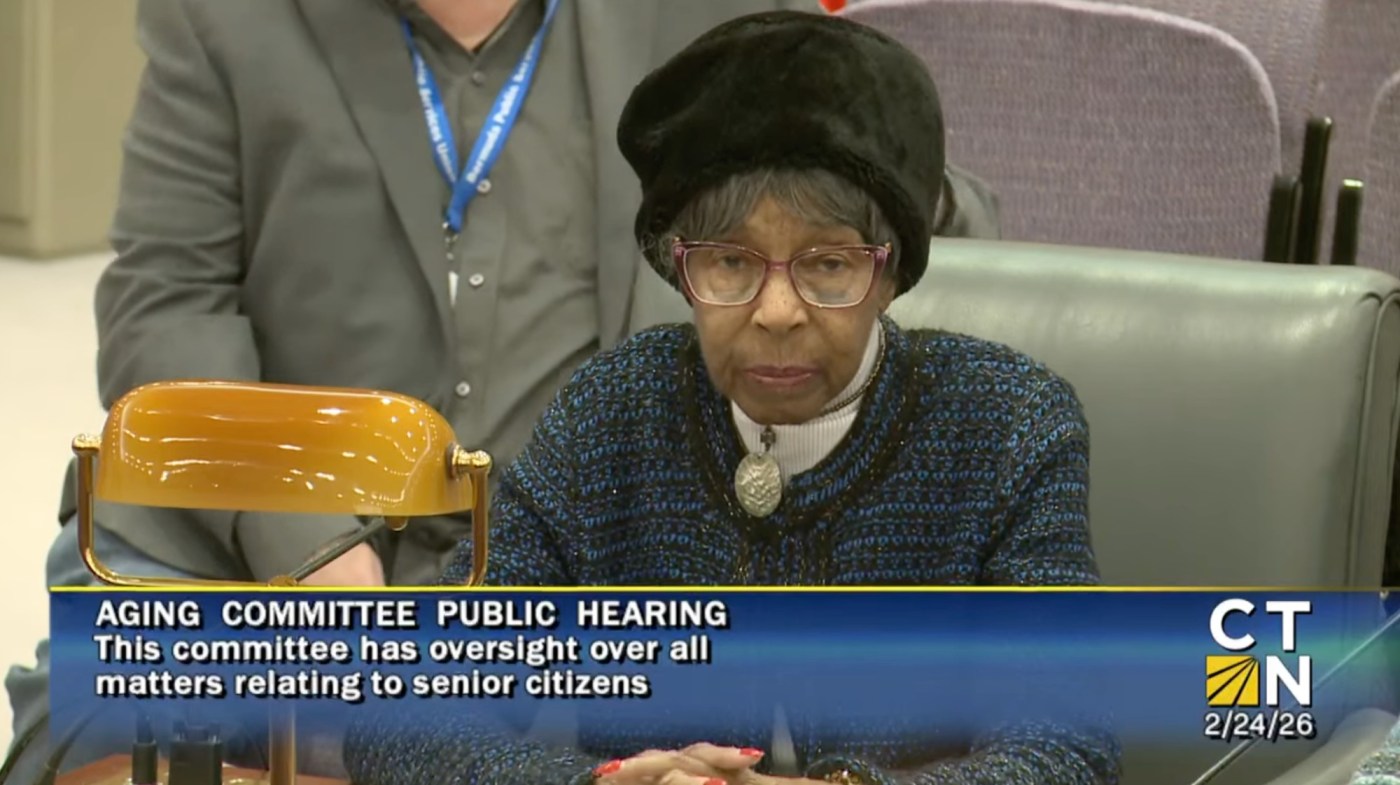
The legislature’s Aging Committee has introduced a bill that aims to offer some relief to long-term care insurance policyholders who have been squeezed by large premium increases.
Residents with long-term care coverage said during a public hearing Tuesday that the bill doesn’t provide enough protections, however, and they encouraged lawmakers to recast the proposal.
The measure would create a tax deduction for people with LTCI policies, require public hearings for rate increase requests that exceed 10%, and mandate that the public receive advanced notice of the hearings.
Under the bill, some long-term care insurance policyholders could deduct the total amount of premiums paid over the course of a taxable year on their tax return, reducing the amount of income that’s subject to state taxation.
The committee introduced a similar bill last year. Although members voted to advance the proposal, it ran into opposition when the state’s non-partisan Office of Fiscal Analysis estimated that it would create a general fund revenue loss of $19.7 million in the 2026 fiscal year and $20.2 million the following year.
Rep. Mitch Bolinsky, R-Newtown, said this year’s bill language was a starting point for discussion on the topic and would likely change.
“We wanted this to have a public hearing because the people behind this problem are having to make really tough decisions about whether they can afford to hold onto the insurance and still eat and have a roof over their heads,” he said. “They deserve the opportunity to have a public hearing.”
Judy Mandel, who purchased a long-term care insurance policy in 2004, said she was frustrated they would pitch a proposal that’s faced strong opposition in previous years.
“Frankly, I was hoping for something better from a committee whose mission is to protect the senior citizens of our state,” she said in written testimony. “When I purchased my policy, I was quoted a premium of $1,170.00 per year. … In just a few months, when I make my 2026 premium payment, I will pay almost $5,200, an increase of almost 400%. To date, I have paid about $50,000 in premiums. That is an amount I cannot afford to just walk away from, if I give up my policy.
“How can this committee think that is fair, and how can you expect this bill, as currently written, which has failed multiple times, to bring justice for the people you represent and are supposed to protect? I ask you to go back to the drawing board.”
David Schwartzer of Newington urged lawmakers to revise the bill to include rate caps, greater financial disclosure requirements for insurers and other reforms that he and fellow policyholders have previously suggested.
“Connecticut LTCI policyholders – mostly seniors – need legislators who will stand up to the LTCI industry, their lobbyists, and the Connecticut Insurance Department. We need legislators who will serve the interests of the Connecticut voters, not special interests,” said Schwartzer, 71.
Nearly 100,000 people in Connecticut have long-term care insurance — coverage that, depending on the policy, supports skilled in-home care, rehabilitation therapy, assisted living, nursing home stays and respite care.
A 2025 Connecticut Mirror investigation found that the annual cost of maintaining long-term care coverage has skyrocketed for many residents due to miscalculations by insurers on how long people would live, the price of care and how many would need it. Policyholders complained of dramatic rate increases, often exceeding 50% and, for a few dozen people, as high as 174%, according to a CT Mirror analysis.
A review of rate hikes from January 2019 to October 2024 showed that more than 17,000 people with long-term care policies have gotten hit with increases of 50% or more. Some of the biggest companies in the market, including Genworth Financial, Metropolitan Life Insurance Company and Transamerica Life Insurance Company, requested hikes for five years in a row beginning in 2019.
When large providers seek premium increases, thousands of consumers can be impacted. In 2019, for example, Genworth Financial requested a 40% rate hike on more than 9,000 Connecticut policyholders. In 2021, Transamerica requested a 20% rate increase on 8,000 policies. The Connecticut Insurance Department approved both requests with no changes.
In 2022, Genworth raised rates for more than 2,000 people by an average of 97%, with increases ranging from 79% to 173%, depending on the policy. The approved amounts were a slight reduction from the company’s original request.
Last year, lawmakers introduced more than a dozen bills seeking to reform long-term care insurance, including five broad committee proposals. One measure passed unanimously in the Senate but died in the House after insurance sector lobbyists voiced strong opposition.
Residents who testified at Tuesday’s hearing made it clear that legislative solutions are still needed.
When Amelia Smith of Windsor bought her policy in 1994, her monthly premium was $85.50. She’s now paying $838.46 a month, she told legislators.
“This is now unmanageable for me,” she said. “I bought this policy to protect myself in my later years, and now I cannot afford it. I used to travel to California to visit my son, family and friends, but I can no longer do this anymore. Fortunately, I’m lucky enough that they come to visit me. But my utility bills, like anyone else’s, are going up, and believe me, I get cold in the winter.
“Please support this bill to help seniors like me.”
“With a little buffing and polishing, this bill could help the 100,000 long-term care policyholders in Connecticut to maybe, just maybe, afford to keep their policies,” said Jan Kritzman, 78, whose coverage with her husband has risen to $7,000 a year, up from $2,000 when they purchased the plans in 2004. “Policyholders with long-term care protections will save the state millions of dollars in Medicaid costs, probably offsetting any loss of revenue from the tax deduction mentioned in this bill.”
Representatives with the insurance sector submitted written remarks in support of the tax deduction but opposing the public hearings.
“As private, for-profit enterprises operating on actuarial principles, insurance carriers are not in the business of holding public hearings,” Eric George, president of the Insurance Association of Connecticut, and two others wrote in joint testimony. “Private insurance is a contractual risk-transfer agreement, not a government service.
“In addition to being time consuming and expensive … public hearings could compel insurance carriers to disclose proprietary data, such as specific underwriting techniques.”
Members of the Aging Committee said the proposal and testimony are meant to create momentum on the issue.
“We have a really serious problem, and it’s one the legislature hasn’t done a particularly robust job at addressing, because it involves some really, really tough decisions,” Bolinsky said Tuesday.
“This is a serious issue and, in this building, it’s one we have not traditionally wanted to speak about. [A bill] typically goes through the Insurance Committee and then … word comes down from someplace in this government that a [rate] cap or other theoretical way to solve the problem is a nonstarter, and the only reasoning given is ‘just because.’ Well, ‘just because’ is no longer good enough.”
“It’s time for us to show the authority we do have on this committee, the changes we have the ability to make for our seniors,” added Rep. Anthony Nolan, D-New London. “I hope we use that authority … to make it better for our seniors.”
Jenna Carlesso is a reporter for the Connecticut Mirror. Copyright 2026 @ CT Mirror (ctmirror.org).