
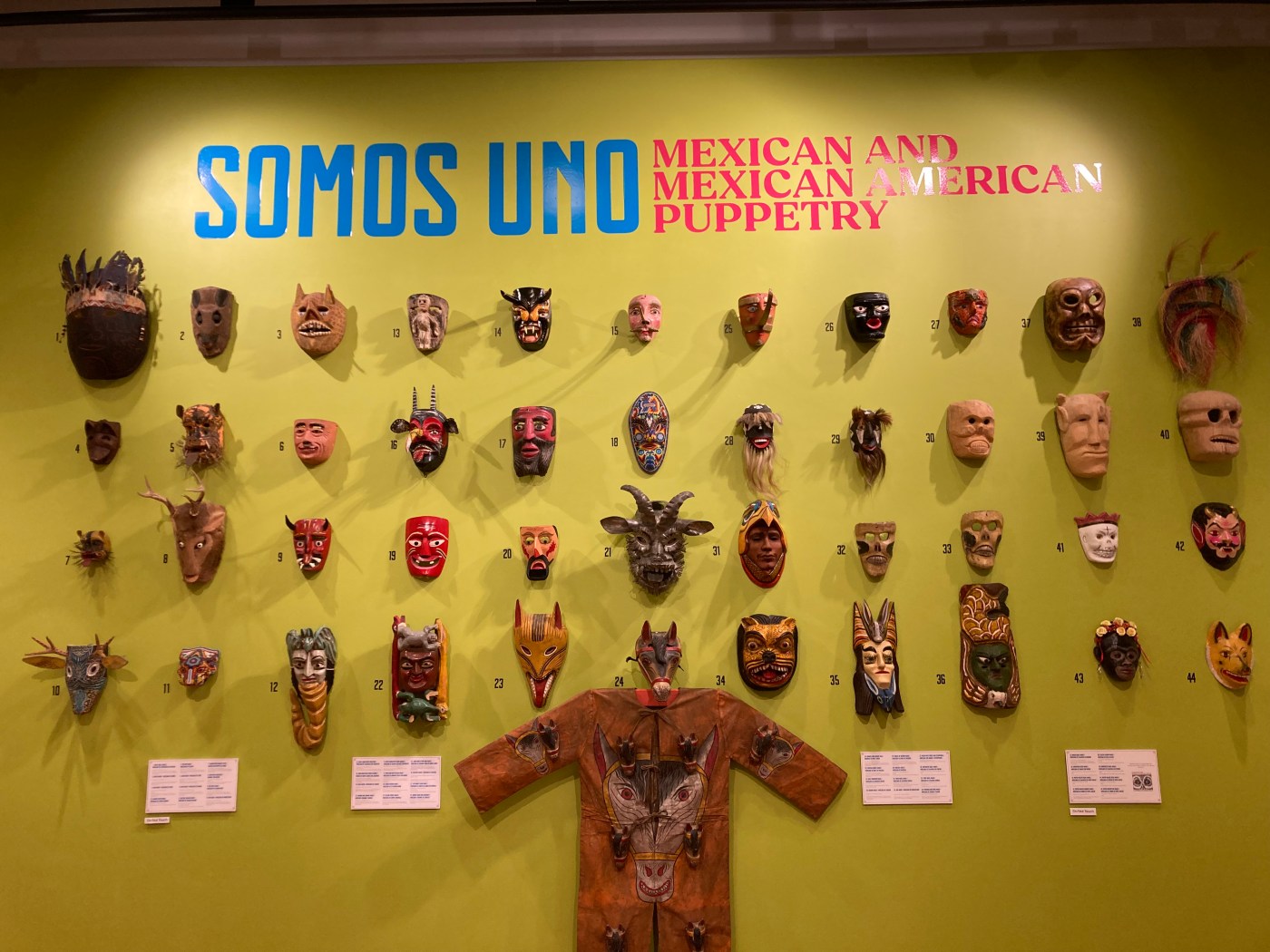
The “Somos Uno: Mexican and Mexican American Puppetry” exhibit at the University of Connecticut’s Ballard Institute and Museum of Puppetry covers the history of puppetry in Mexico and by doing that, covers a good deal of the history of puppetry in the world in general.
There’s a pre-Columbian puppet-like figurine on display. There are examples theatrical and ceremonial puppetry including video of a bullfight and circus acrobat routines depicted with puppets. There are layered diorama-style puppet theater with paper figures. There are gigantic puppets used in street theater and outdoor pageantry. There are giant flapping birds. There are skeletons and the Day of the Dead puppets. There are marionettes, masks, shadow puppets and table top puppets.

Some of the puppets in the “Somos Uno: Mexican and Mexican American Puppetry” exhibit are larger than life, used for outdoor pageantry, protests and ceremonies. (Christopher Arnott/Hartford Courant)
There are also characters from a modern drug cartel-themed puppet production of “Romeo and Juliet,” designed by Kalob Martinez, a graduate of the UConn puppet arts program who has also performed as an actor at Hartford Stage and Connecticut Repertory Theatre.
There is a selection of sinister Seven Deadly Sins tabletop marionettes from an adaptation by North Carolina-based Edwin Salas Acosta of “Dante’s Inferno.” There are Mexican-style puppets that appeared in Connecticut: A big rooster and a skull with a top hat designed by Pedro López Barrios and Hector Hernandez for Unidad Latina en Acción in New Haven.

Connecticut-based puppeteer modern update of “Romeo and Juliet,” set in a Mexican drug cartel operation. (Christopher Arnott/Hartford Courant)
Sometimes the puppetry exhibits at the Ballard museum can seem static, if only because you really want to see these items in motion, doing what they were constructed to do. “Somos Uno: Mexican and Mexican American Puppetry” is livelier than many similar historical exhibits. It’s colorful and varied and includes video clips of the artists’ work in motion. A video of flat paper puppets feels like it’s an animated film. A life-sized bull — basically a big mask and a brown sheet — looks like there are real human legs under it ready to run at a toreador.
“Somos Uno: Mexican and Mexican American Puppetry” explores nature, society, politics, sports, culture and especially art and stagecraft. All the text describing the items is rendered in both English and Spanish. The exhibit beautifully blends the then and the now while proclaiming the importance of the puppet arts in daily life.

A bull puppet in the “Somos Uno: Mexican and Mexican American Puppetry” exhibit has realistic puppeteer legs attached. (Christopher Arnott/Hartford Courant)
“Somos Uno: Mexican and Mexican American Puppetry” is on display through March 8 at the Ballard Institute & Museum of Puppetry, 1 Royce Circle Suite 101B, Storrs. Visiting hours are Wednesday from 11 a.m. to 5 p.m., Thursday from 11 a.m. to 7 p.m., Friday from 11 a.m. to 5 p.m., Saturday from 11 a.m. to 7 p.m. and Sunday from 11 a.m. to 7 p.m. bimp.uconn.edu.