
Nonprofits, Democratic lawmakers and survivors of sexual assault are calling on the state legislature to pass a bill proposed by Gov. Ned Lamont that would codify the provisions of the federal Prison Rape Elimination Act into state law.
The proposal comes after the publication in December of a four-year investigation revealing failures by the Connecticut Department of Correction to address multiple sexual assaults at York Correctional Institution. The report found the department failed to protect women in custody with mental illness from sexual abuse by correction officers and was slow to review whether changes in security or policy could prevent further abuse.
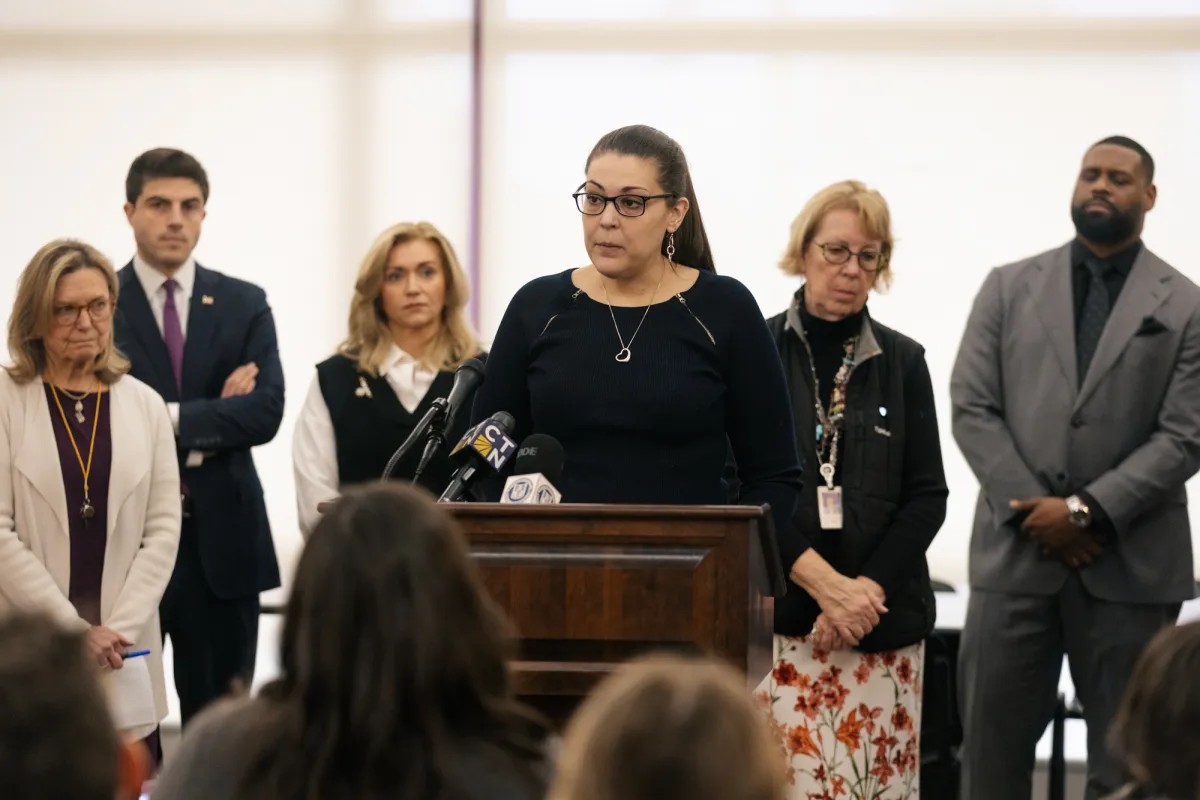
At a press conference on Thursday, Alex Brown, one of the women whose case was described in the investigation, underscored that the abuse she experienced while at York wasn’t limited to just her.
“Sexual abuse in prison is a systemic issue that has been minimized and ignored. For those of us who carry its impact, the harm can be lifelong,” said Brown, who was incarcerated at York Correctional Institution for four and a half years, beginning when she was 19.
The governor’s bill would require any state agency charged with incarcerating people to follow the standards outlined in the federal law. It would also require all complaints of sexual assault to be sent to the state’s correction ombuds for review. The Department of Correction would have to report each year on the number of sexual assault complaints the department has received, the investigations the department has undertaken and any training the department provides to its employees regarding PREA.
Brown said that without putting PREA standards into state law, oversight and accountability remain piecemeal and uncertain. She said many women feel that reporting a sexual assault could put them at risk for retaliation.
“ When I was incarcerated, I was entirely dependent on the Department of Correction for my safety. Women at York remain in that same position today,” she said. “Many lack meaningful protection, confidential reporting options, or assurance that speaking up will not lead to retaliation. That fear is not irrational. It is grounded in how these systems operate.”
Beth Hamilton, executive director of the Connecticut Alliance to End Sexual Violence, said there’s often very little federal enforcement of PREA standards, which leaves survivors without much recourse.
“ If you read that Disability Rights Connecticut report, what you’ll see is that survivors tried to make PREA reports. DOC did not take them seriously. They did not take them. There’s nothing else for those survivors to do,” she said.
According to Hamilton, federal oversight of PREA is limited to a triennial audit of each prison or detention facility, and there is no real penalty when a facility fails the audit.
In a conversation with lawmakers earlier this month, Department of Correction Commissioner Angel Quiros told members of the legislature’s Appropriations Committee that the state has passed all its federal PREA audits every year since 2016. He said he was speaking with the state Office of Policy and Management about hiring a consultant to review the department’s policies around PREA and to look at the curriculum taught to correction officers at the academy.
“I just want to be clear, those ladies were victims, period,” Quiros said, in reference to the women outlined in the Disability Rights CT investigation. “When you take an oath to become a correctional staff member, there’s nothing that’s consensual.”
Andrius Banevicius, a spokesperson for the department, said in a statement Thursday that DOC “maintains a zero-tolerance policy for all forms of sexual assault, sexual abuse, sexual harassment, and retaliation within its facilities” in accordance with PREA. He said the department had a designated PREA investigative unit and that law enforcement are brought in to conduct independent investigations in the case of criminal conduct.
“All reports are taken seriously and investigated in accordance with all applicable laws and departmental policy. Furthermore, retaliation against anyone who reports sexual abuse is also strictly prohibited,” Banevicius said.
The governor’s bill would also require DOC to provide “immediate and ongoing access to sexual assault crisis services.” The Disability Rights CT report found that, of the seven cases of reported sexual assaults that it reviewed, none of the victims received mental health treatment from providers experienced in treating victims of sexual abuse, despite this being DOC policy and included in PREA.
“ For years we tried to get in, post-pandemic, to give survivors services,” Hamilton said, adding that even with the connections her organization had, she wasn’t able to provide services for sexual assault survivors in DOC.
Hamilton also said the version of PREA the governor’s bill seeks to codify is based on standards set in January 2024, before changes to the act made under the Trump administration. These include an executive order signed in January 2025 that requires transgender people to be housed in facilities based on their gender at birth, and the release of a Department of Justice memo last December stating that prisons, jails and detention centers would no longer have to consider whether sexual assaults were motivated by “gender-identity bias” — a protection designed for LGBTQ individuals.
“ We know that codifying [PREA] is going to be really powerful to ensure that as those things continue to happen at the federal level, we are not vulnerable to that here in Connecticut,” Hamilton said.
Rep. Steve Stafstrom, D-Bridgeport, co-chair of the Judiciary Committee, echoed Hamilton in comments to the Connecticut Mirror, saying unpredictability at the federal level made it necessary to codify PREA into state law. He said this would stabilize the law, regardless of changes at the federal level, and would open up the possibility for remedies in state court.
Correction Ombuds DeVaughn Ward said that he requested additional funding from the legislature for an additional associate ombuds who would be tasked with overseeing PREA complaints. According to Ward, his office has 31 sexual assault or PREA-related complaints logged in its online system, which launched in November. He said his staff is still working through the backlog.
“ Legally, constitutionally and morally, sexual violence and custody should not be considered commonplace. It is not inevitable. It is preventable,” Ward said.
Sen. Cathy Osten, D-Sprague, who previously worked in the Department of Correction, said she wanted the bill to apply to staff members who report sexual assault as well as incarcerated people.
And Brown said she wanted the governor’s bill to go even further in its protections for sexual assault victims. She said the bill should apply not only to future sexual assault victims, but to people who had already suffered sexual assault while in DOC custody.
Brown also said there needed to be clear restrictions on department employees supervising incarcerated people who are of the opposite sex. In particular, she said, women should not be supervised by men when they are showering or sleeping, and men should not be responsible for conducting strip searches on women.
“ We shouldn’t have men stripping us in our cell. It should be a female all the time. There’s no excuse for that. We are in 2026,” she said.
Emilia Otte is a reporter for the Connecticut Mirror. Copyright 2026 @ CT Mirror (ctmirror.org).