
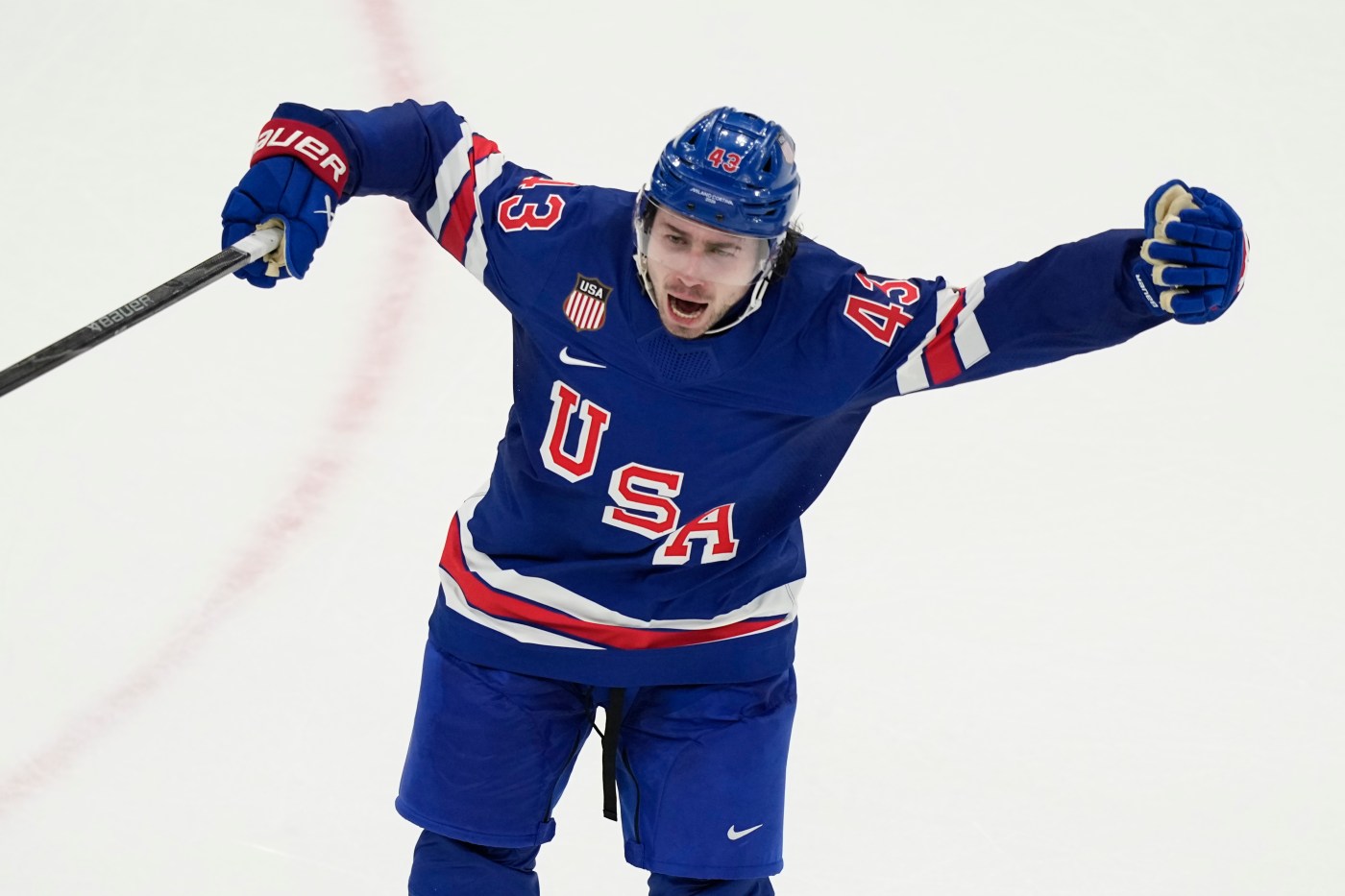
MILAN — When the U.S. gave up a tying goal to Sweden with 91 seconds left in the quarterfinals at the Olympics, even the most seasoned players were on edge.
“That’s as nervous as I’ve been ever in a hockey game,” Dylan Larkin said.
When Canada was trailing Czechia with under four minutes left, guys with gold medals and Stanley Cup rings started to feel butterflies.
“I never had a doubt, but it was getting a little nerve-wracking,” Drew Doughty said.
After plenty of nerves, the U.S. and Canada are moving on to the semifinals, though it took a roller coaster of emotions to get there.
Quinn Hughes scored in overtime to put the U.S. past Sweden 2-1 after Mika Zibanejad scored to tie it late.
“Just relief,” Hughes said.

Earlier Wednesday, Nick Suzuki tied it for Canada late in regulation against Czechia, and Mitch Marner won it 4-3 in overtime to avoid what would have been a stunning early exit.
“It was just all relief,” Canada’s Macklin Celebrini said after scoring three minutes in and then assisting on Marner’s goal. “A weight lifted off our shoulders.”
Finland also escaped an upset bid by rallying to beat Switzerland 3-2 in OT. Sweden is going home early from a tournament that did not go as planned for a team with a full roster of 25 NHL players, while upstart Slovakia is making another improbable run at the Games.
After Canada did its part, the U.S. bounced back from Zibanejad scoring to keep alive the possibility of the North American rivals meeting in the gold medal game Sunday. Goaltender Connor Hellebuyck stopped 28 of the 29 shots he faced, none more important than a Grade-A chance by Lucas Raymond during the second period.
The U.S. will face Slovakia in one semifinal on Friday night. Just before that, also unbeaten Canada plays Finland in the other.
“It’s gonna be an extremely hard test,” Hughes said of Slovakia. “They’ve been rolling. They’re competitive. They’re fast. Doesn’t matter how many superstars you have, just the desperation level’s so high. It’s Game 7 every night now.”
How Olympic OT works: Three of the four men’s hockey quarterfinal games Wednesday going past regulation provided a reminder of how overtime rules work at the Olympics.
U.S. coach Mike Sullivan and his staff talked to players about International Ice Hockey Federation overtime rules.
“We did address overtime at the start of this tournament because we felt at some point it was going to play a role,” Sullivan said. “As a coaching staff, we prepared for that. We had a video session on it.”
The rules to decide games change as the tournament unfolds. All of the round-robin games on the men’s and women’s sides followed NHL rules: 5 minutes of 3-on-3 OT, followed by a shootout.
In the single-elimination knockout round from the qualification playoff and the quarterfinals into the semifinals and the bronze medal game, teams play 10 minutes of 3 on 3 before going to a shootout, also with a minimum of five skaters each.
The gld medal game can no longer be decided by a shootout. When the U.S. beat Canada in the women’s final in 2018 in South Korea, they did so in a thrilling shoutout. That’s no longer possible. The gold medal game now goes to the format the NHL uses in the Stanley Cup playoffs: sudden-death, 5-on-5 overtime until someone scores a goal.