
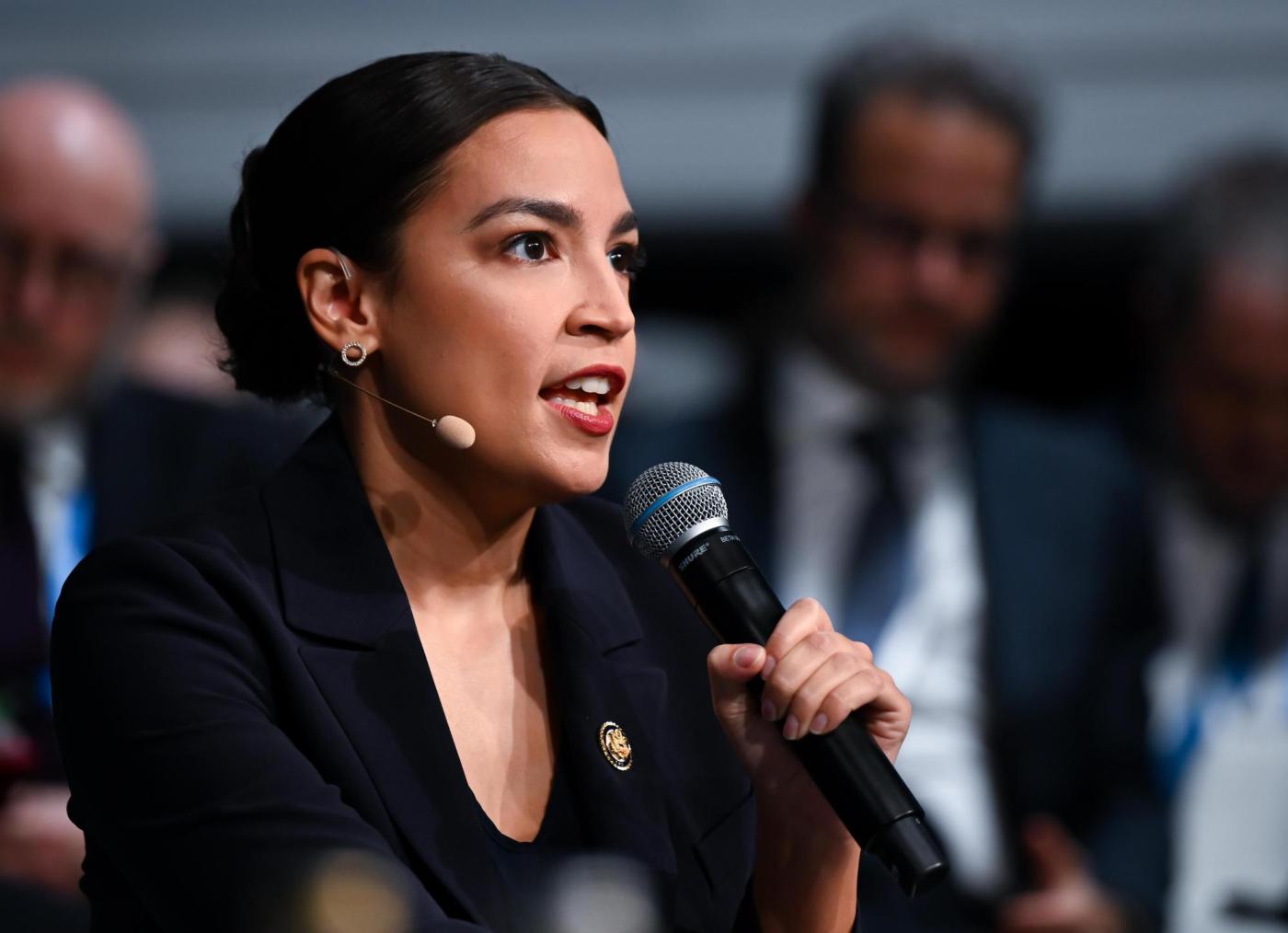
MUNICH — Rep. Alexandria Ocasio-Cortez, D-N.Y., a progressive who made a name for herself focused on economic problems at home in the United States, might have seemed an odd fit for the Munich Security Conference, an annual gathering of foreign leaders and diplomats focused on international security.
But at two Friday panels, she tied worsening income inequality to the rise of authoritarianism, weaving her working-class worldview into a broader message about combating far-right populism and strengthening relationships with Western allies. Everyday people, she argued, were turning away from democracy because wealthy elites had failed to address their needs.
“Extreme levels of income inequality lead to social instability,” she said, adding that it was an “urgent priority that we get our economic houses in order and deliver material gains for the working class, or else we will fall to a more isolated world governed by authoritarians that also do not deliver to working people.”
Ocasio-Cortez has stepped up her visibility in recent months as a leader for Democrats as they oppose President Donald Trump. Speculation about her future political ambitions — she has long been considered a potential presidential candidate — was rife in Munich. Her mere presence was scrutinized as a hint that perhaps she was considering a White House bid and brushing up on world affairs.
“So when you run for president, how are you going to impose a wealth tax?” asked Katrin Bennhold, a New York Times reporter who moderated one of the panels. Ocasio-Cortez laughed and shook her head.
The visit also demonstrated the relative foreign policy inexperience of Ocasio-Cortez, who has made a few overseas trips since taking office but does not sit on any House committees devoted primarily to world affairs. She struggled at times to formulate succinct answers at a nighttime panel session, during which she was asked probing and specific questions about how to respond to international crises.
Questioned about whether the United States should send troops to defend Taiwan if China invaded the island, she stalled for roughly 20 seconds before offering a substantive response.
“I think that, uh, this is such a, a — you know, I think that — this is a, um — this is of course, a, uh, a very long-standing, um, policy of the United States,” Ocasio-Cortez said, before saying that the country should try to avoid reaching that point with China in the first place.
It was a striking moment from a self-assured legislator who is normally nimble at answering impromptu questions from reporters on Capitol Hill, and conservative critics seized on the stumble online. Earlier in the day, she also made a reference to the “Trans-Pacific Partnership” — later correcting that on social media to “trans-Atlantic.”
Ocasio-Cortez was quicker to respond to questions about other foreign policy matters, such as whether she would support military strikes on Iranian nuclear facilities — “There’s still so much runway, so much more we can do to avoid that scenario,” she said — and whether the U.S. should reevaluate aid to Israel. Unconditional aid had “enabled a genocide in Gaza,” she replied.
A host of other Democrats, including some seen as possible presidential contenders, also traveled to Munich, seeking to offer reassurances that their party remained committed to European allies. Trump has shaken the Western world by pulling away from NATO, seizing Venezuela’s president in a military operation, mulling an invasion of Greenland and threatening retaliatory tariffs against countries that defy him.
Gov. Gavin Newsom of California, who also spoke at the Munich conference, promised that his state was a “stable and reliable partner” in the battle against climate change, while another speaker, Sen. Chris Murphy of Connecticut, condemned Trump for engaging “in a consistent campaign to alienate our friends in Europe.” Other possible 2028 Democratic presidential candidates in attendance at the conference included Sens. Ruben Gallego and Mark Kelly of Arizona, Gov. Gretchen Whitmer of Michigan and Gina Raimondo, the former commerce secretary.
Ocasio-Cortez sounded strongest when drawing a direct contrast with Trump’s vision of the world.
“They are looking to withdraw the United States from the entire world so that we can turn into an age of authoritarians that can carve out a world where Donald Trump can command the Western Hemisphere and Latin America as his personal sandbox, where Putin can saber-rattle around Europe,” she said. She urged the United States to instead deepen its bonds with allies and recommit to global projects like the U.S. Agency for International Development, the aid agency Trump dismantled.
And she suggested that monopolistic corporations with huge market shares and wealth were also to blame, arguing that billionaires were “throwing their weight around in domestic politics and in global politics as well.”
An earlier panel with Ocasio-Cortez included Petr Pavel, the president of the Czech Republic; Manfred Weber, the president of the European People’s Party; and Daiana Fernández Molero, a member of Argentina’s legislature. But Ocasio-Cortez was clearly the draw, with conference attendees buzzing about her presence. Audience members at the panel checked their phones at times when someone else was speaking, then perked up as she weighed in.
Düzen Tekkal, a German human rights activist in the audience, said she had been impressed by Ocasio-Cortez. “She’s strong,” Tekkal said. “It’s important that voices like her become powerful.”
In the later panel, Ocasio-Cortez and Whitmer sparred with Matthew Whitaker, Trump’s ambassador to the United Nations, who defaulted repeatedly to praising the president’s approach. At one point, Ocasio-Cortez sidestepped an opportunity to get tough on China, using the opportunity to instead critique the Trump administration’s positioning on the world stage.
“If you want to assert oneself as a global competitor, the kinds of things that one would do in order to really assert that position is investments in science and technology,” she said, criticizing Trump’s cuts to scientific research grants. And she noted that the United States had cut its investment in renewable energy, while China, which like the United States consumes a large amount of fossil fuels, “invested dramatically in wind and solar.”
Whitmer tied many of her answers back to the manufacturing industry in Michigan, even saying at one point that “the two that I am on the panel with are much more steeped in foreign policy than a governor is.” But she appeared poised and avoided any shaky moments.
Julius van de Laar, a political strategist for left-leaning parties in Germany, said he was fascinated to see Ocasio-Cortez, known for her positions on economic issues, being “tested and challenged” on foreign policy.
“The question about Taiwan — someone who is so quick on their feet, that always has an answer on the ready — it appeared like it took some four-dimensional political chess in her head to figure out the right response,” he said.
With so many potential presidential contenders in attendance, van de Laar said, it “almost appears as if Munich turned into Iowa,” a reference to the caucuses where White House hopefuls flock. And for many of them, he said, it felt like “Munich University — getting sped up on foreign policy.”
Whether Ocasio-Cortez’s halting moments will dent her politically in the long term is unclear. American voters have twice elected Trump, who is hardly a foreign or domestic policy expert and often stumbles far more than she did Friday. Her slips could ultimately be outweighed by the practice she is getting in speaking about tough international issues, and perhaps by her star power.
Fernández Molero, the Argentine politician on the earlier panel, said she did not agree with Ocasio-Cortez on every issue. For instance, she said she had been encouraged by Trump’s ousting of Nicolas Maduro, the former authoritarian leader of Venezuela.
But Fernández Molero said she appreciated that they shared similar goals, and she snapped a selfie with Ocasio-Cortez as they waited to take the stage — even though she knew some of her followers might not approve.
“If I put the picture with her on Twitter, probably many people will say, ‘Oh, you’re with a socialist, with a leftist,’” she said.
But would she post the photo anyway?
“Yeah, of course,” Fernández Molero said. “I mean, she’s AOC!”
This article originally appeared in The New York Times.