
As thousands of Connecticut residents cast their ballots in local elections Tuesday, they were greeted by the state’s new tabulator machines.
The old machines for counting residents’ votes were decades old — made before the iPhone was invented — and parts to repair them are no longer being made, officials have said. Due to heat sensitivity and frequent breakdowns, the machines were no longer reliable.
The state purchased 2,500 new tabulator machines for $20 million, including 2,402 standard machines and 51 more advanced machines to be used in high-turnout areas. Paper ballots continue to be used and the new machines are not connected to the internet to ensure security.
While the new machines work like the old, officials said, some voters were confused, causing some delays and concern. But the issues were minor, Secretary of the State Stephanie Thomas said in a pair of briefings on Election Day.

“We’ve have had a fairly smooth Election Day, a couple of minor issues throughout the morning like we see in every election but so far our very well-trained registrars, our IT team, the new tabulator company — everyone has been on top of their game so we’ve been able to smooth everything out with no interruption in voting,” Thomas said.
“One issue we saw this morning, an election worker set a very secure password but forgot what it was so we had to reset the system,” she said. In another case, a registrar “got a notification that Eversource was performing a planned outage so we had to get on the phone and let them know, ‘hey, today is Election Day so this might not be the best day for that.’”
One glitch impacted the new tabulators, she said, likely due to the writing implements that were used to fill out ballots.
Some polling places, Thomas said, “aren’t using the recommended pen for filling out the ballots, so when it scans through the tabulators, it’s causing dirt on the head but luckily we have almost 40 technicians from the tabulator company here in Connecticut today deployed around the state so they were able to go, do a quick cleaning and eradicate that quickly.”
In all, Thomas said, seven of the 1,200 new tabulators in use across the state had issues Tuesday.
“There have been some reports both to the State Elections Enforcement Commission and also to our office about what happens when a tabulator goes down,” Thomas said.
Emergency procedures ensure that voting never stops, Thomas said, including that if a tabulator goes down, voters can put ballots in the auxiliary bin, part of the tabulator equipment.
“We had reports of that happening but a few voters called saying ‘is this what’s supposed to happen or is this unusual,’” she said, assuring that the procedure is normal.
There were no known issues, she said, that could impact race results.
High-profile races
Result were still coming in Tuesday evening in two blue-collar central Connecticut cities where Democrats were looking to win back control of city hall while Republicans sought to maintain power.
Political observers were keeping a close watch on New Britain’s mayoral race because Tuesday was the first time in 12 year that Democrats had a chance to run a candidate against someone other than Erin Stewart, who proved wildly popular across six mayoral elections in her hometown.
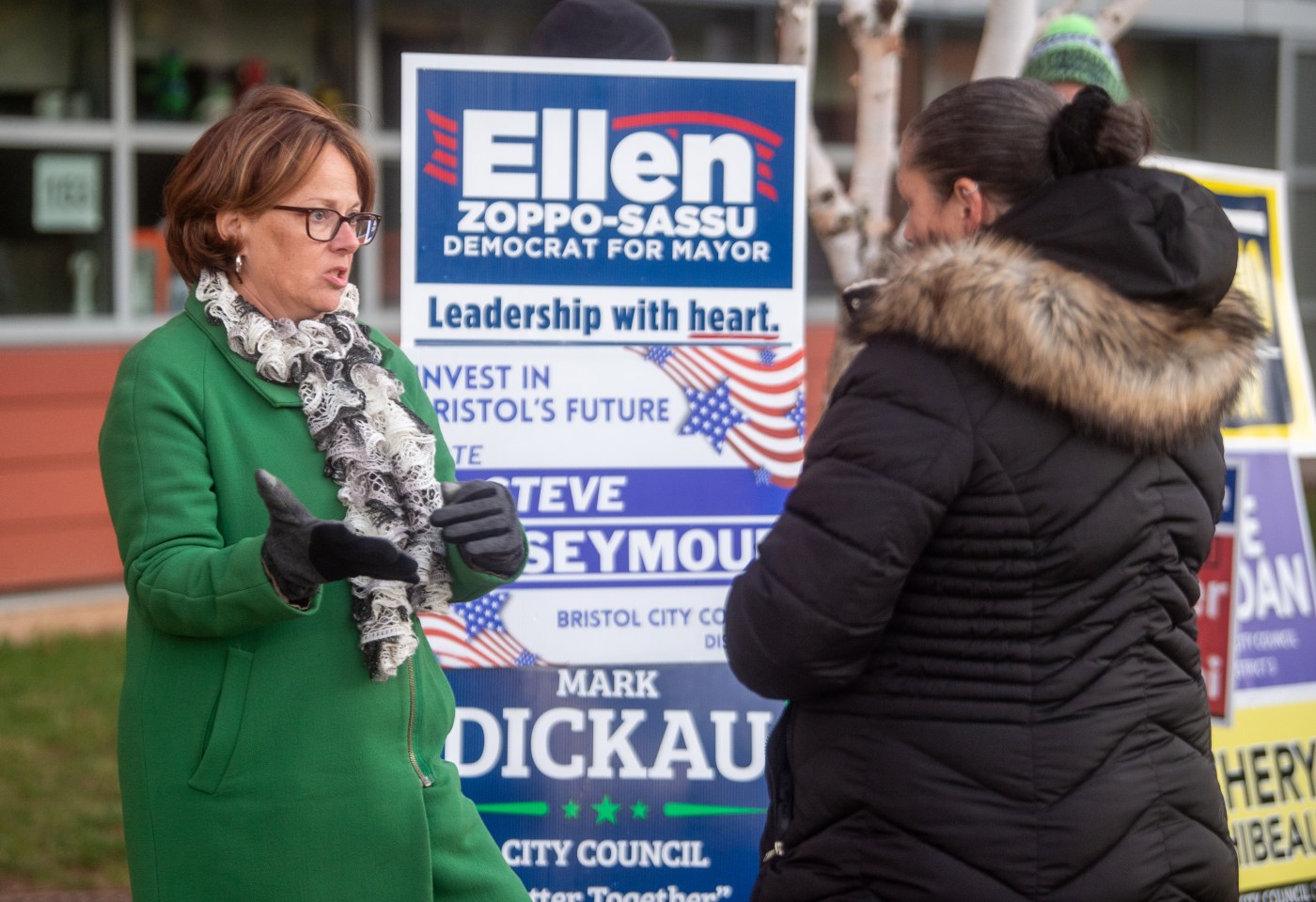
And in Bristol, Democrats were hoping Ellen Zoppo-Sassu could flip the city to blue after Republican Mayor Jeff Caggiano built a solid GOP base in 2021 following several election cycles where voters switched control back and forth between the two parties.

Both parties in both cities were busily working “get out the vote” drives during the day, trying to persuade more of their supporters to cast ballots before 8 p.m. Despite an extended early voting season, turnouts were on track to be in the usual range for municipal elections, with far fewer than half of eligible voters showing up.
In New Britain, early afternoon voter turnout was around 16%, while Bristol was at about 12%.
Elections where only local offices are on the ballot typically draw way less voter interest than contests to choose state legislators, governors, Congressional representatives, senators or presidents. Bristol is fairly representative of that statewide pattern: Just 33.3% of its voters took part in the 2023 municipal election, compared to nearly 77% in last year’s presidential race.
On Tuesday, Bristol voters had a choice between two very well-known candidates.
Zoppo-Sassu, who served for years as a city council member, ran for mayor in 2015 and lost by a thin 128 votes to Republican Ken Cockayne. When his administration hit a series of scandals that infuriated taxpayers, though, she charged back in the 2017 race crushing him by nearly 2,400 votes. She coasted to re-election in 2019, turning back Republican Dante Tagariello by a roughly 1,850-vote margin.
But in 2021, Caggiano defeated her by about 600 votes, and then scored a crushing re-election win over Democratic challenger Scott Rosado with a roughly 2,600-vote cushion.

Bristol, once a solidly Democratic power base, has edged to the right over the past 20 years, despite a hard shift to blue in the 2017 election. Observers are eager to see how voters decided a race between two extremely well-known candidates.
A different scenario faced New Britain voters, who were filling an open seat in the mayoral race. Stewart first won in 2013 with a devastating victory over Democratic incumbent Tim O’Brien, and she easily won each of her five re-election bids since then.
Privately, some Democratic and Republican leaders alike have speculated that she’d have had no trouble winning a seventh term this year; however, she had announced last winter that she’d be leaving to pursue a campaign for governor in 2026.
Stewart’s 2013 victory was considered historic because she was the city’s youngest mayor and only the second woman to hold the office.
Politically, it was her long run of re-election victories that counted even more: She has built a reputation by being a Republican consistently polling strongly in a poor, diverse and heavily Democratic city. Even when Democrats fielded challengers with deep organized-labor credentials, the local police union, AFSCME’s Council 4 and others either backed her or made no endorsement.
This year, Alderwoman Sharon Beloin-Saavedra — Stewart’s political protege — was the GOP’s pick to try to keep city hall under Republican control. Democrats tapped long-term state Rep. Bobby Sanchez to flip it.
To Republican and Democratic leaders alike, the results could signal whether Stewart has permanently changed the political dynamics of the city, which once was considered a Democratic stronghold.
Both candidates are known in the city: Beloin-Saavedra is a veteran alderwoman and former school board chair, and Sanchez built a name by bringing state aid for New Britain school construction projects when he was co-chair of the General Assembly’s education committee.