
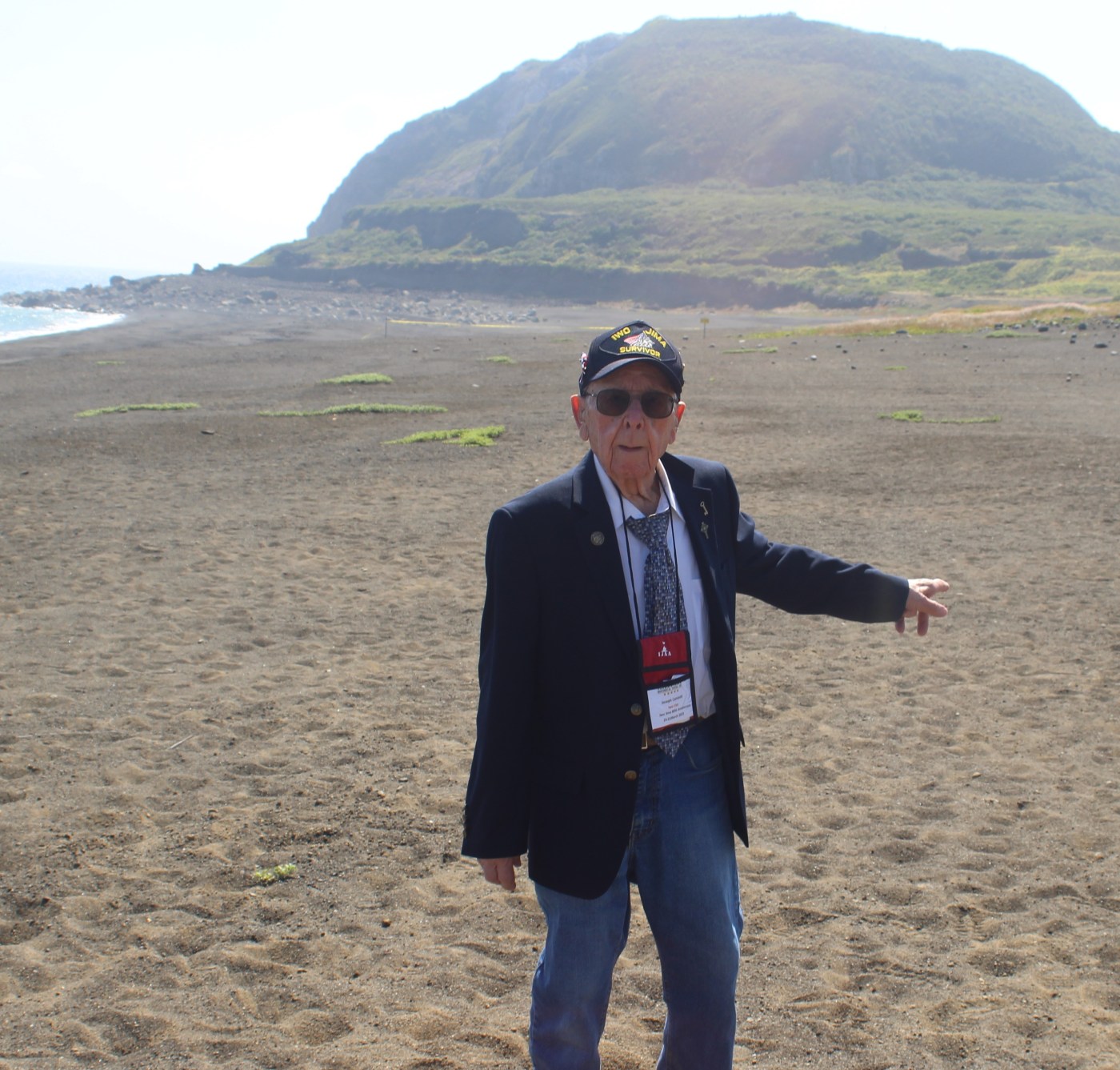
Joseph Caminiti of Bristol sums up his service with the U.S. Marine Corps in a way that likely would not surprise any member of America’s Greatest Generation.
“We all had a job to do and we did it,” said Caminiti, who at age 101 still drives and still works out each day and then heads back to the home he shares with his wife, Germaine, 99. The couple has been married for 80 years he said, and she still makes dinner.
“The people who died are the real heroes of this war [WWII],” Caminiti said. “The lucky ones made it back.”
To honor the U.S. Marine Corps 250th anniversary, those who served, and those who fought in the battle of Iwo Jima, Caminiti is to travel to Washington, D.C., the weekend of Feb. 20 to take part in the National Iwo Jima Remembrance at the 81st Iwo Jima Reunion. The island is now called Iwo To, a change that took place in 2007.

Neal Supranovich, the historian for the American Legion, Post 2, Seicheprey, Bristol, the second oldest American Legion Post in the state, historian for the Bristol Veterans Council, and a friend to Caminiti, himself spent four years in the active Army, with the 25th Division stationed on Hawaii.
“I trained over the same grounds of World War II veterans like Edward Riccio, the last Pearl Harbor survivor in Bristol and Joe Caminiti, a Marine who did some training in the Hawaiian Islands,” Supranovich said. “I spent three weeks on a Navy ship learning about amphibious landing by the Marine Corps, cross training between the Army and Marines. We shared ranges and training areas.”
Supranovich also spent six months as a jeep scout, and later went to Texas to train on armored personnel carriers. And when he returned to Bristol, he was in Company C of the National Guard, then was part of the Connecticut Civil Air Patrol, Auxiliary of the U.S. Air Force for 10 years, most of that time as squadron commander, historian and public affairs officer, as well as search and rescue and disaster relief instructor, he said.
The Bristol American Legion began forming while the World War I Bristol soldiers were still in France, he said.
“Joe assists me with honoring and remembering veterans of all wars and conflicts,” Supranovich said. “I asked Joe what he wanted for his 100th birthday. He gave me two items: first, he wanted to know how many Iwo Jima Survivors were left. and for his 100th year doing more than he has ever done.”

He also is to take part in a national ceremony to be held by the Iwo Jima Association of America with help from the U.S. Marine Corps and the U.S. Navy, while also honoring the 100 from Connecticut who died on the island, including four from Bristol. The plan is for him to help place a wreath on the U.S. Marine Corps Monument.
“Once a Marine, always a Marine,” Caminiti said.
He was careful to note others who served in World War II from other branches of the military.
Caminiti’s military service began in 1942 when he joined the Marine Corps. His family had lived in West Virginia during the Great Depression, as his dad was working in coal mines there, but they had moved back to Connecticut when he was about 6, Caminiti said.
He left Bristol High School and joined up, (he had to wait until he was 18) went to boot camp at Parris Island and then Marine Corps Base Camp Lejeune, and California, he said.
He was part of what was then known as the 3rd Amphibian Tractor Battalion. They were sent to New Caledonia in the Pacific Ocean, then to Guadalcanal and Guam, he said. It was in February 1945 that they landed at Iwo Jima.
What happened on Iwo Jima, made famous in part due to the valorous flag raising atop Mount Suribachi, was “one of the bloodiest battles in Marine Corps history. The bloodbath horrified Allied military planners and American citizens, who feared a far greater slaughter during an invasion of Japan’s home islands,” according to the National World War II Museum.

Caminiti, whose memory remains sharp, spoke of his buddies and being part of the “10th wave” that landed there, on an island of “volcanic ash,” and the amphibian vehicles they used.
“It was the worst battle they ever had,” Caminiti said, noting nearly 7,000 Americans were killed.
“We needed that island for an airport, they needed that island,” he said, noting it was heavily tunneled and had been heavily bombed before the Marines landed.
According to previous Courant reporting, the island’s airfields were the big draw for U.S. strategists, and the Japanese were using Iwo Jima as an airbase and a station to warn forces to the north of American bombing raids from the Marianas. The big new stick in the American air arsenal was the B-29 Superfortress, which could carry four tons of bombs on long-range sorties. Missions from the Marianas to Tokyo went straight over Iwo Jima, and U.S. planners decided the island must be taken to serve as a refuge for the monster bombers and a base for fighter escorts. Iwo, as one historian noted, was like a giant aircraft carrier in just the right place, the Courant previously reported.
Japanese commander Lt. Gen. Tadamichi Kuribayashi’s plan was to let the Americans come onto the island then unleash the furor. His troops were dug into a lacework of tunnels and gun emplacements and most had survived the pre-invasion bombing, the Courant has reported.
When the invaders were 200 to 300 yards inland, enemy machine guns sputtered and the air filled with steel. From the north and from the island’s southern highpoint, 550-foot Mount Suribachi, shells and small arms fire rained on the Marines, the Courant reported.
The Battle of Iwo Jima lasted from Feb. 19 to March 26, 1945, according to the Pacific War Museum.
“To me the real, real heroes are the people who didn’t make it back,” Caminiti said, adding that it is difficult to explain exactly what it was like fighting on that island to anyone who was not there.
Caminiti said he was discharged in late December 1945, but then was recalled during the Korean War. He was married and had a child by then, he said. During that tour, he was kept at Camp Lejeune and was not sent to Korea, he said.
Caminiti and his wife raised three children, two of whom have died, he said. His surviving son is 78, he said.
Caminiti noted he had returned to Iwo Jima in 2025. “The island had changed in 80 years,” he said. “It was all volcanic ash island then. Now there’s vegetation.”
He also has returned to Guam, which had changed a great deal too, and is more like a resort now, he said.

Supranovich said that after he spoke to the office of U.S. Sen. Richard Blumenthal, that office contacted the US Marine Corps and they contacted the Iwo Jima Association of America, which then offered Caminiti the trip to Iwo Jima, now known as Iwo To. At a stop on Guam on the way, Caminiti learned from the island’s governor that he is an official Guam Liberator due to what he did to liberate the island, Supranovich said.
On Iwo To, “we ended up being a part of an Olive Branch of Peace presentation to the Japanese people,” Supranovich said. “Joe physically placed one of three wreaths on behalf of the United States on the ‘Reunion of Honor’ monument with the prime minister of Japan. It is the first time in the history of Japan a prime minister has ever set foot on Iwo To, known back then as Iwo Jima. Let alone place a wreath.”
Supranovich said the monument was donated by the son of John Wayne and they learned there were less than 200 remaining battle survivors across the nation, and Caminiti got to meet some of them.
“Joe is walking history,” Supranovich said. “Joe witnessed the American flag raise up and over the crest of Mt. Suribachi. He saved lives of fellow Marines during the battle and was not a medic.”