
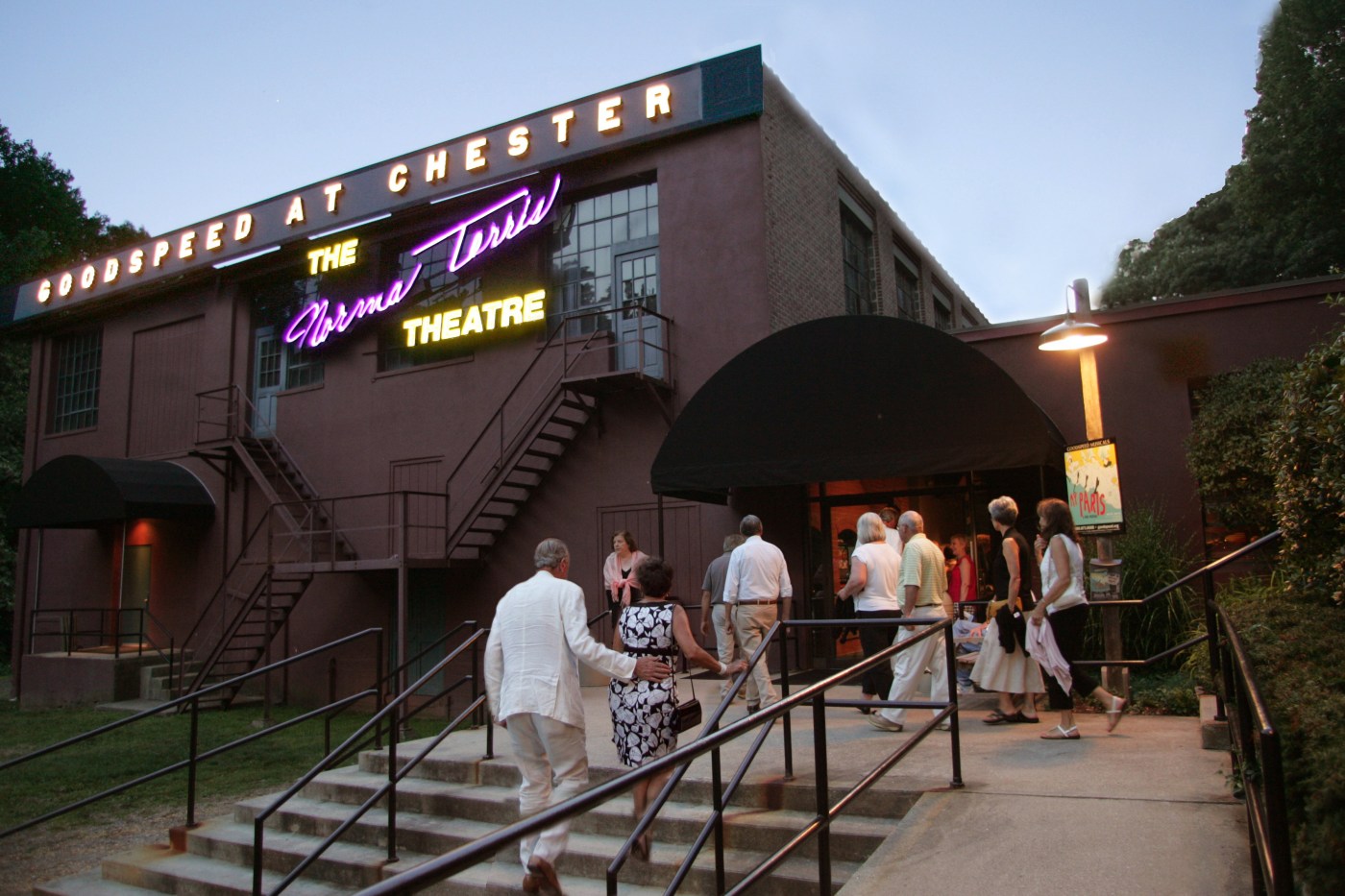
Goodspeed Musicals recently announced a “temporary pause” in productions at its smaller Terris Theatre in Chester. The space may reopen as soon as next year, but no shows are planned there for 2026.
A season had not been confirmed or announced yet, so there have been no cancellations or abrupt changes in production, just an unexpected lull. The season at the Goodspeed Opera House, which is double the size of the Terris Theatre and the flagship of the Goodspeed Musicals empire, was announced earlier this year and is unaffected by the pause.
The news was surprising. This is the time of year when Goodspeed usually unveils its Terris schedule, not the lack of one. Recent news from the Terris suggested steady growth rather than a pause. Ticket sales were strong for both last year’s offerings: The song revue about senior life “About Time” from the established songwriting team of Richard Maltby Jr. and David Shire and the Australian musical farce “The Great Emu War” by Cal Silberstein and Paul Hodge.
The current hiatus is just the latest hiccup in the 42-year history of the Terris. Goodspeed transformed a former knitting needle factory into an exquisite 200-seat theater, named it for the 1920s Broadway star and longtime Goodspeed patron Norma Terris and designated it as a place to develop and premiere new musicals.
Over the years, musicals as diverse as “13” (the Jason Robert Brown musical which launched the professional career of Ariana Grande), “By Jeeves” (P.G. Wodehouse’s Wooster and Jeeves characters musicalized by Andrew Lloyd Webber and Alan Ayckbourn) and “Cyrano” (Erica Schmidt’s adaptation of “Cyrano de Bergerac” starring Peter Dinklage, which became a major motion picture) all got workshops at the Terris. Some shows at the space were essentially brought in by outside producers who were mainly seeking a suitable place to rewrite and rehearse a show away from the prying eyes of New York City. Others were near and dear to the Goodspeed.

“The Great Emu War,” which ran in October 2025, will likely be the last show staged at the Terris Theatre in Chester until 2027. Goodspeed Musicals has paused operations at the Terris while it reconsiders how to best utilize the venue. (Diane Sobolewski)
In recent years, a sizeable number of Terris workshops came from other development programs at the Goodspeed, namely the Johnny Mercer Writers Grove at Goodspeed Musicals, a wintertime retreat for musical theater creators and the Goodspeed Festival of New Musicals, which offers full-length readings of musicals in progress performed by theater students from The Hartt School at the University of Hartford and Western Connecticut State University.
From Dec. 2019, when it hosted the final season of its homegrown holiday musical “A Connecticut Christmas Carol,” until July 2023, when it was a stop on a workshop tour of the COVID comedy with Dolly Parton songs “Here You Come Again,” the Terris was shuttered.
Goodspeed Musicals’ dedication to American musical theater has always had two parallel missions since was founded in the 1960s: Reviving classics or forgotten gems from the century-old art form’s illustrious past and creating new contemporary musical theater works. The shows which put the Goodspeed on the map, including “Man of La Mancha” in 1965, “Shenandoah” in 1974 and “Annie” in 1976, were all new works that went on to Broadway success.
According to Donna Lynn Hilton, who has been the artistic director of the Goodspeed since 2021, the recent Terris situation has “been hitting our bottom line in a very unhelpful way. The model of rehearsing for three and a half weeks then performing for three and half weeks is not sustainable.”
Though shows have sold well and been well received by audiences, it’s a longheld truth in the non-profit theater industry that ticket sales account for only a fraction of the money needed to produce a show. Developing a new show involves additional upfront costs. The risks are substantial, since few new musicals experience the sort of lasting success from which the originating theaters can profit. Hilton laments that very few of the shows at the Terris even get a second production elsewhere. Another major producer of new (though largely non-musical) works in Connecticut, the Yale Repertory Theatre, explicitly builds some longevity into its projects by arranging funding for subsequent productions at other regional theaters or off-Broadway.

The cast of “About Time” at the Terris Theatre. The show completes a trilogy of revues that began with “Starting Here, Starting Now” and “Closer Than Ever.” (Diane Sobolewski)
The pause, Hilton said, gives the Goodspeed “space to look at a number of different models” for continuing. She confirmed her desire to turn the Terris Theatre into a successful, self-sustaining operation that does not drain resources intended for other Goodspeed operations. Among the models she suggested are collaborations with other theaters, a focus on new works that are “more recognizable” and thus potentially more commercial and longer term development plans which include “what’s going to happen to a show after the Terris.”
Hilton described the Johnny Mercer Writers Grove, which has been held since 2013 and is mainly funded by the Johnny Mercer Foundation, and the Festival of New Musicals, as “self-sustaining, also fiscally responsible and not expensive.”
The 2026 Festival of New Musicals was recently held Jan. 16-18 at the Opera House. Last year’s festival was done at the Terris Theatre due to renovations at the Opera House and its grounds.
The festival is like a conference for musical theater geeks of all ages. Besides readings of three new musicals in progress, there are cabaret-style concerts, talks with theater professionals, Q&A sessions with those who work backstage at the Goodspeed and other activities. This year’s event was neatly rethought so it was not as long a slog on Saturday, which lasted from 1 to 11 p.m. instead of 10 a.m. to midnight as in some years.
In many ways, the festival is better set up to acclimate audiences to the special circumstances of watching new works. The readings are done at music stands, scripts in hands with no sets or props and a narrator reading out the stage directions. The show’s writers introduce the performance. It’s abundantly clear that this is a work in progress. Terris shows, on the other hand, can closely resemble finished works, with full scenic design and lighting and sound effects. Since these shows are still finding their feet,t can be disoriented for those at the Terris to get a full theatrical experience but feel understandably that the show could be better. This is one of the conundrums that developers of new musicals face, and Hilton acknowledged that levels of production are a factor going forward at the Terris. The question is, what is the best method to bring a new piece to unprepared audiences?

Jamison Stern and Ali Ewoldt in “Ask for the Moon” at the Norma Terris Theatre in Chester in August 2024. (Diane Sobolewski)
This year is not the first time that Goodspeed has rethought how to use the Terris without altering its main purpose. About six years ago, a schedule was announced where shows would be given a slightly higher level of reading with professional actors and some design but essentially following a standard, cheaper and more efficient staged reading format. Those shows didn’t end up happening due to the COVID pandemic and when the Terris reopened three years later, it was with full productions of new works.
Goodspeed Musicals has other recent interests that may influence how it is using the Terris space. The organization is ramping up its youth and family programming. Earlier this month, it announced a new weeklong summer theater program with theater classes for children that will culminate in a showcase production of “Annie Jr.” performed by the students and directed by Goodspeed’s associate artistic director Michael Fling. The program, called “Goodspeed SummerSong” will run from July 6-10 and is promoted as being “designed for ages 9 to 14” and “perfect for rising stars of all experience levels and abilities.” This is reportedly the first summer youth program in Goodspeed’s history, though the show has created training programs for young performers around specific musicals it has produced such as “Oliver!”
There are already projects being discussed in terms of a 2027 Terris season, Hilton said. Meanwhile, the main 400-seat Goodspeed Opera House isn’t just a venue for revivals and big name shows. Under Hilton, the Opera House went from producing three shows a year to four, and upped the number of new musicals that have premiered on that stage. In 2023, there were Opera House premieres of a new musical about the apostles of Jesus Christ, “The 12,” as well as an adaptation of the movie “Summer Stock.” In 2024, there was the Scottish pop musical “Maggie.” Last year a stage version of the TV movie musical “Mrs. Santa Claus” was announced but had to be canceled. This year, from Aug. 28 through Oct. 18, the Goodspeed is producing the world premiere of “The Snow Goose,” a new musical by Scott Gilmour and Claire McKenzie, who name their partnership Noisemaker as if they were a band. It is based on the novel by Paul Gallico and partially developed at the Johnny Mercer Writers Grove and had a reading at the Festival of New Musicals.
Despite being based on an established literary classic and having already gone through some development at Goodspeed, “The Snow Goose” is nonetheless “a heavy lift for us,” Hilton said. “It is still in development. It involves puppetry.”
The crossbred nature of Goodspeed Musicals’ various developmental programs means that the loss of the Terris Theatre for a year will not shut down the flow of new musicals at the organization. The chance to revise, streamline or otherwise reconsider the Terris operation will hopefully allow for many more new shows in future and even strengthen their viability for moving on to other theaters.
Hilton noted that there are expenses associated with running a large non-proft theater operation that the casual theatergoer does not consider. Besides the two theater buildings, rehearsal studios and a musical theater library, Goodspeed owns numerous buildings in East Haddam where it houses people who work on its shows.
“We had to replace five boilers this year,” she said. “Our audience understands, to a degree, the limitations or challenges we are often facing, but there are still a lot of things we have to do that people don’t know about.”
Sometimes it’s just a problem of scale and expectations.
“We had a really good year at the Terris is 2025,” Hilton said. “‘About Time’ and ‘The Great Emu War’ did very well. Capacity was very good. But the Terris only has 200 seats and these were full productions. By summer, it was pretty clear we needed to take a pause. Ultimately it’s the responsible thing to do.”