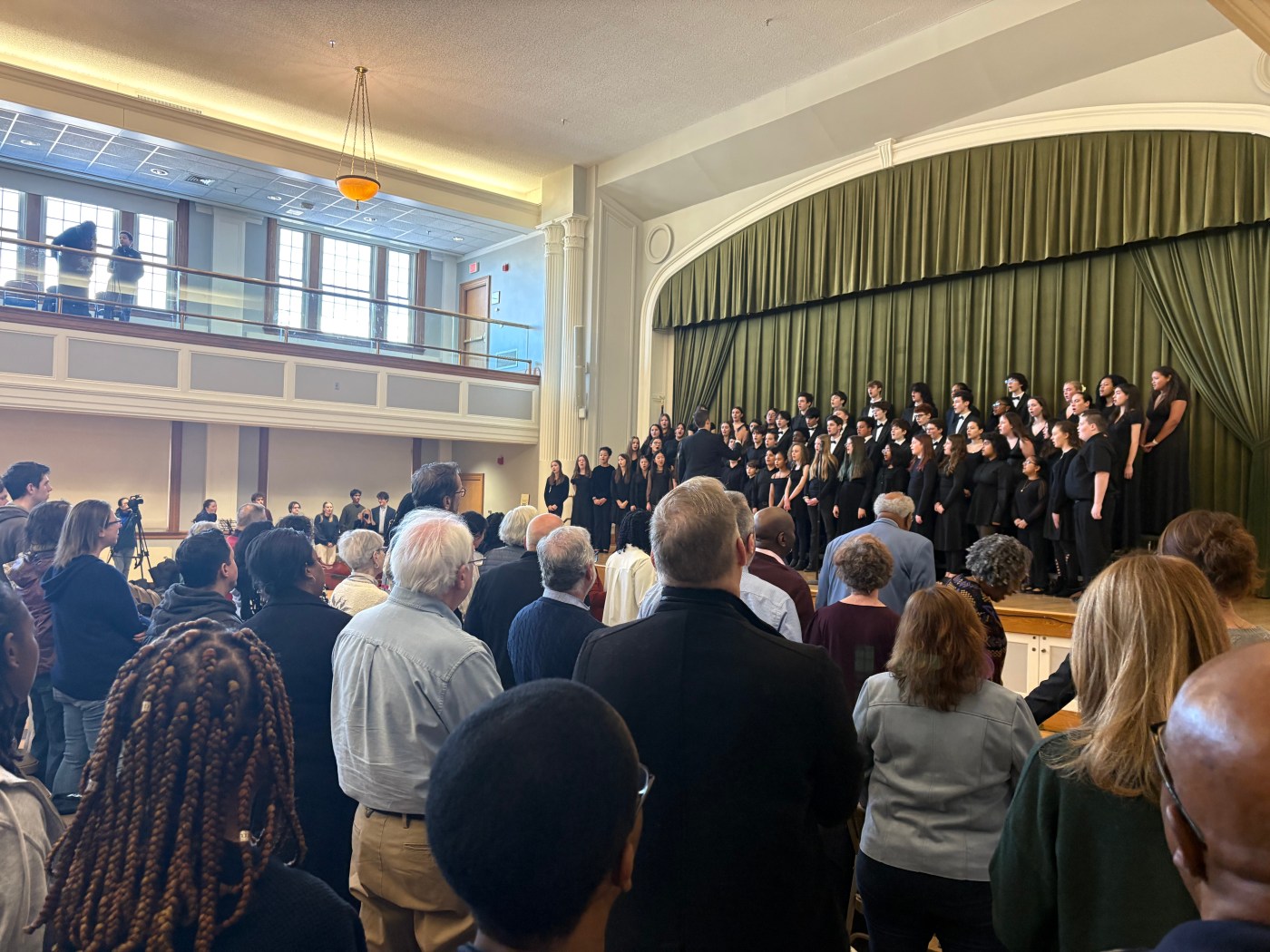
It was a day of celebration and reflection in recognition of the ideals and vision of Dr. Martin Luther King, Jr. with a standing room only crowd.
The 30th Annual West Hartford Celebration of King’s life was marked by many speeches and songs in a tribute to the American icon in front of the many who turned out at the West Hartford Town Hall auditorium.
Many of the themes of the nearly two-hour event were about audacity and mutuality, enduring words King used famously in speeches and writing. King Jr. was felled by a sniper’s bullet in 1968; he was 39.
Audacity was taking form the 7:30 minute mark of King’s 1964 Nobel Peace Prize speech.
“I have the audacity to believe that people everywhere can have three meals a day for their bodies, education and culture for their minds, and dignity, equality, and freedom for their spirits,” King said.
Mutuality was used in the letter from Birmingham Jail in 1963.
“We are caught in an inescapable network of mutuality, tied in a single garment of destiny. Whatever affects one directly affects all indirectly,” King wrote.
The West Hartford annual event finished with the entire auditorium singing “We Shall Overcome.”
Hall High School Jazz Combo, King Philip Middle School’s KP Singers and Conard High School’s Solo Choir all performed throughout the MLK tribute. Artwork, essays and poems from West Hartford students were on display.
Continuing the 30-year tradition, the event honored two West Hartford students, Rowan Thompson of Conard High School and Nybol Bona of Hall High School. Both shared perspectives about King Jr.
“It was beautiful,” West Hartford Mayor Shari Cantor said. “It brought voices from many perspectives and ages.

“I thought it was a very powerful representation of Dr. King’s messages and a reminder of how important it is for us and how essential it is for us to step forward with courage and fight for each other, fight for humanity and have that audacity. We are all connected and it’s so important when we see people being treated unfairly to fight.”
Cantor said this year’s ceremony resonated a little deeper “with people that are seeing so much injustice right in front of our eyes.
“People feel they need to step up, and we all need to be a part of this. It’s up to us, the people, not the people in power,” the mayor said.
Connecticut’s senior U.S. Sen. Richard Blumenthal shared a similar sentiment.
“I’m here to be audacious,” Blumenthal said. “I’m here to make trouble – good trouble. Good trouble is what we need now because we are in the fight of our lives. The fight for our democracy. The fight that we all see day to day. It demands all of us, whatever our background, race or religion to get it together. Good trouble is what John Lewis called on us to do in our daily lives and also in our public lives.”

“I’m going to continue the fight that Martin Luther King embodied, which is affordable housing, decent living and health care,” Blumenthal said. “He died while advocating for sanitation workers in Memphis. Today, I wonder what Martin Luther King would say about what is happening in Minnesota and about the brutality from our own government. I think back to the Edmund Pettus Bridge and the civil rights marchers on that bridge saw the same brutality.”
Blumenthal recited King Jr.’s quote that the “The arc of the moral universe is long, but it bends toward justice.” Blumenthal added. “But what he didn’t say is that it takes a few benders to do it.”
Longtime West Hartford residents Drs. Elena DeVaughn and Booker DeVaughn were honored at the event with the second Earl Exum Servant Leader Award.
“It was very special and I had no idea this was coming,” Booker DeVaughn said. “It’s really nice to be recognized by the community. It’s special for us to receive the Earl Exum award because he was a very special person. To have something that is named for him is very special.”
“It’s an honor and a humbling experience,” Elena DeVaughn said. “Community, is reaching out and helping and being there for others. For us, that is what it’s all about.”
The couple was on the original planning committee for the yearly MLK event in the town each year. Booker DeVaughn also served on the committee for 17 years and said he was proud to see the event still going strong.
“Drs. Booker and Elena DeVaughn embody the spirit of service, education, and community that the Earl Exum Award seeks to honor. Together, the DeVaughns have enriched public understanding of African American history through research, presentations, and exhibits. They are generous in every way, from philanthropy to volunteerism with many non-profit organizations. They are sought-after leaders in the community, and we are lucky to have them,” Cantor wrote in a statement about the DeVaughns.

Dr. Fiona Vernal served as the keynote speaker. She is the associate director of the Africana Studies Institute, associate professor of History and Africana Studies, and the director of Engaged, Public, Oral, and Community Histories at the University of Connecticut.
Vernal spoke about Dr. King’s time in Connecticut in 1944, as a 15-year-old and again in 1947, both while working on a Simsbury tobacco farm. Vernal spoke about the letters Dr. King sent to his parents from Connecticut as a teenager.
“Although his life was cut short, he left a treasure trove of letters and speeches,” Vernal said. “He also left behind letters to his mother and father as just a teenager. Dr. King talked about the mundane in those letters. He talked about working in the kitchen and he talked about because he worked in the kitchen, he had access to more food. He spoke about going to Sunday services in a local church in Simsbury. He reminds his father that he was behaving himself.”
King Jr. also asked his mother in letters to send fried chicken and rolls. He also said in the letter that he worships alongside white people in a Simsbury church and ate at one of the finest restaurants in Hartford.
“Oral history from other tobacco workers showed that Connecticut was not a racial haven in the 1940s, including Simsbury when Dr. King was there,” Vernal said.
Vernal said Dr. King returned to Connecticut in 1959 to discuss integration at the University of Hartford and then again in 1962 at the Festival of Faith and Freedom.


Vernal said Dr. King’s dream was always about the next generation while looking at the students in the crowd.
“He would say to young people, ‘No. 1 in your life should be a deep belief in your own dignity, your worth and somebodiness. Always feel that you count. Always feel that you have worth and always feel that your life has ultimate significance,” Vernal siad.