
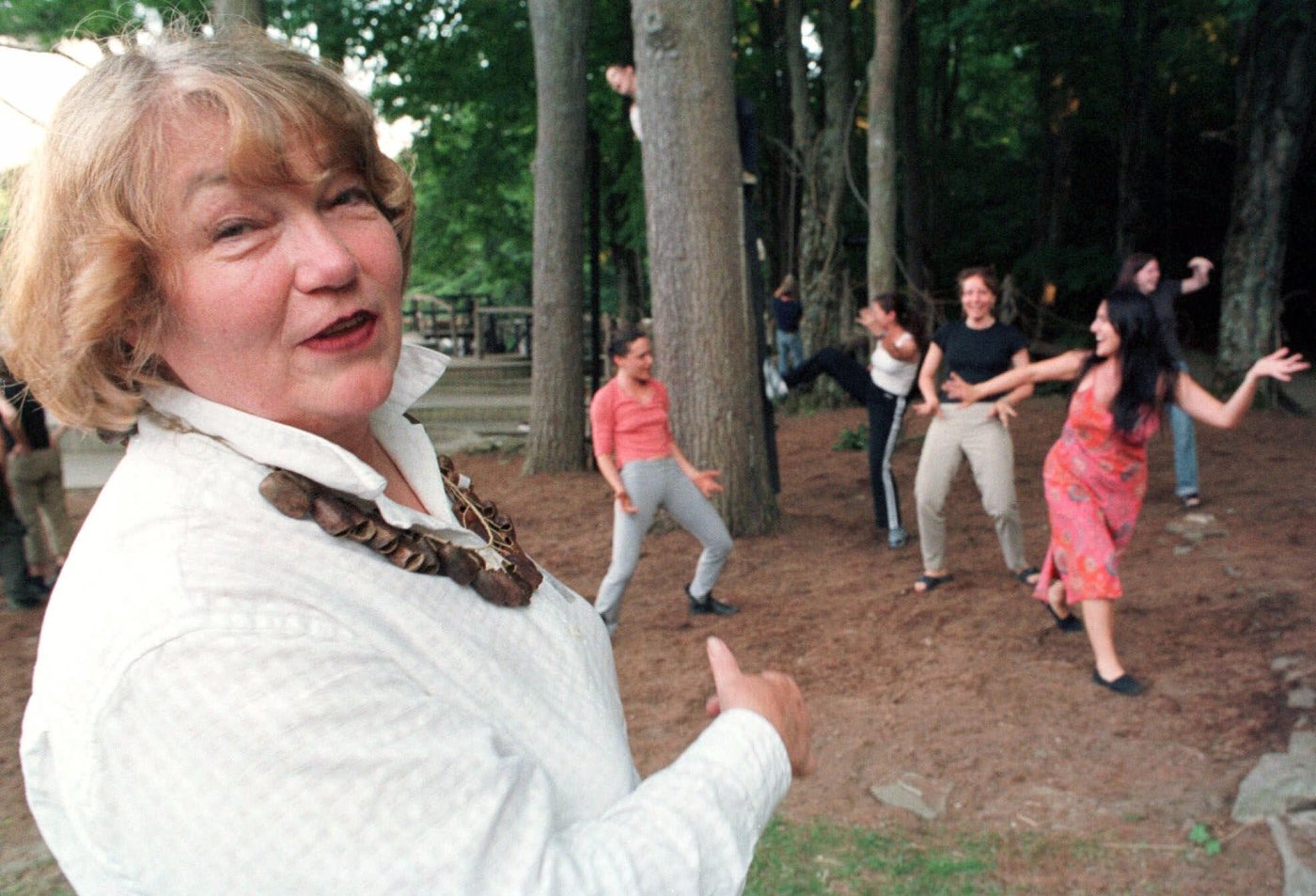
Tina Packer, who crafted singular interpretations of Shakespeare plays for a theater she founded over 50 years ago in Lenox, Massachusetts, died on Jan. 9 at the age of 87.
Her work had a massive impact on how Shakespeare was appreciated and performed in New England. This includes Connecticut, where Packers’ disciples have acted, directed, produced and taught at theaters throughout the state.
“We’ve lost a titan of the theater,” Melia Bensussen, artistic director of Hartford Stage, posted on social media. “Packer made Shakespeare an American art form, adding a muscularity and spontaneity to the craft of performing the Bard. She was a generous teacher, a great mentor to so many, and her influence will continue to be felt for generations. I am lucky to have known her, felt her passion for continuing to make Shakespeare’s works feel fresh and alive to all audiences.”
Packer, who was born in England, studied and acted at the Royal Academy of Dramatic Art and the Royal Shakespeare Company where she perceived there were gaps in how Shakespeare’s plays were being fully explored and accessed. She sought a platform where she could put her own theories to the test, and found it in Lenox, where in the mid-1970s she founded the Shakespeare & Co. theater and training program.

Tina Packer stars as Lettice Duffet in Shakespeare & Company’s production of “Lettice and Lovage,” at Spring Lawn Theatre in Lenox, Massachusetts.
(Kevin Sprague)
( Part 2 — Summer Arts 2004)
Packer directed dozens of shows over the years and worked with hundreds of theater students, inspiring thousands of audience members as well. Shakespeare & Co. has become a major cultural institution in Western Massachusetts. Besides a full summer of performances each year, which includes new and contemporary works besides the Elizabethan classics, Shakespeare & Co. runs education programs, creates theater projects with juvenile offenders, holds festivals and engages into other community outreach.
The most notable influence that Packer had on Connecticut is visible every summer in New Haven’s Edgerton Park when Elm Shakespeare Company produces its weeks-long runs of Shakespeare plays.
The company was founded in the 1990s by New Haven-based actor James Andreassi, who acted for Packer in a 1996 production of the George Bernard Shaw comedy “The Millionairess” that starred Raquel Welch. About a decade ago, Andreassi stepped down as artistic director and passed the reins to Rebecca Goodheart, who has many connections to Packer. Goodheart did some of her training as a teacher at Shakespeare & Co. and served as Packer’s executive assistant for five years. She later returned to the company to teach intensive workshops and serve on committees. Her book on Packer’s husband, Dennis Krausnick, who co-founded Shakespeare & Co. and was its longtime director of training, will be published in April.
For her first production as artistic director of Elm Shakespeare in 2016, Goodheart brought Packer — who had stepped down as artistic director of Shakespeare & Co. in 2009 — to New Haven to direct “A Midsummer Night’s Dream.”
“I talked to Tina almost every week,” Goodheart said. “She was the most influential person in my life after my parents.”

Longtime Shakespeare & Co. member Kristin Wold (center, in gown) starred as Titania and another longtime member Rebecca Goodheart produced this Tina Packer production of “A Midsummer Night’s Dream” for the Elm Shakespeare Company in New Haven. (Mike Franzman)
Goodheart said she found out about Packer’s death last week when she was at the international Shakespeare Theatre Association conference in Newfoundland.
Goodheart describes Packer’s celebrated method of tackling a Shakespeare text as a technique “which embodies the whole being, connected to the heavens above and what is below. It asks ‘What does it mean to be a human being, and what should I do?’”
As with method acting, Goodheart said, Packer could help actors build a universal truth from a specific personal experience. Shakespeare & Co. also had the benefit of being a performance venue and a training program. “Actors came and they were working onstage and teaching at the same time. They were directly tied to the works onstage. They could bounce ideas off each other,” she said.
Among Packer’s many Connecticut connections are Robert Hannon David, professor of theater studies and a longtime cast member of “A Christmas Carol” at Hartford Stage, who is a designated teacher of the Linklater Voice method created by Packer’s Shakespeare & Co. co-founder Kristin Linklater and Raphael Massie, a Southern Connecticut State University grad and Elm Shakespeare veteran who has led or worked at Shakespeare theaters throughout the country.

Kristin Wold, now the head of the undergraduate acting program at UConn, as Titania and Frederick Secrease as Oberon in Tina Packer’s production of “A Midsummer Night’s Dream” for New Haven’s Elm Shakespeare Company in 2016. (Mike Franzman)
A longtime ally of Packer is Kristin Wold, the head of the undergraduate acting program at the University of Connecticut who is retiring this year. Wold lives in Lenox and still works at Shakespeare & Co. She has both acted (as a professional guest artist) and directed at UConn and played Titania in Packer’s Elm Shakespeare production of “A Midsummer Night’s Dream.”
“I was directed by her many, many times,” Wold said. “She was the biggest influence on my career and in my life.”
Working with Packer could be demanding, according to Wold.
“She wanted a visceral connection to the text,” Wold said. “Every single time I was directed by Tina, there was a time when I wanted to leave acting. She brought you to the edge of the cliff and helped you step off. That was her ability, to take actors to the place where they were able to say what they had been trying to say. She had an incredible mind and had a great understanding of Shakespeare’s texts, but that was all secondary to making a connection with the audience.
“The number of people who say that working with Tina was a life-changing experience is astonishing,” Wold added.
“There are many of us,” Goodheart said of the countless theater professionals touched by Packer. “She changed the world. She changed the world by changing individual lives. There wasn’t a conversation you had with Tina that didn’t turn into talking about changing the world.”