
For a generation or more, the lowly penny has been ignored: largely a nuisance at the check-out counter, sidelined by credit or debit and unceremoniously tossed in jars for storage, rarely retrieved for a future purchase.
But now, merchants can’t seem get enough of them.
A nationwide penny shortage, which has deepened since the U.S. Mint stopped production of the one-cent piece late last year, has stores, restaurants and businesses of all sizes in Connecticut scrambling to adjust in a system where prices still generally factor in the one-cent coin.
And when there are no pennies in the till, rounding to the nearest nickel has become the fallback.
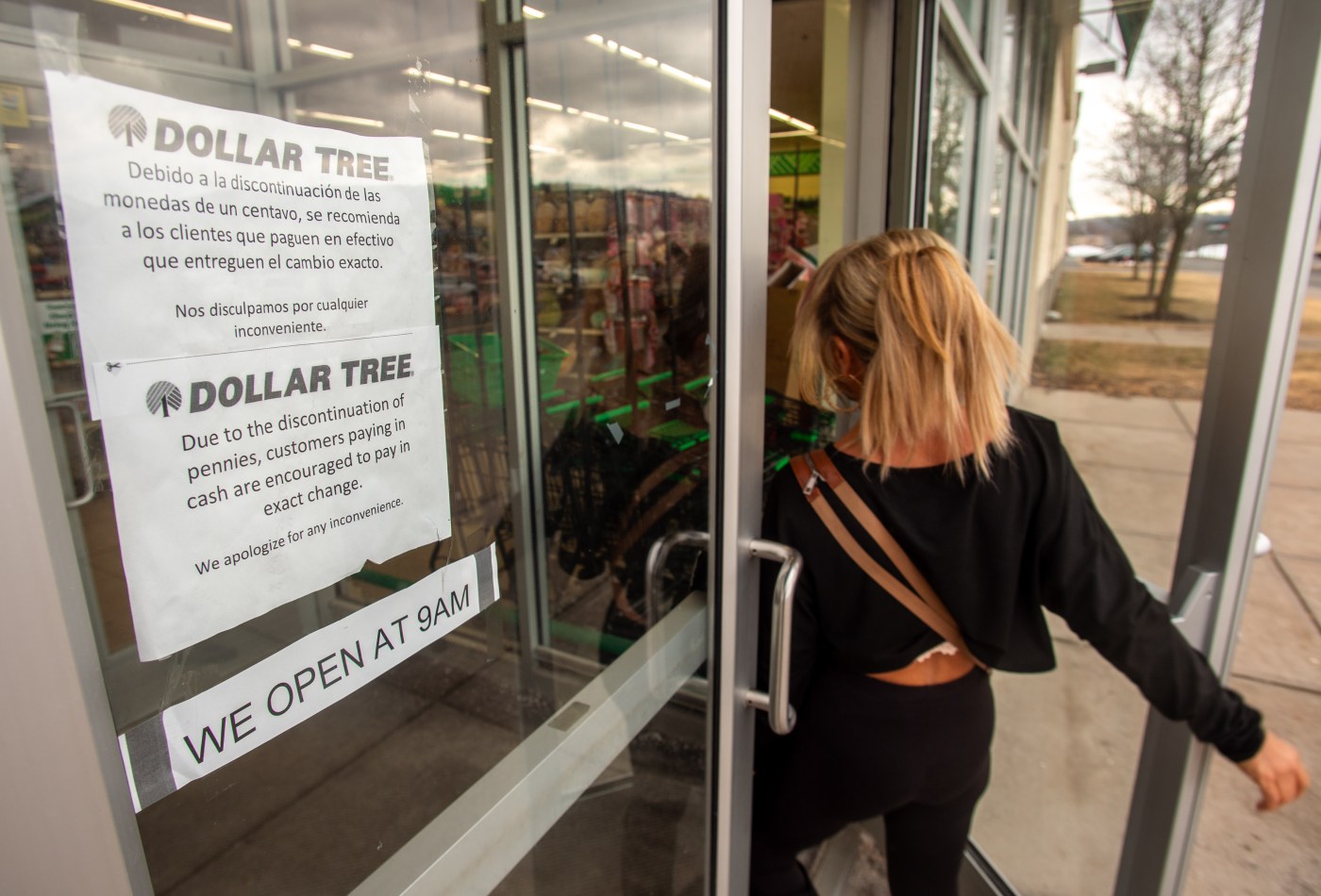
At the Dollar Tree in Plainville, where assistant store manager Jamilette Velazquez estimates more than 50% of customers pay in cash, the scarcity of pennies became acute in December, forcing the store cashiers to round to the nearest nickel.
“We don’t have any (pennies) right now,” Velazquez said recently. “We only get what the customers give us, and then we have to give them right out again.”
Cashiers do the mental rounding math. Signs posted at the discount variety store call attention to the penny shortage and urge customers to pay with exact change.

The shortage has become far-reaching, extending well beyond retailers, even to local governments.
In Bristol, the city came close to running out of pennies in July and August, a heavy time for paying property and motor vehicle taxes, some of which are made in cash. The city recently adopted a new policy to round to the nearest nickel in the event that its supply for one-cent coins gets depleted.
The U.S. Mint estimates that there are 300 billion pennies in circulation — three times the number of stars believed to be in the Milky Way — with a 230-year-plus history behind them. But a majority of those are not actively used and without a fresh supply from the Mint, a shortage has taken hold.
The decision to halt one-cent coin production is estimated to save $56 million annually, according to the Mint.
A recent report from the Federal Reserve Bank of Atlanta noted that cash transactions further declined in 2024, representing just 14% of expenditures in the United States. That was down from 20% in 2020.
Those statistics suggest the penny shortage will not significantly touch all consumers. But it could affect some of the more vulnerable segments of the population, including older adults and lower-income individuals who are more likely to pay with cash, according to Roberto Duncan, a professor of economics at Ohio University.
And if businesses decide to round up, “their customers may feel disappointed or dissatisfied,” Duncan wrote recently in a university publication.
‘Wild West out there’
Retail industry groups in Connecticut say some of their members started seeing penny shortages as early as September. That was well before the mint ceased production of the coin on Nov. 12, primarily because the one-cent piece now costs nearly four times to make than its value as currency.

Since the fall, industry groups such as the Connecticut Food Association, which represent grocers and others in the food business, have advised their members to use federal recommendations for rounding purchases to the nearest nickel, with the advice pertaining only to cash.
Wayne Pesce, CFA’s president, said the association gave that advice in the absence of the state taking a position on the issue.
“It was bit like the Wild West out there,” Pesce said.
The U.S. Treasury‘s recommendation is fairly straightforward: If the final digit of the transaction ends in 1,2, 6 or 7 cents, then the total, including sales tax, is rounded down to the nearest nickel. If the final digit is 3, 4, 8 or 9 cents, the total should be rounded up.
In theory, the burden on the merchant and the customer would even out over time.
But last week, the state Department of Consumer Protection weighed in on the matter, advising that all transactions should be rounded down to comply with an existing law in Connecticut.
The law mandates that a customer paying with cash cannot be charged more than someone paying with credit. In some cases, rounding up would mean cash-paying customers would pay more, if just by a few cents.

“We had heard that places were doing things differently,” Kaitlyn Krasselt, a DCP spokesperson, said. “It’s clear that you cannot charge more for using cash than another form of payment. We’re always going to go in favor of the consumer. We’re the consumer protection agency.”
Consistently rounding down, however, could place an unfair burden on small businesses with slim profit margins.
Robert Rybick, the president and chief executive of Geissler’s Supermarkets, said he foresees an affect on his family-run grocery, which has five stores in Connecticut and one in nearby Massachusetts.
“It doesn’t help in the sense that groceries are a 1% business, meaning we’re making one penny on every dollar,” Rybick said. “So when you tell us to round down, it affects the bottom line. A lot. Some of our stores are doing 30% cash.”
The CFA’s Pesce said he will revise his advice on the rounding issue to association members.
But Pesce said there is growing support among businesses across the board to propose changes to the state law that institute the rounding up and down to more evenly divide the effects of any penny shortage equally between businesses and consumers.
Pesce said he already has contacted state legislators and he hopes the General Assembly will consider the proposal in the session that begins Feb. 4.

A similar proposal is pending on the federal level, but it is unclear when that might be enacted, Pesce said.
“We are looking for a balance,” Pesce said. “The consumer shouldn’t get screwed and the merchants shouldn’t get screwed either. We’ve done rounding in Canada and other countries in the world. It’s easier. People get used to it. Let’s just move forward.”
Meanwhile, the Federal Reserve last week pushed ahead with an effort to help shore up the country’s supply of pennies now that the coin is no longer being minted.
Could be worth something
In meantime, Bristol Mayor Ellen Zoppo-Sassu said the city turned to an unlikely source to bolster its stockpile of pennies.
“We want to be able to provide the pennies and not have all the drama,” Zoppo-Sassu said. “So I commandeered my mother-in-law’s penny collection, which yielded us $63 in pennies, and that’s what we are using. We purchased her jar.”
Zoppo-Sassu said she hopes those one-cent coins will carry through January and February.
Outside the Dollar Tree in Plainville, Samuel Cruz of New Britain said he has taken to carrying loose change, including pennies, when he goes shopping.
But Cruz said he isn’t ready to break into containers at home that are jammed with pennies, nickels, dimes and quarters.
“My father was like, ‘Bro, pennies are probably going to be more valuable if you hold on to them,” Cruz said. “There could be a rare penny in there.”
Kenneth R. Gosselin can be reached at [email protected].