
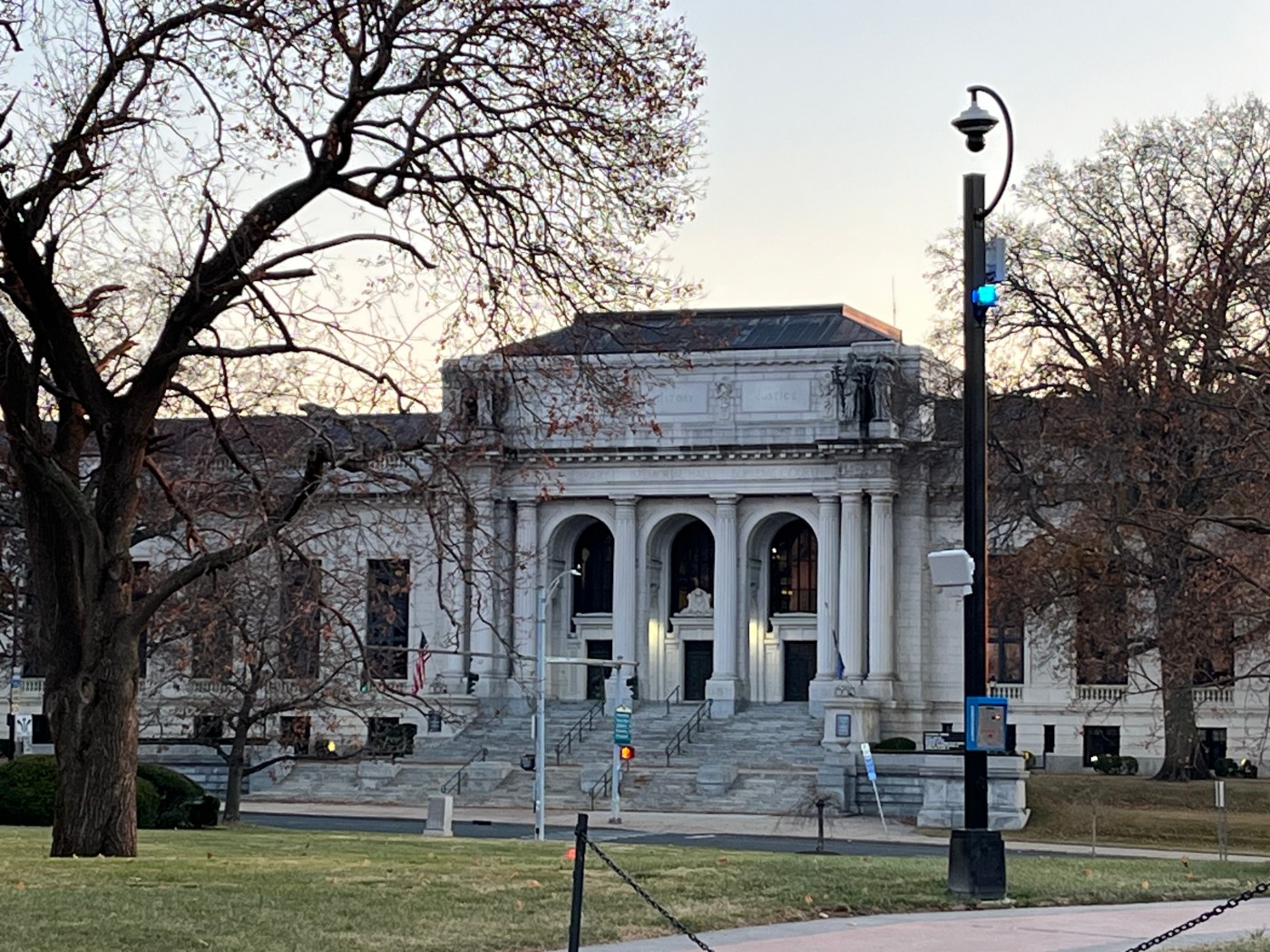
The state Supreme Court cast more doubt Tuesday on the outcome of an already questionable election for Town Council in South Windsor when it ruled for a candidate who claims he was wrongly denied a seat in spite of getting enough votes to win.
The court’s ruling, made from the bench in an expedited election challenge, reverses a Superior Court decision that cost Harrison Amadasum the contest based on a narrow reading of election law. It allows Amadasum to return to court and further challenge an interpretation of election results by Town Clerk Bonnie Armstrong that has been characterized, in and out of court, as “inexplicable.”
“Today was a great day for all the voters of South Windsor when the state Supreme Court ruled they will get their day in court,” Amadasum’s lawyer, John B. Kennelly said. “At the upcoming trial we will investigate the outcome and insure there was no nefarious intent.”
Amadasum was one of six Democrats and six Republicans running for the nine-seat council during the 2025 election. Also on the ballot were proposed revisions to the town charter — revisions that the South Windsor Charter Revision Commission said explicitly were not to take effect until the next election in 2027.
The revisions proposed several changes, among them the elimination of the town’s three member Board of Selectmen and the treasurer, and the conversion of the town clerk from an elected to an appointed position. Most important, from Amadasum’s perspective, was a revision that would reduce the number of council candidates allowed to run from each party from six to five and impose a minority representation rule guaranteeing that neither party ever has more than a five to four majority.
All the offices subject to the charter revisions — council, selectmen, treasurer and clerk — were on the ballot and voted for by the electors of South Windsor, presumably because the changes were not to take effect until 2027. Amadasum was one of six endorsed Democrats on the ballot for seats on the council.
Voters approved the charter revisions.
When the polls closed and the results were tabulated, Town Clerk Bonnie Armstrong decided – inexplicably, according to the suit Amadasum filed contesting the results – that she would apply the newly approved charter revisions to the Town Council race immediately, but not to the races for the selectmen and treasurer.

Even though the Charter Revision Commission said its changes were not effective until 2027, Amadasum claims Armstrong followed language in the old charter language saying revisions are to take effect following their approval by referendum.
That meant, according to Armstrong, that Amadasum, who won the sixth highest vote total among Democrats, finished out of the money. Before the revision, he would have been entitled to a seat as the sixth Democrat. Under the revisions, Democrats were entitled to only five seats — even though the voters were told they could vote for the six Democrats on the ballot.
Confusing the issue further — judging by questions from the justices Tuesday — was Armstrong’s decision to apply the revised charter only to the elections of town council members and not the selectmen and treasurer. Amadasum was out, according to Armstrong, because of the revisions to Town Council elections. But she administered oaths of office to the newly elected selectmen and treasurer – even though those positions were abolished under the revisions.
Amadasum appealed the outcome of his race in Superior Court, where Senior Judge Susan Cobb dismissed his suit. Cobb ruled Amadasum failed to show, as is required in his election challenge, that Armstrong was acting as an “election official” when she ruled charter revisions precluded his election but not the others. Instead, Cobb concluded that Armstrong was acting “in conformity with the charter revisions,” and “was merely applying and abiding by the law.”
The justices sounded skeptical at times.
“Was it her decision to decide which charter applied to which election race?” Justice Andrew J. McDonald asked South Windsor’s lawyer, Jesse A. Langer, at one point during Tuesday’s arguments. “Was it her interpretation that applied different charters to different races?”
“Our position is that there wasn’t a ruling of an election official, whether the charter rules were misapplied or not,” Langer said.
The Supreme Court decision reverses Cobb’s conclusion that Armstrong was not acting as an “election official” when she disqualified Amadasum. The court sent the case back to Cobb for a trial on its merits, meaning there will have to be a ruling on whether Armstrong acted properly when reaching what Justice Steven D. Ecker called her “split decision” on when to apply the charter revisions.
Chief Justice Raheem L. Mullins said the court will issue a written decision at a later date.
There have been political whispers in South Windsor since the November election about whether the decision disqualifying Amadasum was part of a Republican ploy to keep Democrats from achieving a council supermajority. Kennelly said he hopes the question is answered when the case is subjected to further review.