
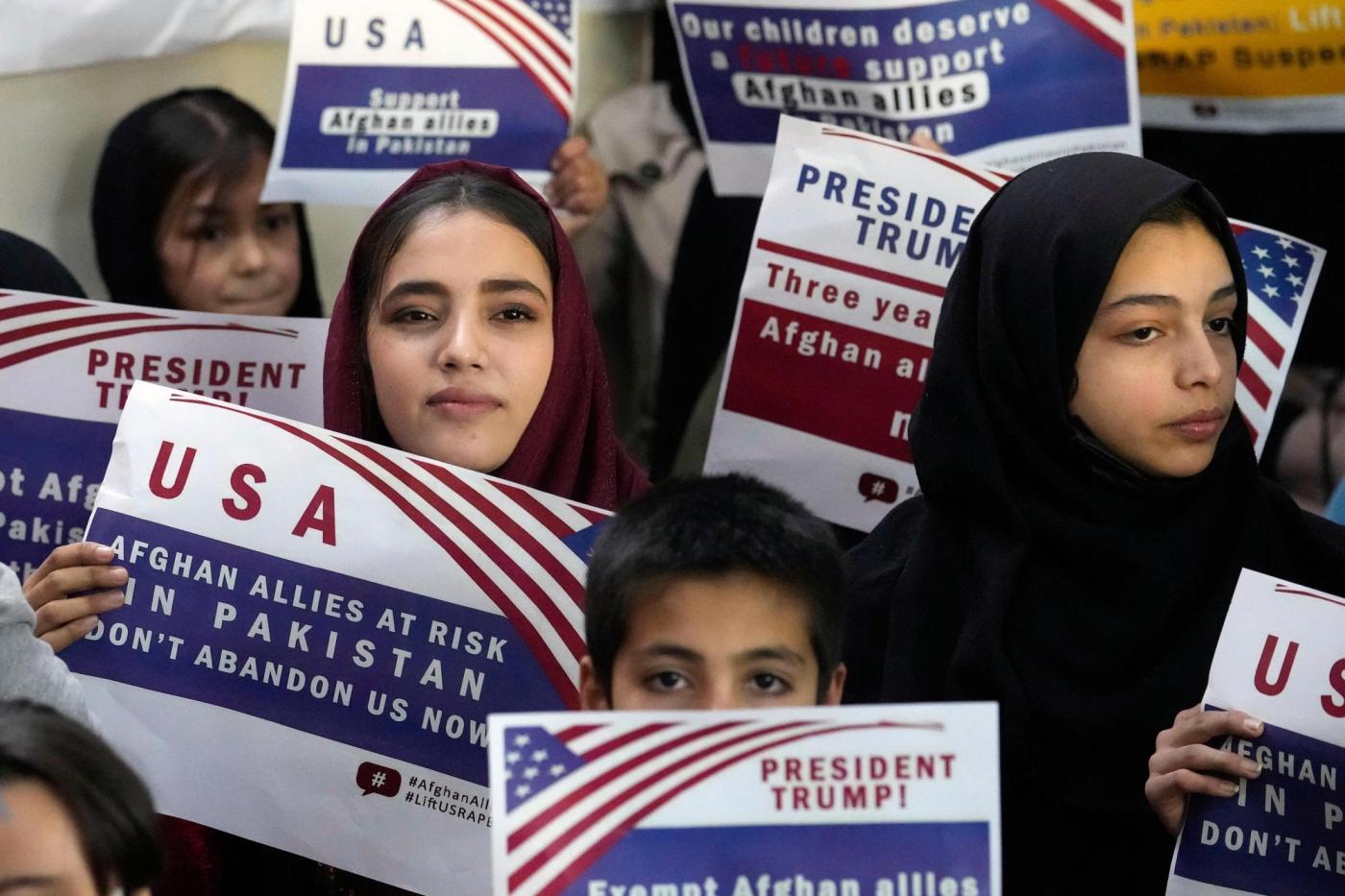
Afghan refugees, like all refugees, are those who are “persecuted or who (have) a well-founded fear of persecution” in their home countries. But many Afghan refugees are subject to persecution for their service to the United States.
Those people, thousands of whom have been resettled in Connecticut since the fall of Kabul in 2021, have built lives here with the help of volunteers from immigrants’ groups, church congregations and veterans. Now those people say the safety and stability they were building in the U.S. has turned to fear and waiting as the Trump administration enacts sweeping immigration changes to purge the country of immigrants, both legal and illegal.
One of them, an Afghan woman who worked with American military and fled to escape the Taliban, began a new life in Connecticut this spring.
She is passionate about America, which she calls calm and friendly. With her husband and four children, she said she felt safe and hopeful, aspiring to become a medical assistant, until the Trump administration ruled it would reexamine green cards for people from 19 countries including Afghanistan.
“I hope for the best and that everything will be fine,” the woman told the Courant in a phone interview.
Immigration advocates and lawmakers say the future remains uncertain for Afghan refugees, who were initially brought to the U.S. under Operation Allies Welcome. Advocates say if forced to return to Afghanistan, they would face a serious threat to their life and safety from the Taliban.
The U.S. considers the country to be “a haven for international terrorist groups,” and the United Nations Assistance Mission in Afghanistan has called it “the most repressive nation in the world regarding women’s rights” and potentially guilty of crimes against humanity.
Effective Jan. 1, “in line with Presidential Proclamation 10998 on “Restricting and Limiting the Entry of Foreign Nationals to Protect the Security of the United States,” the Department of State” fully suspended visa issuance to nationals of Afghanistan, including Afghan Special Immigrant Visas. The U.S. government estimates “tens of thousands of additional Afghans who remain in Afghanistan or other countries potentially qualify for various forms of immigration relief,” denied as a result of new Trump administration policies.
In addition, in November, Trump ordered officials to reexamine all green cards previously issued to people from 19 countries “of concern,” casting doubt on whether those the government brought to the U.S. over the past few years will be returned to the threats they fled. The 19 targeted countries include Afghanistan, Burma, Chad, Republic of the Congo, Equatorial Guinea, Eritrea, Haiti, Iran, Libya, Somalia, Sudan, Yemen, Burundi, Cuba, Laos, Sierra Leone, Togo, Turkmenistan and Venezuela.
President Donald Trump’s administration ended temporary protected status for Afghans in April 2025.
According to the Afghan Special Immigrant Visas Quarterly Report for the second quarter of 2025, the average time to complete the 13-step vetting process from application to issuance of Afghan special immigrant visas (which are issued to Afghan U.S. allies) was 796 days. According to the report, approximately 125,000 primary applicants (who often bring eligible family members) had pending applications.
Before they have been in the U.S. one year, applicants who come to the U.S. through Afghan SIVs may apply for asylum. And if approved for asylum, applicants may apply for a green card granting lawful permanent resident status. Five years after obtaining a green card, applicants may apply for naturalization.
U.S. Sen. Richard Blumenthal said he has come to know personally more than 100 Afghan allies who served as interpreters, translators, guards and guides and they are not just at risk but will have targets on their backs if they are returned to Afghanistan.
“They will be tortured and murdered along with their families by the Taliban because they helped the United States during the conflict with the Taliban,” he said. “They put their lives on the line to help our troops and diplomats and they, along with their families, will pay the price if the Taliban get their hands on them. Their situation is extremely dire. The level of anxiety and apprehension has reached heightened levels because they have no idea what the future will bring.”
Blumenthal said the government has “has seemingly yanked away from them the hope they had to make new lives here and be productive members of our society. I don’t know of any that have any criminal record. The United States made a promise to them. Literally it promised these people they would have a new life here if the Taliban took over there and now the United States seemingly is reneging on that promise and my feeling is a great nation keeps its promises and the United States ought to keep its promises.”
Blumenthal had advocated for the release of Zia, who served as a translator for the U.S. military during the war in Afghanistan and was granted a chief of mission special immigration visa in 2024. He was arrested by ICE when he went to provide fingerprints for his green card in July. Advocates say he had no criminal history. He was detained at the Plymouth County Correctional Facility in Massachusetts until his release in October.
Blumenthal said that Zia’s status is still unsettled.
The immigration policy changes follow the shooting Nov. 26 of two National Guard members near the White House. The suspect, Rahmanullah Lakanwal, 29, is a legal Afghan immigrant who worked with the CIA in Afghanistan and was legally admitted to the U.S. in 2021. National Guardsman Sarah Beckstrom, 20, was killed in the shooting and another was injured.
The Trump administration has said the new policies are necessary to ensure that those entering the country — or are already here — do not pose a security threat.
On Truth Social, Trump posted “This is part of the horrendous airlift from Afghanistan. Hundreds of thousands of people poured into our Country totally unvetted and unchecked. We will fix it, but will never forget what Crooked Joe Biden and his Thugs did to our Country!”
Immigrants, he said the same day, are mostly “on welfare, from failed nations, or from prisons, mental institutions, gangs, or drug cartels” and are responsible for social dysfunction, “failed schools, high crime, urban decay, overcrowded hospitals, housing shortages, and large deficits.”
Dana Bucin, an immigration attorney and partner with Harris Beach Murtha in Hartford, said she hopes if the government does have issues with individual cases that it would provide due process.
“I am not sure what is being desired to be achieved here because our legal obligations under U.S. domestic law is to not send someone to a place where they would be prosecuted on account of their political opinion, ethnicity, nationality, religion, membership and social group or race,” Bucin said.
Trump has advocated potentially sending asylum seekers to third countries that have agreed to accept them, such as Guatemala, Honduras, Ecuador and Uganda. Trump has previously sent asylum seekers to Guatemala, Panama and Colombia, according to the American Immigration Council.
Helping resettle families
Susan and Michael Sames, part of the Simsbury United Methodist Church, have been volunteering since 2021 to help resettle refugees including the Afghan family who recently resettled in the country and spoke to the Courant. They have helped settle five families including two from Afghanistan and three from Syria.
“We do feel in a sense we have adopted them and we love all these families,” said Susan Sames. “We have 23 people and 15 kids. All these people are really looking to us to help them get through this. I don’t know how to make it if we lose one of them to this deportation.”
Among them is a 5-year-old girl from Afghanistan. Sames said she fears what might happen to her if she is forced back to a country under Taliban rule.
“They are going to marry her off if she goes back to Afghanistan,” she said of reports girls are being married to Taliban members.
“I don’t think that is what the American people want,” Sames said. “I don’t think people want to have our formal allies be thrust back into the situation.”
Daad Serweri, associate director of sponsorship at IRIS, who served as a translator for U.S. forces in Afghanistan, said that it goes without saying that if Afghans are deported to their country of origin, there is a very serious risk to life and their safety. Women have no rights in Afghanistan and will “definitely face persecution, detention and torture and even death,” if they are deported, he said.
“If they have asylum they will definitely be considered as disloyal or what the current administration calls ‘westernized’ and this is sufficient to make Afghans a target for retaliation upon return,” Serweri said.
Serweri said Afghan refugees are living in deep fear.
“They are severely distressed because they do not know what is going to happen and there is mistrust in the process,” he said.
A new beginning
The Afghan refugee who spoke to the Courant said she worked with U.S. forces from 2012 to 2014, when she served as an interpreter. She then taught in private school until 2021.
When the U.S. left Afghanistan in 2021, the woman said, she was fearful, living in secrecy and dressing from head to toe in the burqa.
“Every second I was scared,” she said. She worried the Taliban would take her daughter away.
When the Taliban began going door to door, she burned the papers identifying her with the U.S. mission in Afghanistan and stayed away from the home until they had passed. Rapes were occurring when the Taliban went door to door and she feared for her daughter, she said.
The family secured a visa and arrived in Connecticut in May 2025.
Susan and Michael Sames made her family feel at home as soon as they arrived, she said, and her children feel safe. Once she asked if they ever wanted to go back to Kabul, and they told her ‘Mommy never ask this question again,’” she said.
Her 15-year-old daughter, and sons 13, 12 and 7 years old, are happy in school.
“It feels so incredibly good to see the kids go into school. Their children are very bright and eager to be in school,” Michael Sames said, noting they have learned English quickly.
The Trump administration “made false assumptions about most of these people. I don’t think they really understand who these people are,” Michael Sames said.
Susan Sames agreed.
“For all of our differences we are all the same,” she said. “They are devoted to their children and did all of this to bring their kids here to have a better life.”
Blumenthal said there is hope for the refugees because “Americans are decent and caring and understand that these individuals and families have risked their lives to serve our troops and diplomats abroad and they understand the promises that have been made and are hopeful that the Trump administration will listen to the American people who respect the basic sense of decency and fairness.”
But, Blumenthal added, when he speaks to them, he avoids false reassurances.
“The Trump administration has been cruel and draconian,” he said. “In fact (the administration) has detained U.S. citizens and threatened to deport them. This cruel and misguided policy will have human consequences.”
Susan Sames said she is inspired by the families’ courage.
“They are trying not to borrow tomorrow’s trouble,” she said. “They are trying to just make sure they are enjoying what they have now and trusting that things will work and faith that they have the ability to deal with this regardless of what happens.”