
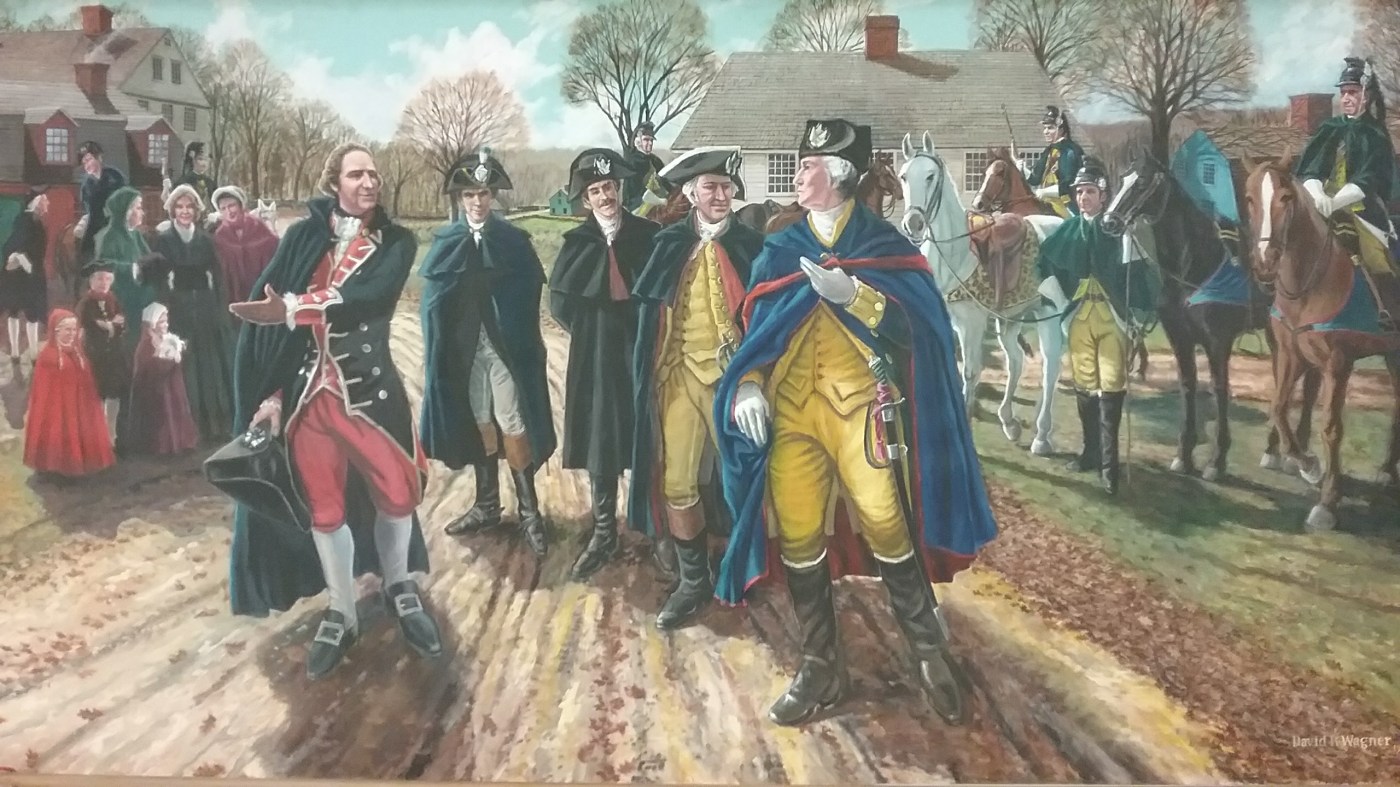
David R. Wagner, the eminent Connecticut muralist and painter of great scenes from American history, died in early December at the age of 85. His work lives on thanks to such varied admirers as Ken Burns, the Mohegan Tribe and schools and libraries throughout the state.
Wagner was a historical artist, which also means he was also a dedicated art historian. He would deeply research the subjects of his paintings and could often bring a fresh perspective to them. He was born in Jewett City on Oct. 6, 1940. He was living in Uncasville when he died on Dec. 6. At various times in his long life in Connecticut he also lived in Plainfield and Scotland.
Wagner’s widow Francesca Cintolo said he was still painting into his late 70s and only stopped because Parkinson’s Disease made it impossible.
“He loved his work. He was self-taught as an artist. He was also a dairy farmer,” Cintolo said. “He died peacefully in my arms on Dec. 6.”
Family and friends will be holding a public celebration of Wagner’s life on Saturday in Griswold. Many of his works will be exhibited as part of his memorial service. The paintings can be viewed from 8:45 to 9:45 a.m. at the Griswold Funeral Home at 30 North Main St. in Jewett City. Military honors will take place at 9:45 a.m. at the Soldier’s Monument followed by a memorial mass at 10 a.m. at St. Mary Our Lady of the Rosary Church at 34 Main St. in Jewett City.
Wagner created hundreds of paintings in his lifetime. Around a hundred of them, which have Connecticut themes, were purchased by the Mohegan Tribe in 2000 for $1 million, Cintolo said. The works are mostly hung in the tribal offices and not on display to the general public, said Rockwell Wagner, David’s younger brother who oversees sales and exhibitions of his artwork.

A photo of Connecticut historical artist David R. Wagner from when he received the prestigious National Order of Merit from France in 2017 for his paintings depicting the Washington-Rochambeau journey to Yorktown during the American Revolution. (Courtesy of Rockwell Wagner)
In an appreciation of David R. Wagner posted this month on the blog of his friend Jack Dempsey, Dempsey writes that the Mohegans’ affectionate name for him was Big-Hearted Little Bear.” In 2004, David R. Wagner and Dempsey co-authored the history book “Mystic Fiasco: How the Indians Won the Pequot War.”
David R. Wagner’s paintings were informed by diligent research and a unique historical perspective which sometimes countered common wisdom about the events being painted. “He always loved a good controversy,” Rockwell Wagner said.
David R. Wagner was often credited for his thoughtful portrayals of Native Americans. In another example of the cultural diversity found in his work, his Revolutionary War paintings make a point of including Black regiments when applicable. One of those paintings, of the Battle of Rhode Island, was used in the 2020 documentary “Black Patriots: Heroes of the Revolution” narrated by Kareem Abdul-Jabbar.
Rockwell Wagner mentioned that one of his brother’s paintings will also be part of an upcoming Netflix series about the American Revolution. “He tried to give credit to those who didn’t usually get credit,” Rockwell Wagner said of how his brother chose the subjects of some of his paintings.
One of David R. Wagner’s most celebrated series of paintings concerns the Washington-Rochambeau Revolutionary Route, a nearly 700 trek undertaken by General George Washington with French Royal Army officer Jean-Baptiste de Rochambeau and their troops which brought them from Newport, Rhode Island to Yorktown, Virginia in 1781.
Over 50 paintings in that series are digitally reproduced on David R. Wagner’s website, and around a fifth of them depict events that took place in Connecticut. They range from bucolic, deliberately uneventful scene-setting paintings such as “Meeting at Ferry Crossing” and “Supply Depot at Danbury.” They also include the action-packed works “Battle of Groton Heights,” one of the largest murals Wagner ever did, bought by the city of Groton to display in their town hall, and “Difficult Duty,” which depicts a firing squad readying to execute two French soldiers for desertion. In 2017, France honored David R. Wagner with a National Order of Merit for his Washington-Rochambeau paintings.

David R. Wagner’s action-packed depiction of the Battle of Rhode Island, one of many events from the American Revolution that he painted. Wagner died in December at the age of 85. (Courtesy of Rockwell Wagner)
David R. Wagner made Connecticut the subject of his paintings throughout his career. Besides Revolutionary War scenes, he painted the historic New-Gate Prison in East Granby, Quinabaug River and other locations. When he did a drawing of the signing of the Declaration of Independence, he based it on the famous painting by John Trumbull but made sure the Connecticut signers of the document were clearly seen in his version, Rockwell Wagner said.
David R. Wagner also served as First Selectman in Plainfield from 1971-73. He designed the official town seal, which depicts a British settler trading goods for land with a Native American from the Owneco tribe, and painted a mural in Plainfield Town Hall. The idea for the mural grew from a dispute David R. Wagner had with the state Department of Transportation while he was in office. A stone arch along Route 14-A in Plainfield had been scheduled for demolition. He was convinced that the arch had been on a stop on the Washington-Rochambeau Route and should be preserved due to its historical significance, but the DOT said it had found no evidence to support his argument.
He diligently researched the route and duly presented the DOT with a receipt from a tavern Washington stopped at in Plainfield as well as a map of Rochambeau’s with Plainfield on the route, but it was too late to stop the demolition. David R. Wagner decided to paint the murals as his own way of spreading the important local history he had uncovered. He also painted murals in Preston, Groton and elsewhere.
David R. Wagner’s work is also part of this year’s celebrations for the U.S. Semiquincentennial. One of his paintings found its way into the acclaimed Ken Burns documentary “The American Revolution,” which aired on PBS in November, and also appears in the elaborate coffee table book based on the series. Rockwell Wagner said that a display of some of the American Revolution paintings will tour to a few Connecticut schools this spring, including a stops at Plainfield Memorial School in June.