
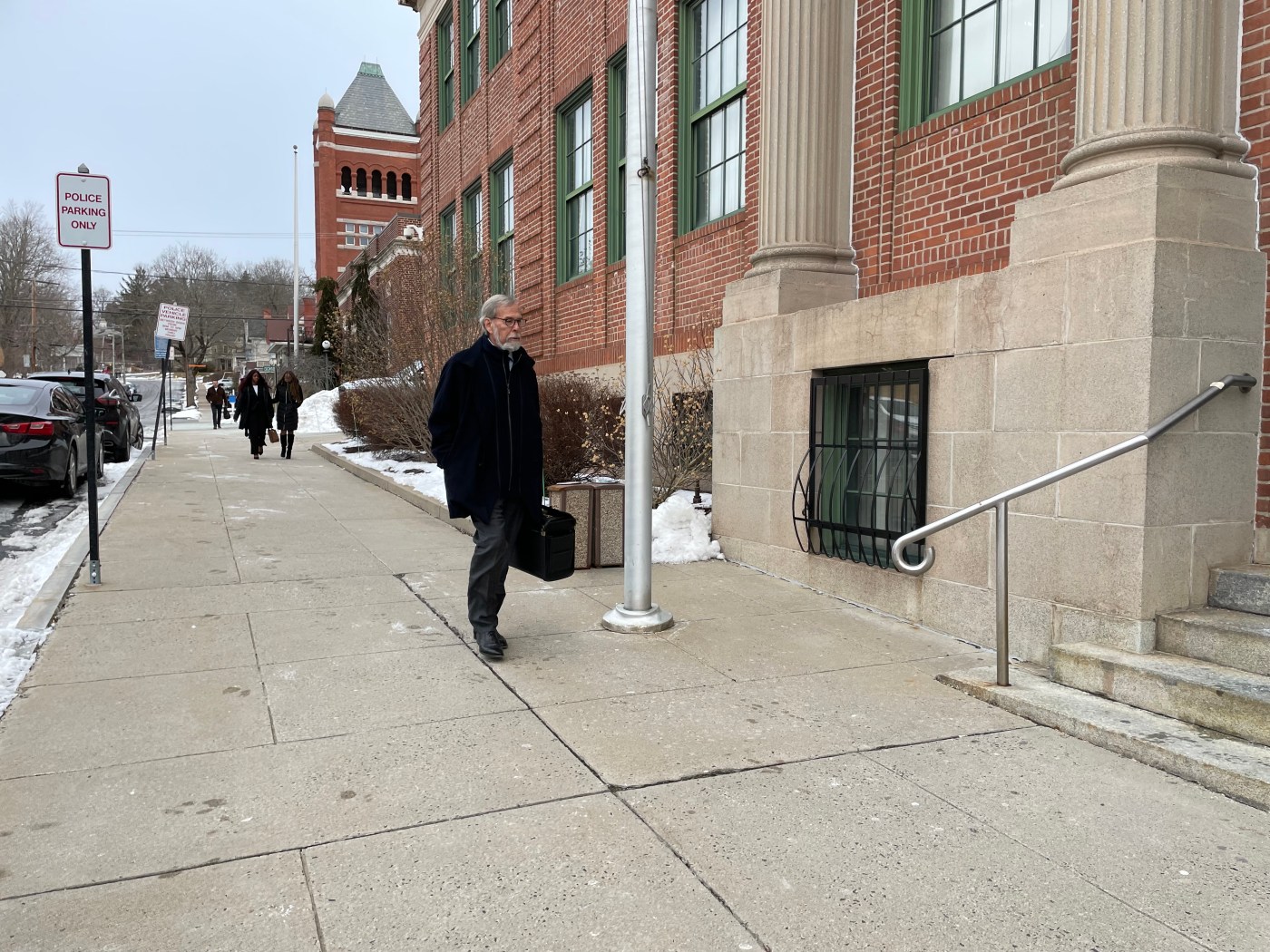
The trial in Michelle Troconis’ habeas petition seeking to overturn her conviction in connection with the death and disappearance of Jennifer Farber Dulos began Monday with the repeated questioning of the lawyer who advised her to undergo multiple police interrogations.
Andrew Bowman took the stand for about five hours in Rockville Superior Court to testify about what advice he gave Troconis in the days and months after Farber Dulos went missing on May 24, 2019, after police began zeroing in on Fotis Dulos, Troconis’ boyfriend and Farber Dulos’ estranged husband.
Authorities believe Dulos waited for Farber Dulos at her New Canaan home and viciously attacked her the day she disappeared.
Throughout the proceeding, Bowman was pressed on his thought process as the case unfolded and repeatedly questioned about his decision to allow Troconis to speak with police. He said he advised her multiple times not to speak with investigators who believed Dulos had killed his wife amid contentious divorce and custody proceedings involving their five children.
That all changed when Bowman said he got a call from Richard Colangelo, former state’s attorney for the Stamford Judicial District, on June 2, 2019, while Troconis was in police custody on tampering with evidence and hindering prosecution charges.
“If we find the body, we’ll charge her with accessory to murder,” Colangelo said, according to Bowman’s testimony.
“It was pretty aggressive,” Bowman testified. “It was very aggressive. It doesn’t get much more aggressive.”
Bowman described Colangelo’s statement as a “threat” and said it changed his opinion about whether Troconis should speak with police. He said she was “very persuasive” about her innocence and her belief that Dulos had nothing to do with the killing.
Attorneys agree: Michelle Troconis ‘had everything to lose’ in interviews with CT investigators
The petition filed by lawyers representing Troconis’ habeas petition argues that Bowman gave her “no meaningful advice” about the downsides to speaking with investigators on three separate occasions between June and August 2019 without any formal protection from prosecution. Attorneys argued in the petition that she was deprived of her rights to effective counsel under the 6th and 14th Amendments.
During hours of testimony, Bowman was walked through the case as it unfolded over the eight months he represented Troconis until January 2020. Michael Brown, an attorney representing Troconis during the habeas petition, hammered away at Bowman’s decisions to allow Troconis to continue giving interviews to police after they indicated a number of times they believed she was lying and knew more.
Upon learning that Colangelo could be pursuing an accessory to murder charge against her, Bowman said he felt some urgency to get Troconis interviewed by investigators before they could find Farber Dulos’ body, which has never been found.
“They were looking everywhere for her,” Bowman testified. “It was an intense investigation I thought there was urgency. I thought they could find that body at any minute.”
Bowman said his strategy for Troconis was to show to police that she could be cooperative and that she had not played a role in Farber Dulos’ disappearance. Ultimately, it was her decision whether she wanted to speak to police, he said.
“I wasn’t pressing her,” he said. “I had a duty to convey to her what Colangelo was saying.”
After the initial interview on June 2, 2019, Bowman said police were very clear that they did not believe much of what Troconis was saying. He said he arranged a second interview with investigators at his office on June 6, 2019, to help reestablish her credibility.
“I thought she had a reasonable claim of innocence,” Bowman testified.
“I had hoped that the second interview would rehabilitate her (credibility),” he said.
When asked by Brown if Bowman had ever asked investigators about a formal agreement of immunity, he acknowledged that he had not. He said he had worked with Colangelo a number of times in the past and that he was very “deliberate” in his attempts to show that she could be a valuable cooperating witness.
Michelle Troconis found guilty on all charges in disappearance of Jennifer Farber Dulos
Brown also questioned why Bowman did not show police the timeline Troconis had made with Dulos about what they did the day Farber Dulos disappeared. He said he considered it attorney-client information which he later learned was a “false alibi” for Dulos. He also said it could have potentially been used to implicate her as a co-conspirator.
It was only during one of the police interviews that Bowman learned Dulos and Troconis had gone to Hartford and Dulos was seen dumping evidence that was later found to have Farber Dulos’ blood on it.
During one of the interviews with police, Bowman said at least some investigators began wondering if Troconis was “telling the truth.”
“So we were on the right road,” Bowman testified.
Bowman said he arranged a third interview with investigators in August 2019 where Troconis planned to admit that Dulos was never with her on the morning when Farber Dulos disappeared.
“The plan was she was going to tell them that Fotis was not home that morning,” Bowman said. “It was the destruction of his alibi.”
Following the final interrogation, Bowman testified that he sent a letter to the state’s attorney saying he believed Troconis could be a valuable cooperating witness and that she should not be charged in connection with Farber Dulos’ death. She was charged in connection with the killing after that.
Bowman said the chances of Troconis serving as a cooperating witness took a huge hit when Dulos died at a New York hospital in January 2020 following what police said was a suicide attempt using carbon monoxide in the garage of his Farmington home.
“What Dulos did, that put a big hole in that expectation,” Bowman said. “That was the most devastating event — his suicide — as far as Michelle was concerned.”
Bowman underwent a little more than an hour of cross-examination from Senior State’s Attorney Russell Zentner before court adjourned for the day. The trial is expected to resume on Friday.
Troconis was sentenced 14 ½ years in prison in May 2024 following a trial that ended with a jury finding her guilty on charges of conspiracy to commit murder, tampering with evidence, hindering prosecution and additional conspiracy charges.
According to court documents, the claims raised in the petition were not allowed to be heard during her trial. The petition is separate from an appeal Troconis has filed alleging there was insufficient evidence to convict her and that several errors were made during the trial.