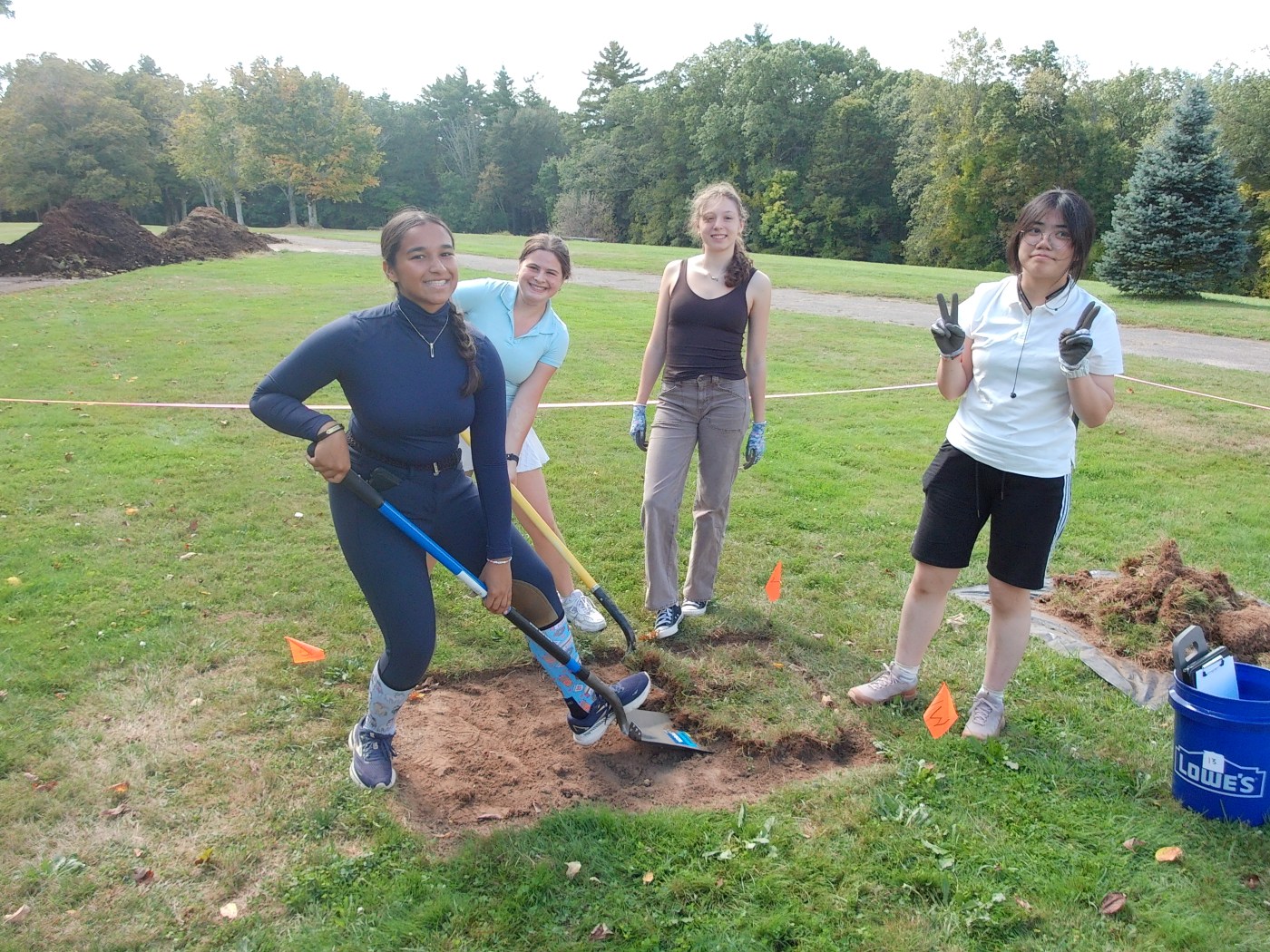
The objects were delicately retrieved from the ground like pieces of the puzzles of history.
Broken shards of ceramic plates used long ago by students, chunks of roofing tile from a mansion that once stood on what is now an open field, known and unknown fragments of metal, all scraps of yesteryear that will help tell a story.
It is the story of the Ethel Walker School in Simsbury, founded in New Jersey and moved to its current location, the former Dodge estate, in 1917. The school is a private boarding and day school for girls in grades 7 through 12; it is independent and a college preparatory school.
That is how Ethel Walker wanted it, according to school archivist and teacher Kim Harris-Thacker, who is a font of knowledge about the school, its history and the interesting stories that star more than a century of students, teachers, and others. “She was very good at education,” Harris-Thacker said, of Walker.
It is Harris-Thacker who leads the archeological pursuit and class that led to the digging that turned up treasures left as the school evolved and grew.

“The way we present history to kids is very curated. I decided it was time to disrupt curated history,” Harris-Thacker said.


In part, Harris-Thacker was motivated by what is dubbed a “bottle dump.” Yes, such a dump is exactly what is sounds like: a place where generations of Connecticut residents left bottles, glass containers that had held myriad liquid parts of life they led. Beverages, perfume, medicines, elixirs, and more, the glass containers ended up in the woods, only to be found many decades later by those curious about who had left them there. There is a collection of such bottles, some adorned with the name of the company that used it, at the school’s Bell Library.
“The story that they tell gives you a real life connection to real people,” Harris-Thacker said. “It made me want to create a hands-on history [course]; I felt we needed to get hands-on history going.”
So, with the support of the school for developing an introductory class on archaeology, Harris-Thacker developed one. “We are a hands-on school,” she noted.
As Harris-Thacker is so familiar with the history of the school, where buildings had been and where they came from, and even its topography, she knew a spot that could prove to be a treasure trove for young and budding archaeologists.
It was the site of a former building that had once served as a dormitory at the school, and prior to that was a family’s Tudor mansion that had been shipped to Connecticut from England by a member of the wealthy Dodge family.

There is a note of melancholy associated with the former house, as the dormitory long bore the name of a student, Emily Cluett, who had caught the flu more than a century ago and died. Harris-Thacker said Emily’s family was wealthy and they donated the money to the school that was used to buy the mansion. Ethel Walker, an accomplished equestrian, later married the doctor who had cared for Emily, Dr. E. Terry Smith. The marriage took place in the Emily Cluett House.

A newer dorm building at the school also carries the Cluett name.

Faced with what is now where the once imposing mansion had stood — an open field on a hill, with thick woods abutting it and the still active equestrians occasionally using it — Harris-Thacker did not tell the students where they should place their squares for the dig, but had them figure it out using old photographs, a metal detector and other information.
The work required “real world skills,” and collaboration, she said.
Before they turned the soil in that field, students practiced in a flower bed-like set up in which Harris-Thacker had placed items for the students to find. The practice not only allowed students to learn the techniques archaeologists use, but also created excitement, she said.
Then came the real dig.
“I was so excited and overjoyed to have found some things that were part of Walker history,” said Emma Edelman, 17, a senior at the school who participated in the dig. “There is so much more than what meets the eye.”
“It is our history,” she said. “We’re all connected.”

Edelman, standing in the area where the mansion has once been a home, pointed to areas around the field that served as clues. One was the curve of the driveway, still in the same place it had been generations ago. The square Edelman and fellow students dug in, after determining the spot might yield interesting relics, did produce tiles, pieces of ceramic and more.
All of the items the students found were safely ensconced in a work area Harris-Thacker has created so students can study their finds.


“I think it is showing us … making us focus on what is around us,” said Edelman, who also noted the class, which had students using their hands in dirt, was a time when phones and such electronics were put aside.
Edelman said a very special part of the work for her was sharing what they learned with younger students.
“There is a lot to learn about yourself,” she said.
Walker senior Livi Samaraweera, also part of the dig, noted in her part of the dig field report that, after getting through the very dry top layer of sod, they moved on to layer two and “that is when things started to change.”
“As we continued to dig down, we found pieces of pipe, brown glass, driveway asphalt, painted and unpainted brick, and stucco. When excavating these artifacts, we used shovels, and when it got deeper, we ended up just using our trowels. We sifted everything we found, and the majority of the glass discovered came out of the sift as it was the same color as the dirt it was found in,” she wrote.
“We were told the chances of finding things were slim, so when we found glass and pipe, it was huge. We worked in quadrants and split up all the work evenly. We did not find any evidence of the [former Cluett house] Sundial statue being there, but all of these artifacts showed that there was, in fact, a structure near the area we were digging,” she wrote.
At one point, digging near a large rock, they “found many more artifacts, such as more pieces of pipe, charcoal, lime, and what we think are foundation stones of the house. When we found lime and charcoal, we began to suspect this may have been a filled-in outhouse. Charcoal and lime were used to cover up the scent of feces back then. We only got to dig in that spot for one class, so we are unsure of just exactly what still lies beneath,” Samaraweera wrote.

Harris-Thacker said the class has been a “special” one, as it included women helping women, and “drawing on a variety of skills.” She also said the class helped to draw on her own skills.
“I am a big promoter of research,” she said. “We’ll just keep doing it.”
Ethel Walker Head of School Meera Viswanathan, said the Introduction to Archaeology class fit in for students as, “the goal is for them to realize that the past is literally the ground on which we tread each and every day.
“Hence, our goal is to render archaeology as closer kin to biology than to history — in other words, how it informs who we are now in our daily beings and doings rather than simply a portrait of how things were,” Viswanathan said. “Kim Thacker’s class thoughtfully guides our students on how to excavate the foundations of our existence, both literally and metaphorically.”
“These studies show us how archaeological methods help preserve context and reveal the history of a site. Overall, this project demonstrated careful planning, and the use of tools such as datum points and quadrants makes archaeological interpretations reliable and meaningful,” Walker junior Caroline Mattison wrote in the field report.