
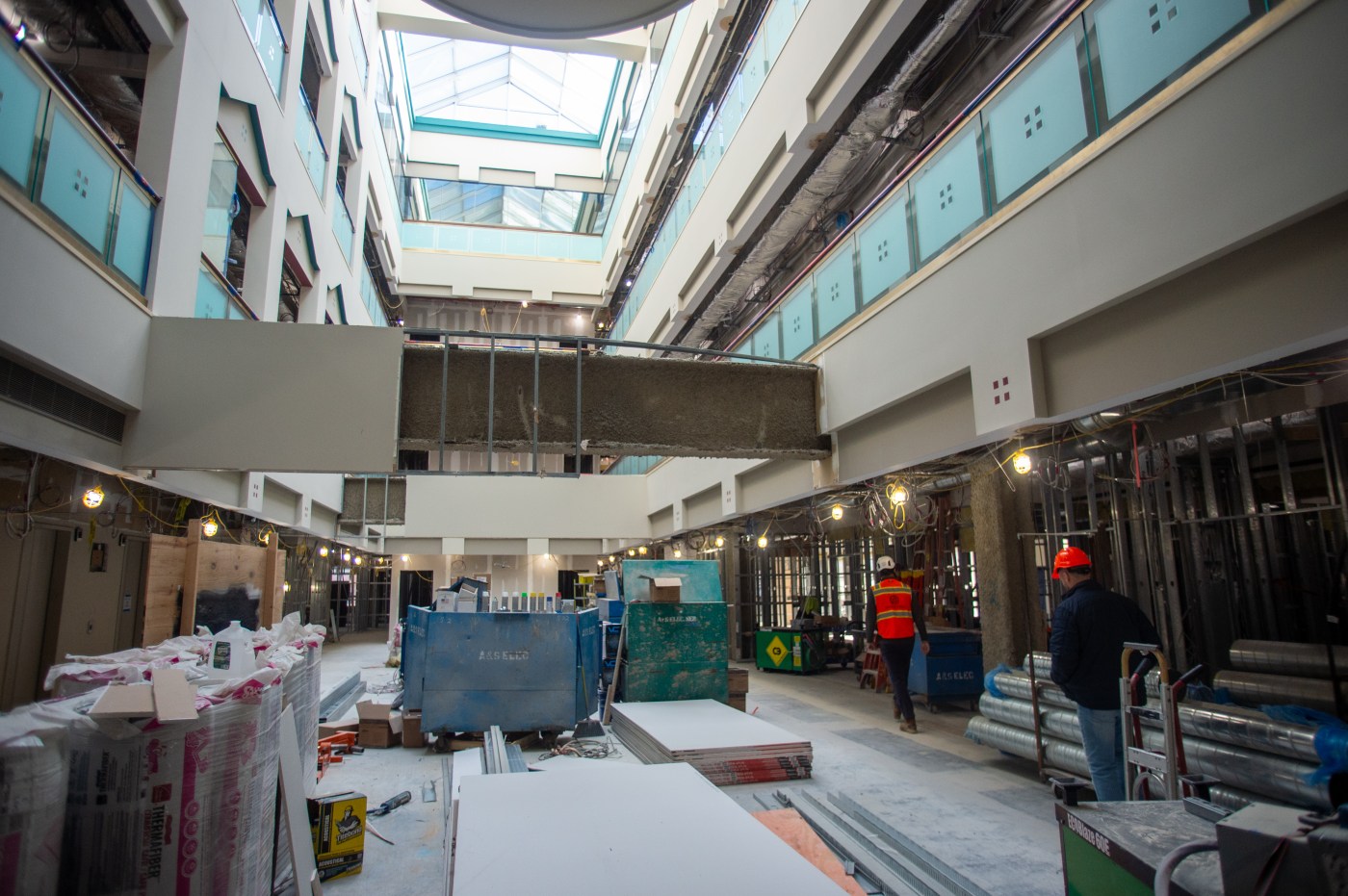
Walk by 64 Pratt St. and there’s little sign that major construction in full swing, so much so that some have wondered whether a new residence hall for the University of Connecticut will actually be ready for the fall of 2026.
But inside, the impression is far different: dozens of framers, electricians, plumbers and others are carving 50 suites, for up to 200 students, out of former, long-vacant office space in downtown Hartford, all headed to a hard-and-fast deadline at the end of July.
“It’s actually a compliment we’re quiet,” Igor Stojcevic, project manager for InnoConn Construction Management, said. “We’re kind of staying in the background.”
The new residence hall for UConn’s Hartford regional campus makes The Courant’s 7 Hartford Projects to Watch in 2026, a list drawn from interviews with developers, business groups, public officials and others.
While new projects strike a note of optimism, the challenges faced by the city remain significant. Office vacancies — a consequence of corporate lease downsizings after a major shift to remote work following the pandemic — still dog the downtown.
A recent study by major developers downtown found a 40% vacancy rate in prime office space among the some of the most recognizable towers in the city’s skyline: CityPlace I, 20 Church St. — the “Stilts Building” — and two skyscrapers in Constitution Plaza. The same study estimated that $450 million in public subsidies over three years would be needed to convert to new uses, including apartments and hotel rooms.
How Hartford deals with its office troubles will have major implications. Buildings will high vacancies have lower values, affecting property tax collections that pay for municipal services and the schools. Downtown office towers traditionally have been a cornerstone of the tax base.
In 2026, the corporate community, led by The Hartford, pledge taking a bigger role — not seen for decades — forming a group to collaborate with the community, establish priorities and potentially make strategic investments to boost the vibrancy and revitalization.
Attention also is expected to turn on rebuilding and further growing the city’s hotel industry.
During the pandemic downturn in travel, hotel owners scrambled to convert hotel rooms in the city into apartments, which led to the loss of nearly 700 rooms. In the aftermath of Covid, fewer rooms has left the city hamstrung in its efforts to attract larger convention and other events.
The MetroHartford Alliance, the region’s chamber of commerce, said it is now taking on expanding hospitality as a new focus in 2026.
“Our partners in the state have spent several hundred million in building the convention center, and it’s just finishing $150 million at PeoplesBank Arena,” said Gene Goddard, the alliance’s chief business investment officer. “We’ve got the hospitals that are spending hundreds of millions of dollars as well. Those investments are not being utilized to the full capacity because we lack the number of hotel rooms that are needed.”
More than a decade of apartment conversions remain a bright spot with occupancies in projects financed in part by state taxpayer-backed, low-cost loans from the Capital Region Development Authority holding steady at 90% or better. More than 3,500 units have been created in and around the downtown area, with new units in the former Society for Savings building on Pratt Street and in the old Pearl Street firehouse expected to come online early in 2026.
Hartford Hospital also is pushing ahead with its plans for $1 billion in improvements over the next decade and is well underway with a new, $100 million “arrival center.” The center could eventually accommodate about 1,700 spaces — the first 1,000 next year — and would also include restaurants, shops and other services sought by patients and visitors. The amenities also would be open to public.
Here is The Courant’s list of 7 projects to watch in 2026:

A hotel renovation near Bushnell Park
Name: Capitol Hotel
Address: 440 Asylum St.
Cost: $13.6 million, with public funding of up to $4 million in a low-cost loan from the Capital Region Development Authority
Developers: Springfield-based DVR Ventures and Lexington Partners, headquartered in Hartford
The Project: The new owners plan a four-month renovation in March. The plans call for new bathrooms, all new furniture, tile, carpeting doors, ceilings and artwork. The upgrades to the breakfast room, fitness center, business center and meeting rooms — all meeting the standards for the hotel’s new brand, Holiday Inn Express & Suites.
Why It Matters: While the renovation will only modestly boost the number of rooms from 96 to 105, its success would likely spur addition of more sorely-needed hotel rooms in the city. There are plans for a hotel near Dunkin’ Park, the city’s minor league ballpark. In addition, plans for a hotel in older office space at 15 Lewis St., also across from Bushnell Park, have been discussed as well as potential for hotels at Constitution Plaza. A portion of the vacant office space in downtown office buildings also is seen for potential hotel conversion.
The city lost 700 hotel rooms in the pandemic, amid conversions to residential as travel took a nosedive. The fallout — far fewer hotel rooms — has left Hartford hamstrung in its ability to attract bigger conventions and other events. A condition of the CRDA loan requires that the new Holiday Inn Express provide blocks of rooms that could be advertised as available for Hartford’s convention center.

Incentives could boost downtown storefront leasing
Name: Arena Retail District
Addresses: Trumbull, Asylum, Pratt and Main streets
Funding: $2 million in state-funded, matching grants
The Project: The storefronts that surround the Hartford 21 complex in downtown Hartford — PeoplesBank Arena at its center — have struggled for two decades to attract long-term tenants. But a new grant program — patterned after the successful, $9 million Hart Lift storefront revitalization program in 2021 — seeks to fill spaces primarily on Trumbull, Asylum and Main streets.
Why It Matters: The thrust of the new district is further boosting downtown vibrancy and building off momentum from the recent $145 million renovation of PeoplesBank Arena. The idea for some of the larger spaces is the create destinations that go beyond restaurants and bars — “experiential” businesses — that will draw visitors when there isn’t a major event in the city.
The grants also are aimed at attracting businesses that will cater to college-age students at a time when the University of Connecticut is expanding it regional campus in Hartford and plans to open a residence hall on Pratt Street in the fall of 2026.

Demolition of a hulking eyesore near Dunkin’ Park
Name: Former Bank of America data-processing center
Address: 150 Windsor St.
Demolition cost: $9.4 million, including $6 million in a state brownfields grant, plus $3.4 million in city and CRDA funds.
Developer: RMS Cos., Stamford.
The Project: The former data-processing center, just east of Dunkin’ Park and long part of the North Crossing redevelopment around the ballpark, will be torn down to make way for what the city hopes will be a center for a $90 million applied artificial intelligence and a $30 million hotel and parking garage on the site. The demolition of the city-owned structure is expected to be nearly complete for the start of the 2026 Yard Goats season, the data center now a hulking presence just beyond center field.
The city is seeking funding from the state’s “Innovation Clusters” program and elsewhere.
Why It Matters: Hartford Mayor Arunan Arulampalam and others see the AI center raising the city’s technological profile not only regionally but nationally. The city’s sweet spot for the project is the area between how large companies are investing in AI and the start-ups. This is where new ideas — some developed at colleges and universities — are tested and worked on in a lab using digital tools that are commercially available.
A key part of the vision also targets training to prepare a workforce for using AI, which many believe will be the most consequential technology in the future, its impact even deeper than the development of the internet. However, there also are concerns that AI could displace workers in the future.

Century-old institution plans new headquarters
Name: Hartford Foundation for Public Giving
Address: 10 Columbus Boulevard
Cost: $35 million
The Project: Capping its centennial year in 2025, the foundation announced plans to build a $35 million headquarters at the intersection of Main Street and Albany Avenue. Construction is expected to begin in the spring and run 18 to 24 months. The foundation has talked seriously about such a project for three or four years.
Why It Matters: The roughly, 35,000-square-foot structure would be built in a now-forlorn area of Hartford that has long been seen as a gateway between downtown and Hartford’s northern neighborhoods. The new structure will form a strong connection between the two parts of the city, but the foundation’s headquarters also is firmly planted in the Clay Arsenal neighborhood, one the city’s poorest areas.
The foundation says the new location more clearly embodies its core mission of dismantling structural racism and achieving equity in social and economic mobility throughout the 29 towns and cities it serves in greater Hartford. The foundation also hopes the project will be a catalyst for more investment in North End neighborhoods in Hartford.

A 1960s development needs overhaul for a post-pandemic world
Name: Constitution Plaza
Address: Bounded by Columbus Boulevard, State Street, Market Street and Talcott Street
Cost: To be determined
The Project: While technically not a project yet, Constitution Plaza — a vision of 1960s Urban Renewal — is increasingly seen as a likely target for tackling Hartford’s office vacancy woes. The courts recently approved a foreclosure that could set the stage for redevelopment involving conversions to apartments or hotel rooms or new uses by arts or educational institutions. The foreclosure involved six buildings, including the One and 100 Constitution Plaza office towers.
Why It Matters: Office vacancies in downtown Hartford in prime, or “Class A” office towers is more than 40%, according to a recent study, but not all office buildings lend them to easy conversions. Constitution Plaza is seen as a good fit for such projects. There is general agreement that building a cohesive, redevelopment plan first for the 7-acre property is essential, but that won’t be easy because of multiple owners with interests in the plaza.
A recent report filed with the courts showed the occupancy of the six buildings involved in the foreclosure is about 70%. But the reports also warned that major tenants such as law firm Shipman & Goodwin and insurer XL America are likely to downsize their leases — now at about 100,000 square feet each — once their leases expire in 2026 and 2027.

A residence hall aims to bring college students downtown
Name: University of Connecticut residence hall
Address: 64 Pratt St. (annex to 242 Trumbull St.)
Cost: $28 million, including a $10 million, state-taxpayer backed loan from CRDA, plus $4.9 million in state and city grants
The Project: The residence hall will include 50 suites for up to 200 students on four floors of the annex with occupancy ready for the fall semester of 2026. The hall is being converted from vacant office space and includes a spacious atrium that allows space for amenities and student gathering. The atrium was a key selling point in UConn’s selection of the location.
Why It Matters: College students attending the UConn regional campus at Hartford’s Front Street and living downtown are seen as another source of vibrancy or “feet on the street” in the city, a younger vibe and the city’s aspirations to be more of a college town. The housing also is addressing a residential space crunch at the university’s main campus in Storrs.

A project sought for decades may debut in 2026
Name: Woodland and Albany
Address: 1163 Albany Ave.
Cost: $19.4 million. Public funding includes $12.8 million from Hartford’s revolving loan fund administered by CRDA and $1 million directly from the city. In addition, recent approvals were secured for $1 million from the state and $700,000 from CRDA, both for environmental clean-up discovered during the course of construction.
Developer: Grow America
The Project: The roughly, 32,000-square-foot development at the corner of Albany Avenue and Woodland Street on city-owned land will include storefront retail space for a sit-down restaurant, a branch of Liberty Bank as well as two other tenants. The upper floor will be occupied by the city’s health department.
Why It Matters: The Upper Albany neighborhood has pushed for redevelopment of the 2-acre lot for at least two decades. Once completed, the new building would offer a sit-down restaurant and a visitor attraction, the beginnings of establishing the neighborhood as a destination rather than a pass through between the suburbs and downtown.
The city hopes the project will build on $30 million in recent streetscape improvement and spur other redevelopment on Albany Avenue near the Artists Collective, a nonprofit arts and cultural center.
Kenneth R. Gosselin can be reached at [email protected].