
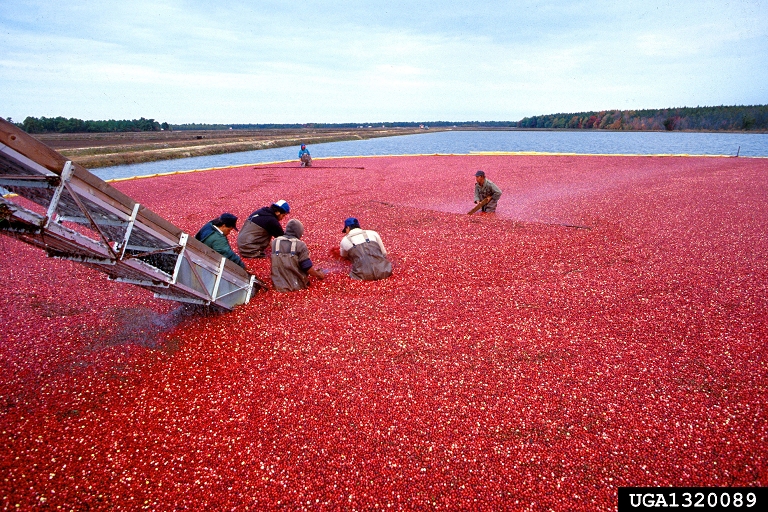
Each holiday season, a wave of bright red cranberries appears on Instagram feeds, Pinterest boards, and tables across the nation in the form of sauces, desserts, drinks, and decorations. Beyond their seasonal fame however, these tart red berries play a major role in U.S. agriculture and culture.
Let’s start with some numbers. The USDA estimated the 2024 U.S. cranberry harvest at about 8.24 million barrels, roughly 824 million pounds of fruit. Here in the U.S., the cranberry king is Wisconsin, producing nearly 4.9 million barrels, around 60% of the national total. In second place is the historical cranberry producer, Massachusetts, with approximately 2.2 million barrels produced in 2024. The top agricultural crop in the state, Massachusetts’ cranberry crop alone is valued at $73.4 million, supporting over 6,400 jobs and generating $1.7 billion in annual economic activity. Cranberries are so important for Massachusetts, in fact, that they are the state fruit and cranberry red is the state color.
Cranberries, known scientifically as Vaccinium macrocarpon, are native to North America and are a close relative of blueberries. Compared with blueberries however, cranberry plants tend to be smaller, low to the ground and vine-like. The vines require acidic soil (pH 4.0–5.5), a reasonably cool growing season, and abundant fresh water. If these conditions can be emulated at home, cranberries can make an attractive edible ground cover. They perform well when planted alongside plants such as conifers and rhododendron, provided they are given plenty of water and appropriate fertilizer for acid-loving plants.
For commercial production, cranberries thrive in uniquely engineered wetland environments – bogs built atop beds of sand, peat, gravel, and clay. The annual commercial production cycle of cranberries begins with winter flooding, which forms protective ice that shields the vines and prepares the surface for sanding, which stimulates spring growth. As temperatures rise in spring, bogs are drained, and bees pollinate the blossoms. Summer is devoted to irrigation and monitoring, followed by harvest from mid-September through early November, before the cycle repeats with winter flooding and freezing.
Cranberry growers will typically harvest their crop one of two ways: through wet harvesting or dry harvesting. Wet harvesting describes the process where bogs are flooded to allow berries to float to the surface before being netted and loaded into equipment for cleaning and processing. This harvesting technique is the most popular, but requires proper equipment and careful planning. Dry harvesting, the process of using mechanical pickers that comb berries into conveyers, is an approach primarily used for fresh markets. More fruit are left on the vine with this approach, but the collected berries for fresh market can be sold at high prices and dry harvesting allows growers without the means to flood and drain their bogs on a schedule to grow cranberries.
Cranberries are deeply embedded in holiday traditions, thanks to their seasonal harvest, festive red color, and historical use. For more than 12,000 years, they’ve been utilized by Indigenous communities, especially the Wampanoag People, for food, medicine, dye, and winter preservation. The cranberries collected by hand in the bogs of southern Massachusetts were both eaten fresh and dried for shelf stability, then eaten as-is later in the winter or mixed with dried meats and fat to make pemmican, a hearty winter staple.
European settlers in New England quickly adopted the appreciation of cranberries, integrating them into winter celebrations. By the 18th and 19th centuries, cranberry sauces, relishes, and baked goods were staples of Christmas feasts. Their vibrant red hue also made them popular in holiday crafts such as cranberry-popcorn garlands or wreath embellishments.
U.S. cranberries reach peak consumption during the holidays. Though 95% of cranberries are processed into juice, sauce, or dried fruit, fresh cranberries remain a holiday staple, used in everything from stuffing and pies to cocktails and décor. Around 400 million pounds are eaten annually, with an estimated 20% consumed during Thanksgiving week, about 80 million pounds. With per-capita annual consumption averaging 2.3 pounds, mostly in juice or processed form, cranberries rank second among berries consumed in the U.S. after strawberries!
Cranberries exemplify a convergence of historical tradition and the advances of modern agricultural practices. They support regional economies, sustain traditional farming techniques, and bring seasonal joy to millions. As you gather with loved ones this holiday season, enjoy an extra serving of these tart crimson berries and remember that food isn’t just sustenance, it’s heritage, celebration, and connection.
The UConn Home Garden Education Office supports UConn Extension’s mission by providing answers you can trust with research-based information and resources. For gardening questions, contact us toll-free at (877) 486-6271, visit our website at homegarden.cahnr.uconn.edu, or reach out to your local UConn Extension Center at extension.uconn.edu/locations.