
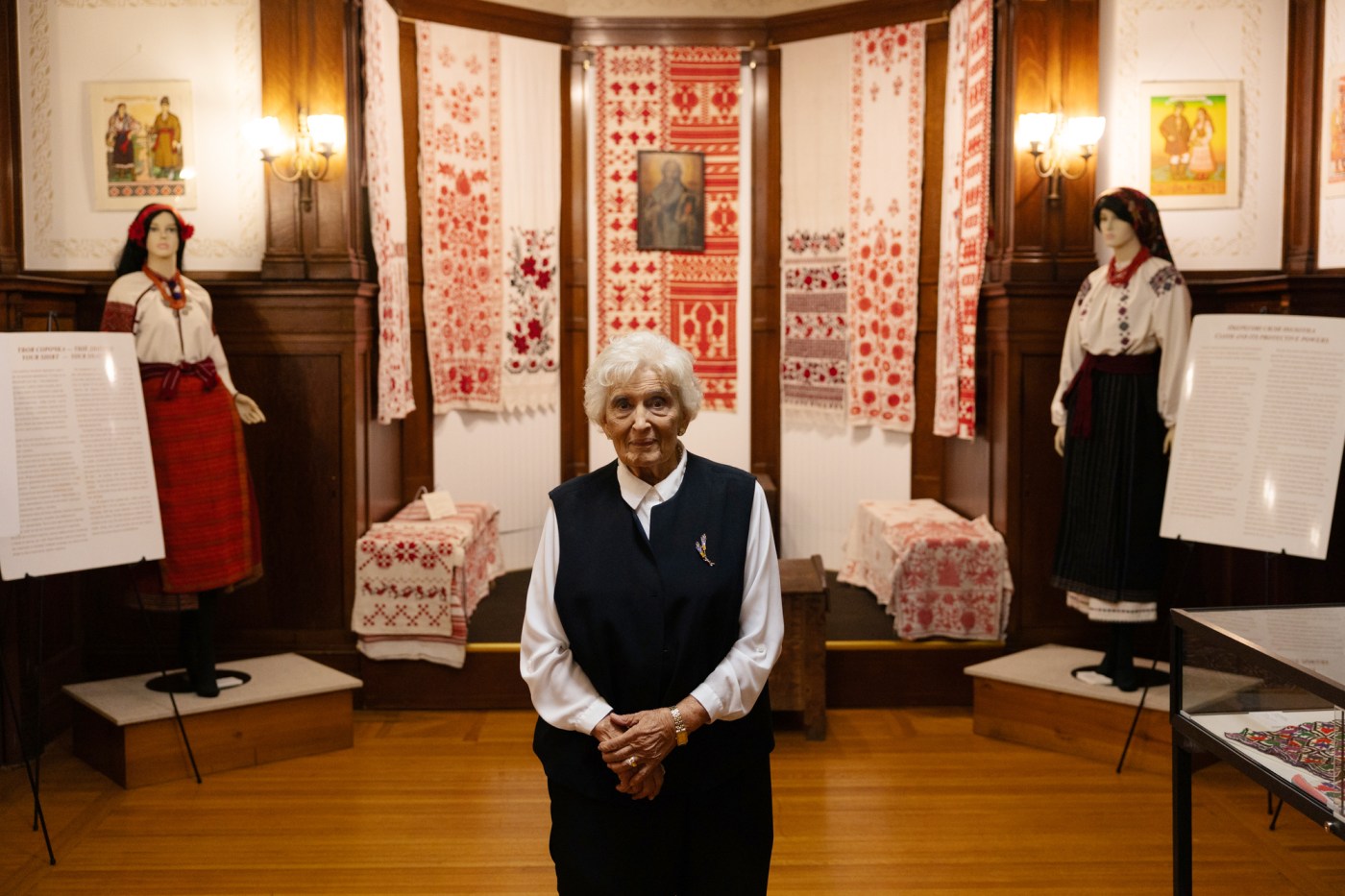
Lubow Wolynetz has served as a curator with the Ukrainian Museum and Library in Stamford for over four decades. Many of the items in the collection were passed down, over generations and across continents, and they hold deep meaning, she said.
They are bits of the national identity Ukrainians are fighting to keep alive.
“We have duplicates and triplicates, but we save them so that when Ukraine — when they’re finally free — [we can] send it there,” she said.
Wolynetz said she believes the current war, and the hardships that have come with it, has elevated the art’s significance.
Among the variety of folk art showcased in the museum is row after row of colorful vyshyvankas — embroidered shirts made by artisans across Ukraine, from the Carpathian Mountains in the west to the rivers in the east, each with distinct patterns and styles.
“The Ukrainians were always a nation that was overpowered by a stronger nation. So most of the populace had to learn how to survive within the oppression of the powers,” Wolynetz said. “The way they did it is that they would stick to their traditions. And one of these traditions would be their outfits and the way they dress, the way they created things around them.”
Oleksandra Storchai, a senior research associate at the Ivan Honchar Museum in Kyiv, said Ukrainian history “has many tragic pages,” when it was taken over by outside interests. “Traditional folk culture was the only thing that helped to keep the identity,” she said.
Vyshyvankas have held a particular strength in that regard. According to the tradition, the embroidered patterns and designs serve as amulets meant to protect the wearer.
“It has an inner meaning,” Storchai said.
“It’s a much wider picture than just stitching,” Wolynetz said. “It’s one of the basic identities that we have.”

Threading old and new worlds
In West Hartford, retiree and artist Yelena Kirshon is working on curating her 12th Ukrainian art exhibition, set to take place in April. Kirshon, who grew up in Ukraine, also teaches folk art classes — focused on the Eastern painting style of Petrykivka — and sells handmade jewelry.
Proceeds from those endeavors have been supporting the Fastiv School of Folk Crafts, in Fastiv, Ukraine — a town about 40 miles southwest of Kyiv, where Kirshon’s niece, Oksana Zuienko, is the director.
The school seeks to revive Ukrainian folk craft traditions, ranging from woodwork to embroidery, Zuienko said. Over 500 children attend its afterschool classes, and several former students have been recognized nationally for their work. (Kirshon is one of those former students — the school is where she learned Petrykivka painting.)
“Children delve into the roots of our past,” Zuienko said. “They know our customs and rituals. They know our symbolism.”
Of the school’s 18 teachers, most have a partner or relative on the frontline. The war’s impact on the school, however, doesn’t end there.
In early December, Fastiv suffered three consecutive nights of drone strikes. Explosions ripped through the approximately 45,000-person town, decimating the train station and train depot. At the Fastiv School of Folk Crafts, just half a mile from the impact, the blasts knocked canvases down from the walls.
But the sleepless nights and the threat of more attacks failed to deter the school’s staff or students. On the day following the three-day strike, students dutifully filed into their classes after school.
In one room, 7-year-old Nadiia honed her beading technique. In another, two young boys worked with clay, surrounded by the ceramic creations of their predecessors.
The money that Kirshon has raised in Connecticut made it possible for the school to add a toilet, which allowed younger children to enroll.
In the school’s main room, which doubles as a museum, sisters Alisa and Diana watched in a corner as their teachers assembled wheat in a typical holiday sheaf known as didukh. Around them, nearly every surface was adorned with embroidery, traditional easter eggs and paintings in the Petrykivka style.
Around 5 p.m., Fastiv went dark. Power cuts have become a daily occurrence in Ukraine, as Russia has targeted the nation’s energy infrastructure during cold months. Unable to continue teaching in the darkness, teachers sent the students home early.
The neighborhood was submerged in darkness. Car headlights lit the streets, which were suffused with the hum of generators and the faint smell of gas.

Stitching together a community
Driving through the east side of Stamford, the grandeur of the stone manor at 161 Glenbrook Road stands out amidst rows of multi-family homes. The ornately decorated Stamford estate, which now serves as home to the Ukrainian Museum and Library, was purchased by Bishop Constantine Bohachevsky in 1933 with the intention of establishing a cultural institution.
The collection sits beyond iron gates, down a winding driveway and through a heavy wooden door. Dozens of models and cases dispersed through wood-paneled rooms display colorful stitching from across Ukraine.
For Wolynetz, the vyshyvankas, in particular, hold deep personal significance.
She first encountered embroidery as a displaced person living in Germany in the 1940s after fleeing her hometown in Western Ukraine during the Dnieper-Carpathian offensive. Growing up in a camp for displaced people, she observed as her mother and other women would gather to stitch clothing with distinct patterns from their hometowns.
She recalled that her embroidery teacher in Germany would “pull up an old suitcase” to show the class examples of the craft. “And when I saw that, I just said, ‘When I grow up, I’m going to have the same kind of [suitcase.]”
Now in her 80s, Wolynetz teaches workshops in Ukrainian embroidery techniques in Connecticut and New York. And she proudly carries her own suitcase to class.
One series of those workshops recently took place this autumn at the Ukrainian Museum in New York, on the lower level of a building where traditional Ukrainian easter eggs, paintings and other art adorn the halls. Every week, over a dozen students gather to learn embroidery from Wolynetz.
Patterns and colored threads spilled onto the table as she unzipped her suitcase at the start of the session. She was met with a mix of friendly chatter and technical questions from the students. Mostly women, with backgrounds ranging from Puerto Rican to Italian-American to Ukrainian, the students shared bits of their personal lives with each other amidst their triumphs and struggles with the craft.
“It’s one of those social groups that you wish was around more,” Wolynetz said.

One student, Jo Ann Radioli, said she found the class after joining an initiative to embroider amulets for soldiers fighting on the Ukrainian frontline.
The samples that were mailed to her to replicate seemed daunting. “It was like jumping off the end of a diving board,” Radioli said. “Because I found Lubow, I felt I could do it.”
In the past, soldiers would go to war, return, and stop wearing embroidery. This practice was especially common after the first and second World Wars, where Ukrainians were forbidden from wearing vyshyvanka, and embroidered items were seized or destroyed.
Storchai, of Kyiv’s Ivan Honchar Museum, said today’s war is different. Some Ukrainian soldiers are wearing embroidery under their military uniforms and even off the battlefield, she said. “It’s like spiritual armor.”
Liubov Sholudko contributed reporting in Ukraine.