
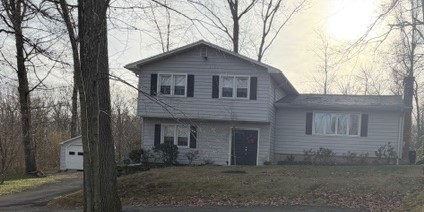
Two neighbors appeared at my parents’ front door in the Mt. Carmel section of Hamden in 1962 with a petition to keep Black people from moving into our neighborhood.
They were about to give my parents the opportunity to act out Lorraine Hansberry’s 1959 play “A Raisin in the Sun” in real time on the front steps of our house.
A New Haven schools administrator, Kenneth Redmond, had bought the split level house next to my parents’ split level house on Still Hill Road. The neighbors with the petition didn’t want them to move in to their fashionable middle class neighborhood full of new houses.
Kenneth Redmond and his family are African American.
The civil rights movement was in full swing down south in 1962. But Dr. Martin Luther King Jr. was just a civil rights leader whose face was on television in Connecticut of 1962.
My mother answered the door but when she heard what the petitioners wanted, she called my father to the door too.
My parents did not invite the petitioners in but the door was open quite a while. My brother and I were watching television so we didn’t pay attention but it seemed peculiar then that the people were talking so long with my parents at the front door.
When they finally left I shouted from the TV room “What did they want.”
My mother said “They wanted us to sign a petition.”
“Did you sign it?”
“No. Your father told them we were not interested in signing,” was her answer.
“Why?”
“Because they didn’t want the new neighbors who bought the house next door to move in to the neighborhood,” she told me.
“Why not?”
“Because they are not white people ”
“What? Who cares,” I recall exclaiming.
I was 17 going on 18 and a junior in Hamden High School In 1962. Lorraine Hansberry’s play “A Raisin in the Sun” had only been published and produced three years before in 1959. It was about a Chicago Black family who wanted to move into a white neighborhood
I am sure my parents hadn’t read it or seen it, but here they were at their front door acting it out in the real world of white people without knowing they were doing so.
My mother continued, “Your father told them it was not our business who moved into the neighborhood. It was a free country. We don’t agree with your petition.”
There was no shouting, but the door was closed firmly and the petitioners had not been invited to step over the threshold.
I was too young to realize how proud I should have been of my parents’ courage.
When the Redmond family moved in next door my mother brought them her traditional housewarming homemade casserole.
When my mother died 23 years later in 1985, Mrs. Redmond brought a homemade casserole down for my father and his mourning guests.
My father died seven years later at age 78 in 1992. Mrs. Redmond attended the funeral. She came back to the reception at our house and told me she always waved at and said hello to my father in his loneliness.
It was likely the first time in 30 years she had stepped inside our house. We were good Yankee family next door neighbors, friendly, but minding our own business.
Mrs. Cynthia Redmond died in 2023 at age 97. I don’t know if she still lived on Still Hill Road as our house was sold in 1993 the year after my father died, and I live in Vermont.

Paul Keane is a Connecticut native, graduate of Yale Divinity School and retired Vermont teacher.