
To what extent the $145 million renovation of PeoplesBank Arena would boost downtown restaurants and bars got its first test in late October just two days after a rousing grand reopening of the sports and entertainment venue.
Rock icon Stevie Nicks was booked for the arena, and before the concert, Tom Dubay, co-owner of the Hartford Flavor Cocktail Parlour on Pratt Street, took a walk around the heart of downtown and was encouraged by what he saw. The cocktail parlor’s business that night was among the strongest in the 18 months since the bar and restaurant opened.
“It just felt like there was a vibe downtown that’s been missing for so long,” Dubay, also president of the Pratt Street Merchants Association, said. He noted that Pentatonix concert in early December came in a close second.
“Based on those two, we are really encouraged, if they can bring in a dozen or two dozen more shows a year,” Dubay said.
The arena renovation captures a spot on The Courant’s list of the five development projects in Hartford that made a difference in 2025. The high-profile, much-debated arena renovation provided an upbeat note in the city at a time when the challenges of soaring office vacancy rates downtown — upwards of a stunning 40% — came clearly into view.

The pandemic shifted the culture of the workplace with corporations downsizing leases as their employees spent more time working at home.
The cost of converting at least some of that space to apartments, hotel rooms or other uses could require hefty public subsidies, possibly as much as $450 million over three years, according to one study by major commercial property owners downtown.
Office vacancies post-Covid aren’t particular to Hartford with markets across the country struggling with the same troubles. But in Connecticut, the problem is particularly acute in Hartford because the city has more office space than New Haven, Waterbury and Bridgeport combined.
The weak leasing market has forced some of the city’s most recognizable commercial properties — CityPlace I, 20 Church Street — the “Stilts Building” — and Constitution Plaza — into foreclosure and their values have taken a beating.
How the city’s office space troubles are tackled also will have broad implications for property tax collections and the delivery of municipal services, the downtown office towers being a cornerstone of revenue for the city.
Apartments a bright spot
In the face of the grim realities of the office market, however, the demand for new apartments has remained strong.
The conversion of the historic, 55 Elm St. into apartments came online in October and apartments are under construction along the stretch of Main Street near Dunkin’ Park and elsewhere downtown.
Stamford-based RMS Cos., the developer of the North Crossing development around the ballpark, says it expects to wrap up the first half of the second phase of North Crossing by early spring, and has plans to move on to the second half immediately. Together, the two portions of the second phase — following the opening of the first phase, “The Pennant” in 2022 — will add more than 500 residential rentals.

RMS said the apartment occupancies at The Pennant and another RMS residential rental complex, The Revel, on nearby Trumbull Street are 95% or better. Together, the two locations represent a combined 417 apartments.
In 2025, Hartford Mayor Arunan Arulampalam worked to shift more of the city’s redevelopment efforts to Hartford’s neighborhoods.
Arulampalam — fast approaching the two-year mark leading the city — has introduced a program to redevelop vacant, city-owned lots scattered throughout the city with the intent of building on Hartford’s property tax base and strengthening neighborhoods.
He also has leaned into an initiative to attract tenants to vacant storefronts along major commercial corridors such as Albany Avenue, Park Street, Barbour Street and Maple Avenue.
Last week, Arulampalam boosted the program — patterned after the successful Hart Lift storefront revitalization program that heavily focused on downtown — by adding another $5.6 million, adding Farmington Avenue. Farmington Avenue runs through the Asylum Hill and West End neighborhoods.

Arulampalam said downtown redevelopment is still a top priority, but the neighborhoods he described as the “lifeblood” of the city.
“Our hope is to build small businesses in neighborhoods again,” Arulampalam said. “To allow for everyone in every neighborhood to have access to places to eat, to have coffee and to gather to feel like a community again and to bring folks back into their neighborhoods and make those destinations.”
Corporations seek a bigger role
Top executives at some of Hartford’s largest employers, led by property-casualty insurance giant The Hartford, have banded together to fast-track a plan to develop a strategic vision for the city’s redevelopment. The plan could include investments in specific projects seen as critical to the city’s revitalization.
The executives are collaborating with local businesses, nonprofits and community groups on the effort and have hired a consultant known for guiding urban revitalization efforts. A report with recommendations is due out in late spring or early summer.
“Hartford’s been the beneficiary of a lot of generosity and contributions of varying kinds from our corporate citizens over time,” David Steuber, executive director of the Capital Region Development Authority, said. “But it has been many, many years — many decades — since we’ve seen major corporations coming together to talk to one another and act together in a coordinated fashion in the public, civic interest and to try to cultivate moving the city forward.”
Steuber, newly appointed to lead the influential CRDA, said the formation of the executive group was one reason he is excited about leading CRDA. The quasi-public agency has provided state taxpayer-backed, low-cost loans on housing and other projects in Hartford and surrounding towns that might otherwise not have gotten off the ground.

“We have a moment of growing interest in tackling some significant problems,” Steuber said.
There also are examples of employers in the city taking individual steps in investing in the city.
One of the more recent ones came last month when Hartford Steam Boiler purchased a lot at the foot of the Founders Bridge — vacant for 15 years since the demolition of Broadcast House on Constitution Plaza.
HSB, whose headquarters is across Columbus Boulevard from the lot in the One State Street tower, had previously commissioned a mural on the site and, just days after the purchase, erected a Christmas tree. HSB said it wanted to preserve the value of its headquarters building and would initially use the lot for parking for its employees.
But the specialty insurer said it was open to proposals for future uses.
The purchase comes after HSB bought One State Street in 2014 to better control the building where its headquarters is located. The same could be said for buying the vacant lot — arguably an eyesore, one that’s even caught the attention of Gov. Ned Lamont.
“They don’t want their front door turning into something they don’t like,” said David Griggs, the president and chief executive of the MetroHartford Alliance, the region’s chamber of commerce. “Do they have a plan now for what’s going to go in there in the future? No. But what we do have is an owner who is interested in seeing something positive.”
Here are 5 Hartford projects that made a difference in 2025:

Renovation of a downtown arena
Name: PeoplesBank Arena
Address: 1 Civic Center Plaza
Year Built: 1975
The cost: $145 million. The financing included $125 million in state funding and a $20 million investment from Oak View Group, which manages the arena on a daily basis.
The project: The renovation focused on the lower half of the 16,000-seat arena, originally built as the Hartford Civic Center. The arena now offers more options for premium seating — loge boxes and bunker suites and accompanying amenities such as an event-level club and seat-side ordering of food and beverages. Menu delivery to premium seating also is aimed at relieving congestion in the venue’s concourse. All seats, regardless of ticket price, are now cushioned.
In addition, updates to rigging and electrical systems are expected to better accommodate increasingly sophisticated needs of concert performers, especially lighting. Some work still remains, including the addition of more women’s restrooms on the concourse level and sprucing up the drab exterior along Church Street with sports- or entertainment-themed murals.
Why it matters: Critics of the renovation argued the arena, now 50, was too old to invest such a large amount of state funding, while supporters said the project was essential for vibrancy and a boon to downtown restaurants, bars and other businesses. OVG sees the potential to double or even triple the number of concerts booked for Hartford to 30 or more annually. More concerts — key moneymakers for modern arenas — are seen as a path to profitability. It is hoped that the state-run arena’s money-losing track record, at about $2 million annually, will be reversed in the coming years.

Conversion of historic office building near Bushnell Park
Name: The 55 Elm Club
Address: 55 Elm St.
Year built: 1926
The cost: $67 million, including a $13.5 million state taxpayer-backed loan from the Capital Region Development Authority.
Developer: Spinnaker Real Estate Partners, South Norwalk
The project: First built as the offices of a major insurer in the style of a Florentine palace, the historic building at 55 Elm St. on Pulaski Circle near Bushnell Park served for years as the offices of the state attorney general and other Constitutional officers. The conversion to 160 apartments was delayed at least a year, but the project has since been described as one of the most impressive apartment projects in downtown Hartford in the last decade. The new apartment building — including an annex building — held a grand opening in October and is now 20% occupied.
Why it matters: The conversion provides a boost for redevelopment in the Bushnell South neighborhood, dominated by a swath of parking lots just east of The Bushnell Center for the Performing Arts. Development has languished on some of the larger surface lots, including one controlled by CRDA, amid conflicting priorities in addressing high office vacancies and the potential for some of that space to become residential rentals.
But Spinnaker — citing the need for more housing and its optimism for the downtown market — now plans further apartment construction on lots it owns near 55 Elm. Conversion of two, historic and former state office buildings nearby by a separate developer, also are moving ahead.

Expansion in Hartford’s hospital district
Name: Connecticut Children’s
Address: 282 Washington St.
Year first opened: 1996
The cost: $326 million for eight-story clinical tower; $72 million for 900-space parking garage
The project: The 195,000-square-foot expansion of Connecticut Children’s doubled the size of its flagship Hartford campus and allowed it to push deeply into fetal care. The new tower, which opened earlier this month, also gave the hospital its first neonatal intensive care rooms for parents, which nearby Hartford Hospital had previously provided. While the surrounding neighborhood supported the new tower, plans for the parking garage turned controversial.
The hospital later agreed to relocate rather than demolish four structures — three of them historic — to make way for the parking garage, saving nine apartments. Connecticut Children’s also pledged to construct a new mixed-use building across from the hospital to add more housing to the neighborhood. Planning for that development is expected to start in a year.
Why it matters: The expansion is a key component in the evolution of the city’s Washington Street corridor near the contiguous campuses of Connecticut Children’s and Hartford Hospital. The area is seen as a health and innovation district, one of 10 projects that could transform Hartford by 2035, the city’s 400th anniversary. The expansion also has the potential to raise Connecticut Children’s profile both regionally and nationally — and create hundreds of jobs.

New apartments around Dunkin’ Park
Name: North Crossing, Phase 2
Address: 1143 Main St.
Developer: RMS Cos., Stamford
The cost: $63 million for the first half of the second phase, including a $13.5 million state taxpayer-backed loan from CRDA.
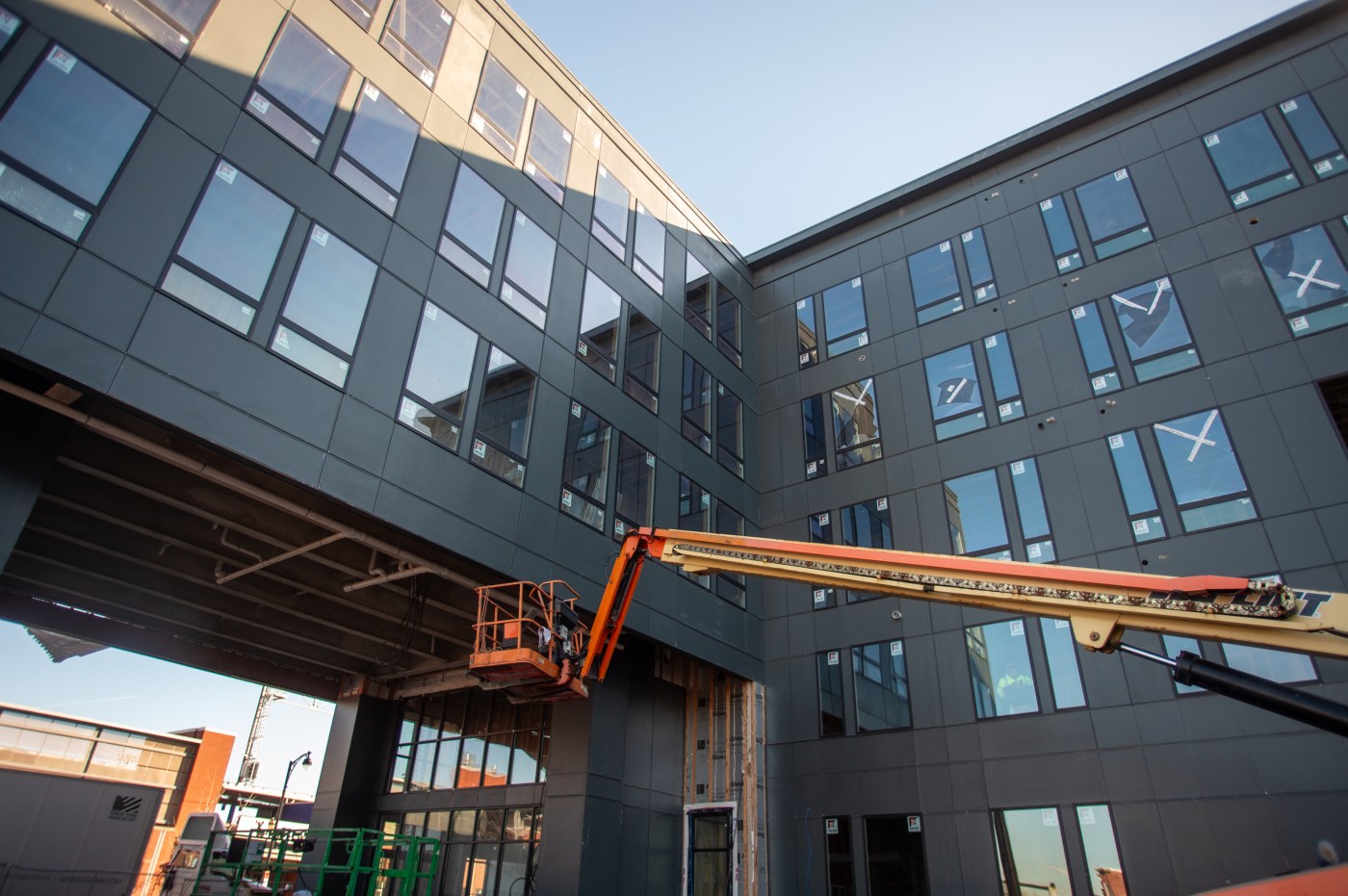
The project: Diagonally across from Dunkin’ Park, the city’s minor league ballpark, the first half of the second phase of North Crossing is expected to be completed by early spring and include 237 apartments, storefront space and a 525-space garage. The apartments wrap around the parking garage and also can be seen by travelers on I-84. Construction on the second half of the phase is expected to begin as the first half wraps up, with the number of apartments eventually totaling more than 500.
Why it matters: The second phase is dramatically changing the visual landscape of the city, easing the decades-long separation of downtown caused by the construction of the interstate highway systems that tore Hartford in half. The apartments also respond to the well-documented need for housing and a need to better balance residential and commercial space in Hartford, especially downtown. Development around the ballpark, ever since the stadium was first planned, was intended to both build on Hartford’s tax base and help pay off the tens of millions of dollars in debt incurred by the city in financing the sports venue.

A sprawling redevelopment district on the Connecticut River
Name: Materials Innovation and Recycling Authority trash-to-energy plant
Address: 1 Reserve Road
Year opened: 1988
The project: Control of the 80-acre, trash-to-energy plant, shuttered in 2022, was transferred to CRDA after the end of this year’s legislative session. The transfer also came with about $50 million in reserves that could be used for future development with CRDA guiding those efforts. The trash-to-energy plant also is part of a newly-created, 1,000-acre development district in Hartford South Meadows that also includes Hartford-Brainard Airport and the Connecticut regional market. The district stretches from the Connecticut River to Wethersfield Avenue.
It is likely the trash-to-energy plant would be the initial focus. There are no specific plans for elsewhere in the district, which also will be overseen by the quasi-public CRDA.
Why it matters: The trash-to-energy plant is seen as promising for future redevelopment, given its location on the Connecticut River. Redevelopment could provide a sorely needed boost to the city’s grand list and property taxes, promoting economic development and creating jobs.
A recent recent study detailed the challenges facing redevelopment however. Cleanup could take years, the costs are dependent on what is envisioned for the property and not only what’s in the soil but how many buildings are demolished. Environmental remediation requirements become much more stringent if residential development becomes part of the plan.
According to the study’s findings, the costs just to get the property ready for development could range from $48 million for industrial and commercial uses to $334 million for heavily residential. Those figures are based on getting started in 2026 and rise significantly waiting five or 10 years.
Kenneth R. Gosselin can be reached at [email protected].