
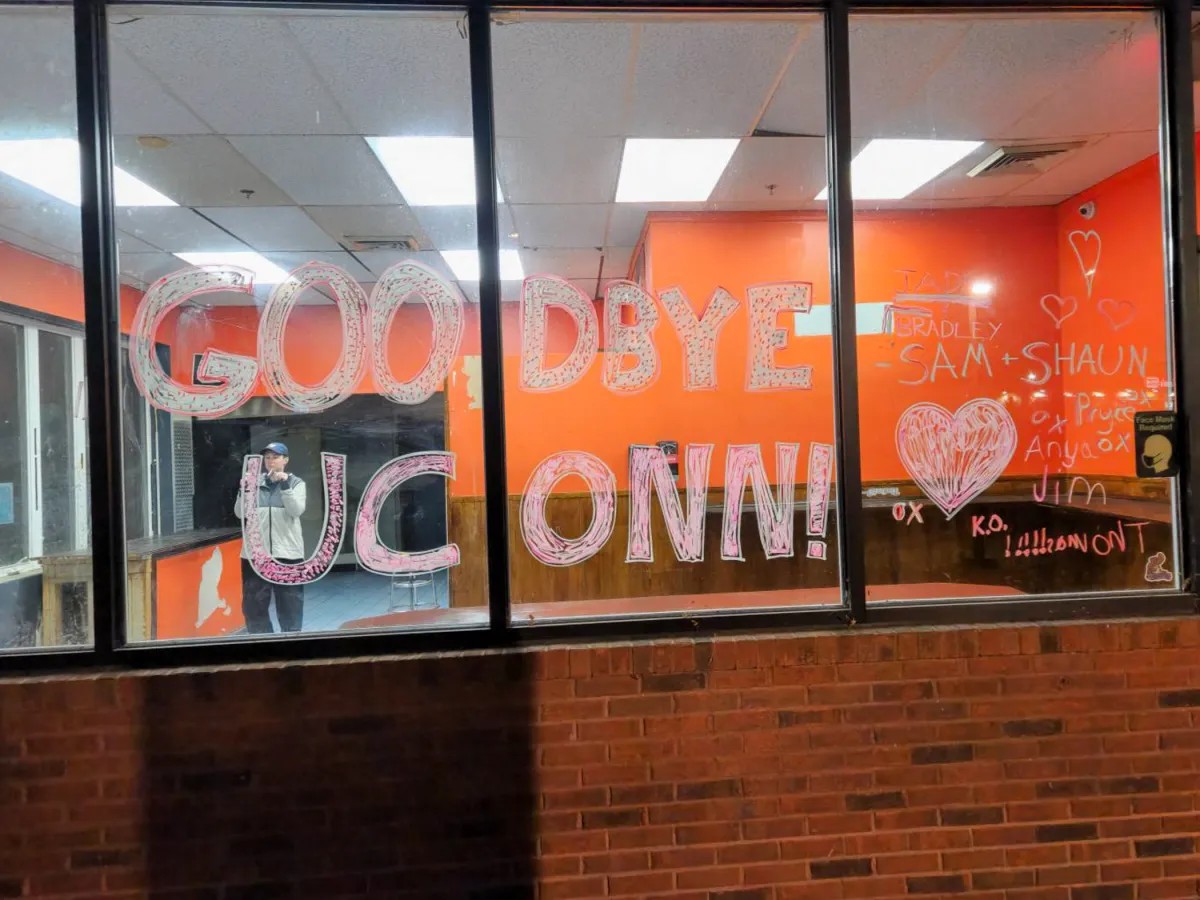
When Shaun Comins moved from Glastonbury to Storrs in 2007 to attend the University of Connecticut, his dream was to become an English teacher. It was the need for some extra cash that led him to a job at Sgt. Pepperoni, a local restaurant that had been serving the Storrs community since 1992.
Comins climbed the ranks quickly, becoming a trusted leader in the restaurant. Once he graduated, the “burned out” Comins decided to continue working at the restaurant to pay off his college expenses. That’s when an opportunity presented itself.
The then-owners of Sgt. Pepperoni, who had moved out of state years earlier, leaving Comins in the role of general manager, were looking to sell the restaurant. They offered it to Comins for around $175,000, and Comins accepted.
Along with his spouse, Sam Tolhus, who’d previously worked at Sgt. Pepperoni, the couple continued serving pizza to the UConn community for another 10 years.
But by the early 2020s they were drained and looking to do something new — to change locations or possibly sell the business to keep the Sgt. Pepperoni namesake alive. When they learned the building’s landlord had decided to sell the property, they faced a sudden time limit, a limit that ultimately forced them into a difficult decision: closing the restaurant.
It’s a decision that still stings for many students and alumni.
Sgt. Pepperoni’s fate isn’t unique. In the past decade, several small businesses near UConn’s campus have shut down. Sarah’s Pockets, Wally’s Chicken Coop, Baja Cafe, Husky Pizza and many others have come and gone, replaced by restaurants and other businesses that either sink or swim in the tough Storrs market.
“A lot of those restaurants were right by us,” Tolhus said. “Watching them all go one by one was sad.”
When Sgt. Pepperoni closed its doors in 2023, students and longtime customers didn’t just lose a pizza spot — they lost a piece of campus tradition. The restaurant sat on North Eagleville Road, just downstairs from Huskies Bar and Restaurant, becoming a haven for students seeking late-night slices, families grabbing a quick bite before basketball games and anyone looking for a meal after a night out.
For Tolhus and Comins, the loss of their shop wasn’t just about rent and expenses — it was about how fragile small businesses can be in a college town where the customer base flows with the student calendar, where campus space is shifting constantly and where long hours and late nights are necessary.
“Each way this campus has changed since we’ve been here has made it harder for a small delivery business to operate,” Tolhus said.
Running ‘a college place’ can come with challenges
The restaurant industry has long been known as a volatile one, with owners needing to navigate a complex web of trends, shifts in consumer habits and rising costs. These calculations can become especially difficult in college towns, which see significant changes in foot traffic depending on whether school is in session.
At UConn, those challenges have been compounded by another factor: a shifting student population. In recent years the school has grown rapidly, with the incoming freshman class of 2029 expected to push total enrollment to roughly 20,500 students, a new enrollment record for the Storrs campus.
That growth has sparked a wave of development on campus, including new dining facilities and academic buildings. The growth has also brought new challenges for businesses operating in Storrs, as off-campus residential and commercial development seeks to keep up with new demand.
On one hand, so many students can be a boost to a business. But when those students leave — on break temporarily, or at graduation, for good — it can make things harder to navigate. “One thing I don’t think people realize about businesses on college campuses is the split between the students and the locals,” Comins said. “Once a place gets labeled as ‘a college place’ locals won’t tend to go there.”
“It makes things tough when the students go,” he added.
The ebbs and flows of students can make things difficult in other ways. Comins said Sgt. Pepperoni focused the bulk of its annual operations on busy hours during the school year, closing during the shorter winter and spring breaks and adjusting hours when opened in the summer to focus on lunch service.
“Historically, the old owners never opened over the summer. They never even tried,” Comins said. “We did try, but it was tough.”
The restaurant also had to weather national changes like the pandemic, which heavily affected college towns and campus dining, a category that includes on-campus dining halls as well as restaurants and food businesses where college students make up a sizable portion of customers. Inflation also drove up costs, which for a place selling slices at college student prices made it difficult to turn a profit.
“COVID had a huge impact on collegiate dining,” said Robert Nelson, the president and CEO of the National Association of College & University Food Services. “I believe, though, it really had a huge impact on food service nationwide, on or off campus, in community towns, in communities with campuses and without campuses.”
Those issues compounded already present challenges for the food industry. “If you think about the last five to 10 years, even further past the pandemic, there’s all these things that the restaurant sector has gone through,” said Chad Moutray, a chief economist for the National Restaurant Association. “From trade wars, to the pandemic, to supply chain disruptions, and worker shortages, right? There was a lot of inflation right in that period of time, as well.”
In the years since, the restaurant industry has largely bounced back from the lows of the pandemic, though persistent inflation and the growth of takeout dining have become post-pandemic “hangovers” of sorts according to Moutray.
Comins told the Connecticut Mirror that Sgt. Pepperoni was able to receive some grant and local support during the pandemic, which helped the business stay afloat and kept it from many of the struggles food businesses in the state faced at the time. But the business soon faced a different challenge that ultimately led to closure.

A sudden end
Before closing down, Tolhus and Comins had hoped to sell the business. But the couple ran into issues getting their landlord to agree the lease terms potential buyers had requested.
As time went on, Tolhus started to hear rumors from other businesses nearby that the landlord planned to sell the building. The landlord later made the couple an offer: They could receive a one-year lease at a bigger discount than what they were paying, but after the lease ended in mid-2024 the building would be torn down.
The couple declined. “We told her no to the lease,” Comins said. “We were still salty about the whole situation.”
In April 2023, they announced on social media that Sgt. Pepperoni would close later in the summer, also posting a video of memories of more than a decade running the restaurant.
“As people leave Storrs and move back home, we will bake our last pie,” the couple wrote.
The Connecticut Mirror made multiple attempts to reach the building’s former landlord, Freda Sanderson, to discuss Sgt. Pepperoni’s lease, but did not receive a response.
Earlier this year, a Georgia-based real estate firm announced it had purchased the former Sgt. Pepperoni building, and would use the site to provide housing near campus — a need that’s grown in recent years. The site will be redeveloped into The Mark Mansfield, a mixed-use development that includes 738 housing units for students and 7,000 feet of retail space. The property is currently slated to be completed in 2028.
For food businesses, Storrs can be a competitive environment
In conversations with the Connecticut Mirror, business owners and industry experts noted that surviving in Storrs can be complicated, particularly as development needs in the area shift. Students can be a tough client base to engage, in part because young people are constantly flowing on and off campus and are often looking for new things to try.
“I think if you’re going to build a business, a food business, specifically on a college campus, you have to tap into their curiosity,” said Katrice Claudio, the food program manager for reSET, a nonprofit that offers incubator programs for startup businesses. “If they know what a Buffalo wing tastes like, they’re not going to go above and beyond to get yours.”
That challenge hasn’t stopped numerous businesses from cropping up in the area. According to the Mansfield Downtown Partnership, which handles economic development work and some community programming for downtown Storrs and the broader town of Mansfield, there are more than 70 businesses and organizations currently operating in downtown Storrs. That includes a mix of independent small businesses, national chains, local franchises and other operations.
When it comes to local businesses, “I think the one sort of unique characteristic is we’re very food heavy,” said Steven Ferrigno, the executive director for the partnership. “I think that’s because we are adjacent to 20,000 hungry undergrads.”
Ferrigno said businesses that do well in Storrs are able to expand their customer base beyond the student population, finding ways to appeal to local residents and nearby towns as well. “The town residents are going to be kind of the core that help support you year round, and then the students kind of help bump you up when they’re around,” he said.
The partnership works to help many of these businesses as they set up in the area providing resources and helping make broader connections.
That was the case for Nikki’s Dog House, a restaurant that opened in the area in July. The restaurant has had a location in Putnam for 45 years. The new restaurant in Storrs is its second location.
Restaurant owner Larry Groh, who runs the business with his wife Erica (their daughter Ali serves as the Storrs location’s manager) said that opening in Storrs was a chance to bring new business to an area that would be receptive to their classic menu of hot dogs, burgers, and old-fashioned milkshakes.
“It’s just like starting any new business where you have to get your name out there and go into the community,” Groh said of building out the Nikki’s customer base in its first months. The Mansfield Downtown Partnership has helped with some advertising and also organized a ribbon-cutting ceremony for the restaurant.
And while the restaurant is looking forward to engaging with UConn and has already served plenty of students, Groh said the business will work to appeal to as many people as possible.
“We’re not bringing down Nikki’s Dog House just for the college students,” he said. “We’re bringing it down for the local communities as well.”
At a time where economic conditions are shifting nationally, Ferrigno said he is optimistic about the business climate in the area. “I think people see the potential and the growth at UConn and the growth in that market, and they’re like, ‘you know what, this is an exciting place to be,’” he said.
A lingering campus memory
When you ask students and alumni today, many still remember eating at Sgt. Pepperoni during their first fun night at UConn or ordering delivery during a late-night study session. The youngest students who had the chance to eat at the restaurant are set to be rising seniors next year. When those students graduate in 2027, they will be taking some of the last remaining student memories of Sgt. Pepperoni with them.
After running the business for a decade, Comins and Tolhus said the memories will always linger.
Since the closure, the couple often find themselves looking back, fondly recalling late nights when the dining room was full or when they recognized returning students. Tolhus said some of her strongest memories are of the staff. Many became close friends who she still keeps up with.
Running the business for so long has transformed the former restaurant owners in other ways.
“I grew up here,” Tolhus said. “I wasn’t an adult when I started here and I was one when I left.”
In recent years, Tolhus and Comins have worked multiple jobs, including stints at restaurants near UConn’s campus. Tolhus is currently not working due to health issues, while Comins works as a manager at Connecticut Hall, the newest dining hall on UConn’s campus.
“But nothing feels the same as running your own place, because it’s yours,” Tolhus said.
When walking around UConn’s Susan Herbst Hall, you might still spot Sgt. Pepperoni merchandise. Their stickers dot surfaces around campus, and student-run social media accounts still mention nostalgia for the restaurant.
In time, these things will mean little to new students attending the university. The building where Sgt. Pepperoni once stood has already been torn down, soon to be replaced with hundreds of apartments as the region continues to usher in redevelopment. Other restaurants and small businesses will move into vacant spots around campus, ready to take their chance on making sales to incoming UConn students.
Tolhus and Comins said they still feel the love students had for Sgt. Pepperoni. But at this point, after years poured into the business and the challenges they faced running it, they doubt a comeback would ever be possible.
“I don’t think people realize how hard it is sometimes [to run a small business],” Comins said. “Even if you gave me a million dollars, I don’t think I can go back anymore.”