
By Brian Womack, The Dallas Morning News
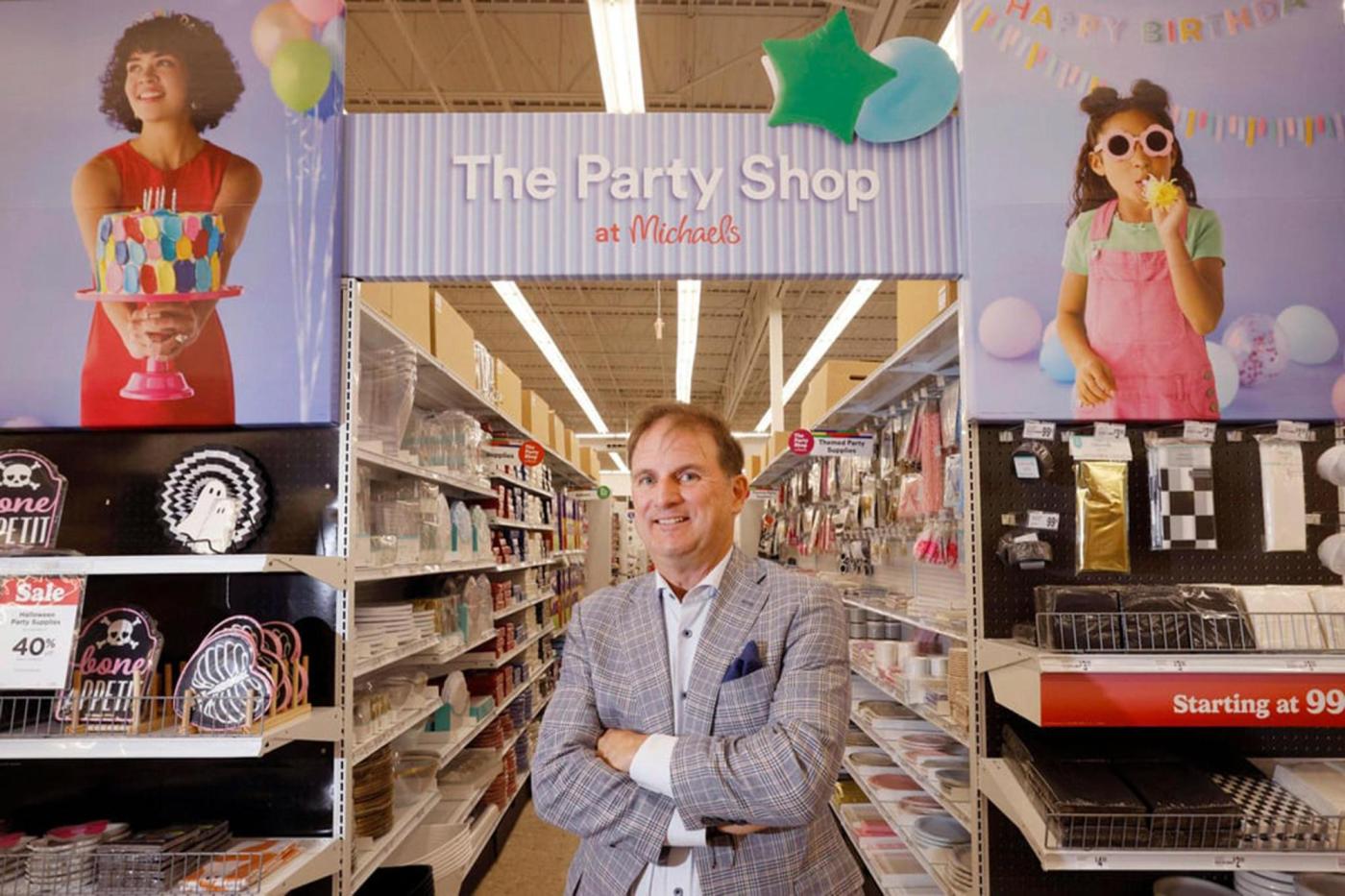
On a sunny morning in Flower Mound, Texas, at a Michaels store, David Boone, the CEO who joined the retailer earlier this year, walked among the shelves and shoppers.
The executive showed off a growing list of products among shelves packed with options like the right items for hosting parties, or growing fabric options for fans of sewing.
“We’ve been working hard for the last six months,” Boone, whose company is based in nearby Irving, Texas, said in a September interview.
The news features for Michaels are part of Boone’s vision for a company whose stores dot sites throughout the country in all but one state. Boone is focused on making Michaels “the center of creativity and celebration in every community,” Boone said.
Michaels, the big-box arts and craft chain with more than 1,300 locations, is trying to pick up the pieces left by stumbling competitors such as Joann and Party City, two bankrupt national chains hit hard by rising supply costs and growing online options. Michael’s has acquired the branding for one of those competitors and expanded its party space to take advantage of the demise of the other.
Boone arrived at a dynamic — and challenging — time in retail, amid economic changes that include inflation-weary consumers and whipsaw tariff policy. Yet he sees healthy demand — and a path forward.
Over the last six months, he’s looked to put resources into the stores for promising categories — while pushing innovations and empowering employees. Still, it’s early in his tenure, and there’s more to prove as he faces rivals such as Amazon.com, Hobby Lobby and Walmart.
“We’re (in) a very unique position in the market, and that’s why we’re growing,” Boone said. “It’s all about us carving out our space for Michaels. That is something I’m incredibly passionate about.”
While not providing specifics, Boone said the company is growing with its revenue and profitability.
‘Seems to be performing well’
Michaels — which sells products such as ribbons, frames and decorative candle making kits — is expected to show sales growth in fiscal 2025 after three years of declining sales, analysts at Standard & Poor’s wrote in a July research note.
“The tenor is still kind of short, but it seems to be performing well,” Mathew Christy, an associate director at S&P Global said in an interview. He noted there are macro challenges with the economy and the consumer that are still unclear.
Before Boone arrived, Michaels was under the leadership of an interim office of the CEO, after the previous longtime CEO, Ashley Buchanan, stepped down in January. Under Buchanan, who left to join Kohl’s, the company navigated the challenges of the pandemic and was taken private.
Boone came with a resume that shows he’s familiar with an industry that’s been under pressure. That included being the CEO of Staples Canada, holding leadership roles at TD where he served retailers ―and spending his early years at Loblaw, a grocer in Canada.
And that background is helping him now, said Scott Benedict, founder and CEO, Benedict Enterprises, an omni-channel retail consultancy.
“This is someone (who) … very much understands retail, very much understands larger format retail,” Benedict said.
“He’s got the kind of experience in retail in senior leadership roles. It feels like a very logical fit for him.”
Taking advantage of stumbling competitors
And it’s no secret that some retailers are struggling with closures, and even bankruptcies. Two of the more high-profile chains to fall are Joann, the large fabric and crafts retailer, and Party City, the provider of supplies for fun events.
With so many former customers of both stores likely being close to a Michaels, the Irving retailer can pick up some of that traffic.
There are “opportunities for Michaels to mop up market share in Party City’s and Joann’s core categories in proximate locations,” said John Mercer, head of global research, in an emailed statement. There were roughly 1,600 stores between Party City and Joann, he noted.
Earlier this year, Boone took one of his bigger steps as CEO in addressing that gap. The company said it acquired the intellectual property and private label brands of Joann, which struggled despite some rising interest in sewing and fabric.
Since then, Boone has rolled out “The Knit & Sew Shop” in its stores, featuring both the logos of Joann and Michaels. It includes a curated lineup of threads, fabric, yarn and other products for fans of sewing. The move comes after search for “fabric” surged by more than 75% over the past year, it said in September.
The Irving retailer offers fabric in over 840 stores and plans to add that to more than 250 more. It’s also boosted the amount of space for fabric by nearly one-fourth and has over 95,000 items available online.
“We have introduced … a ton more fabric than we’ve had, and we brought in a whole bunch of brands that Joann’s customers were looking for,” Boone said. “It was really a beloved brand, Joann, and they had a bunch of products that customers love.”
The company also is stepping up its game with what’s called the “The Party Shop,” an in-store area that gives shoppers a new option for hosting their fun events. That includes custom balloon bundles, and a big assortment of supplies.
It’s expanded its party space in every store to hold 700 new products such as tableware and themed paper goods.
“The reality is, we’ve been helping customers celebrate for many, many years,” Boone said. “And so what we’re doing is adding party supplies, adding party products, to the stuff that we already do.”
Amid these new rollouts, it doesn’t hurt that Michaels already has a lot of brand recognition — and it’s getting more cultural cachet. One of the hottest shows of the year, “The Summer I Turned Pretty,” shot an episode at a Michaels store in North Carolina.
Michaels benefited from its own reputation, as the retailer was contacted by the show to set up the shoot.
Investing in the future
The company is also bolstering its number of stores. This year, Boone expects to add about 20, though that’s down a little bit from the previous year.
But the focus is being put more on existing real estate.
“What we’re doing is building a little bit bigger stores, and it’ll be pretty consistent in the out years,” Boone said.
“We’re shifting our capital towards improving our existing store network. … We think we can improve the value proposition in each store by investing in the stores.”
Other improvements at the stores include a quick-turn framing service. For about $30, shoppers can upload a photo ― and then get a framed picture within minutes at stores.
But it’s not just about store improvements for Boone ― but the employees themselves. He’s worked to empower front-line workers who are at the shops, allowing them to talk and connect more with consumers, Boone said.
“One of the opportunities for the organization was to reduce the amount of administrative work that was happening at the store — free up time for those associates to engage with customers more,” Boone said
That extra work included checklists for reporting back to the home office to show that tasks were completed — rather than managing for better engagement with shoppers and providing some data points.
There are other efforts to connect with employees. About two months ago, Michaels brought together about 1,300 store managers in Irving for a conference, something that has not happened in about decade.
“People need to be excited about what they’re doing, otherwise they’re not gonna get our customers excited, our vendors excited,” Boone said.
And more recently, the company held “town hall” meetings at stores around the country that were hosted by managers on a Sunday. It aimed to better show how associates can engage with customers and to also train them on the new products and services.
Dealing with tariffs
While Boone can help with employees, one issue that’s beyond his control has been tariffs. Within weeks of taking the job, the White House announced new surcharges, including key countries with China and Vietnam. It’s an issue that grabbed headlines as many in the industry struggled to make sense of the changes and the potential for rising costs.
Yet the company’s risk with those issues have decreased, according to a research note by S&P Global Ratings in July. The chain store was taken off “creditwatch,” where it had been placed in April, with negative implications.
“We believe its financial obligations remain manageable over the next 12 months,” the note said. “… We expect Michaels’ operating strategies will support relatively stable profitability despite ongoing trade tensions.”
Boone has gone to work on tariffs, looking to address the challenge.
“We’ve optimized our supply chain,” Boone said. “So we have gone end-to-end to try and bring out every efficiency possible — every country of origin, changes that need to be made. And that has been the majority of our work.”
Growth is helpful, driving revenue and offsetting the challenges. Still, in addressing tariffs as well. Still, “the last place that we generally go is pricing,” he said. “If we do anything, we just focus on … predominantly (on) our promotional strategy and just how we promote products,” Boone said.
The company is looking to find pockets of value and provide price cuts. For example, it recently reduced the price of in-store birthday parties by about half.
Tariffs are just the latest issue for retailers. But this is an industry that lives with change — whether it’s been the move to online, or the power of mobile. Yet Boone can point to his experience in an industry that never sleeps.
“We all live through significant disruptions,” Boone said. “Retail is always changing, like there is always a new competitor. There’s always a new way of shopping. There’s always a new consumer need. It’s a fast-paced business, and you have to be on your game.”
©2025 The Dallas Morning News. Distributed by Tribune Content Agency, LLC.