
Two fatal shootings at the hands of police officers in a little over a week in Hartford that involved men experiencing mental health crises have drawn criticism and raised concerns over what services are available to individuals and how calls for help are handled.
The shootings of 53-year-old Everard Walker and 55-year-old Steven Jones have brought renewed attention to the systems in place for family members of someone struggling with mental health. Family members of both men had reached out for help before they were killed by a police officer.
Reactions to the shootings have been raw and wide-ranging, leading to several community demonstrations and unrest. Walker’s family has publicly said they intend to file a wrongful death lawsuit if city officials cannot come up with a resolution to avoid civil action.
Some advocacy groups, including Hartford-based Black Lives Matter 860, have called for some of the officers to be fired while making calls to “defund” the police — a mantra started in the wake of George Floyd’s death in 2020. Others have questioned the systems in place and whether they’re the most effective way to handle individuals with mental health needs.
According to the office of Hartford Mayor Arunan Arulampalam, the city partners with the Capitol Region Mental Health Center and the Community Renewal Team to deliver mental health services when someone is in crisis or distress.
But police say the services someone receives can be dictated by resource limitations, high call volumes and a slew of situational factors.
Family of man killed by Hartford police weigh wrongful death lawsuit. ‘They took my world,’: wife
Hundreds of call to date this year
According to Hartford Lt. Aaron Boisvert, families who reach out to 211 for help will generally receive services from social workers with a crisis team from Capitol Region.
“But sometimes they’re not available,” Boisvert said. “Sometimes they’re tied up on other mental health calls. This is how often they come in.”
Christopher McClure, a spokesperson for the Connecticut Department of Mental Health and Addiction Services, which oversees Capitol Region, said the state partners with a number of police departments “across the state” to provide mobile crisis teams.
According to Boisvert, Hartford police responded to 1,937 calls involving an emotionally disturbed person in 2025. Prior to the incident on Blue Hills Avenue, police had responded to 341 such calls already this year, he said.
“That gives you an idea how often we go to these calls,” Boisvert said. “Multiple times a shift officers are going to these calls.”
Boisvert said police will respond to mental health calls if social workers are not available or if their assistance is requested. They also need to respond if safety is a factor.
“There’s a whole litany of reasons why a social worker may be uncomfortable going to that situation alone and want to have a police officer come with them,” said Thomas Wydra, executive director of the state Police Officer Standards and Training Council — which dictates accreditation standards for all Connecticut officers.

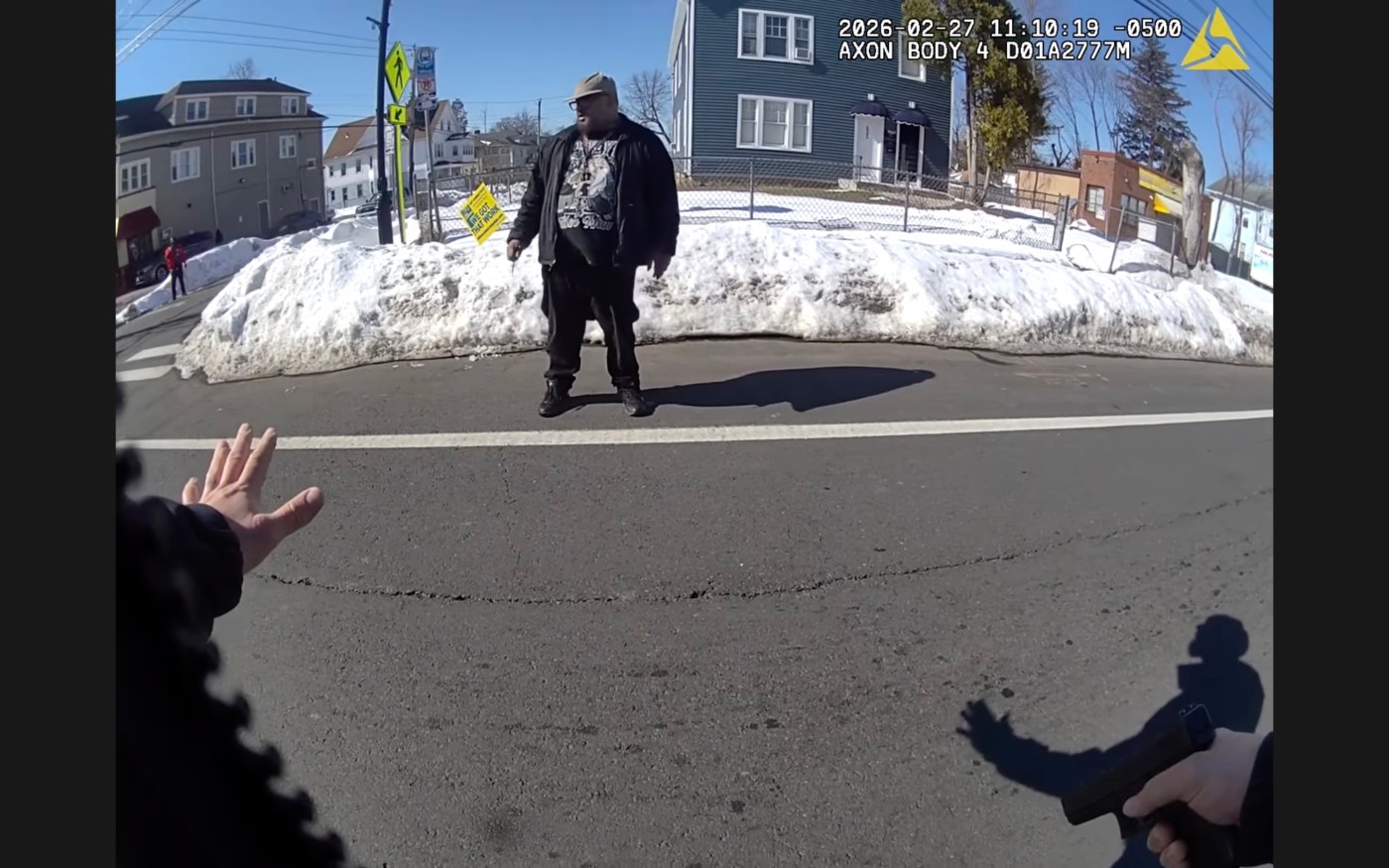
Video from a police officer’s body camera taken moments before a man was shot and killed. (Connecticut Office of Inspector General)
In an ideal situation, Wydra said dispatchers will collect as much information as they can about the individual experiencing a crisis before anyone responds to the scene. That can include talking to family and learning what kind of services may have previously been provided and whether there is any history of previous issues.
But any time a potential threat is involved, Wydra said it changes everything. He said the circumstances of the situation will dictate whether police or social workers will take the lead at the scene. He also said situations are often fluid and can evolve rapidly.
According to Boisvert, police need to respond immediately to any “threat of violence.”
“If there’s a threat of violence or weapon implied or hostility or something that requires a police presence, we respond immediately,” Boisvert said.
According to Boisvert, if the situation allows, Hartford police always prefer to let social workers talk to someone in need of mental health services.
“If social workers are there, we always defer to them,” Boisvert said. “We let them take the lead.”
“Circumstances will tend to dictate that,” Wydra said, adding that one of the primary objectives of police is ensuring the scene is safe.
“In a situation like that, not even fire or EMS will step on scene until the scene is safe,” said Wydra, who spent 26 years with the Hamden Police Department before retiring as chief in 2018.
In Walker’s case, his family said they did not want a police response when they called 211 after he ran out of his medication on Feb. 19. Two social workers who responded to Walker’s Capitol Avenue apartment requested assistance from Hartford police, according to a preliminary report from Connecticut Inspector General Eliot Prescott.
An armed man was fatally shot by CT police. What the video shows
‘This isn’t how police wanted it to end’
The incident turned fatal when Walker raised a knife toward a policeman during a struggle inside the apartment after he ignored demands to drop the blade, the report and body camera footage showed. Officer Alexander Clifford fired several shots at Walker, who was later pronounced dead at a hospital, Prescott said.
In Jones’ case, it does not appear that he received any mental health services when his family member called 911 on Feb. 27 and said he had cut himself and was armed with a knife. Three officers responded one-by-one to Blue Hills Avenue and made repeated demands for Jones to drop the knife as he advanced toward multiple policemen with the blade, Prescott wrote in his preliminary report on the shooting.
Police appeared to have calmed Jones down while forming a circle around him in the street before Officer Joseph Magnano arrived and began shouting for him to drop the knife, body camera footage showed. Magnano backed away and made numerous demands for Jones to drop the knife as he advanced toward the officer, the footage showed.
Magnano fired nine shots at Jones, who was in critical condition for several days before he died in the hospital, according to Prescott.
According to McClure, a Mobile Crisis Team was preparing to respond to the Blue Hills Avenue scene if they were requested when they learned that shots had been fired.
Hartford police bodycam footage shows man shot at nine times following mental health call
Though Hartford and multiple other police departments have their own academy for incoming officers, Wydra said the accreditation standards are dictated by POST. He said recruits must undergo four hours of training designated solely to de-escalation techniques but that the topic is littered throughout the nearly 30 hours of curriculum covering mental health and related issues.
“We could probably successfully argue we have the most highly trained police officers in the country,” Wydra said.
State Rep. Jillian Gilchrest, a West Hartford Democrat, said she watched the footage from the shooting of Jones and believes it was a “failure” to someone struggling with mental health.”
“I felt horrible for everyone involved, quite frankly,” she said. “The community members, the family, the individual who was obviously struggling and the law enforcement. This isn’t how police wanted it to end.
“It just felt like such a failure in a system where we actually know there are tools where we could do better,” Gilchrest said. “And there are communities who have those tools and are able to do it better.”
“No one is born knowing how to take care of people with mental illness,” she said. “And I think that’s what we have to remember is everybody’s trying to do the best they can with the resources they have.”
Gilchrest, who works as a social worker and helped spearhead Southern Connecticut State University’s Social Work and Law Enforcement Project, said she’s an advocate for police departments having social workers on the payroll.
“We have social workers on the force in West Hartford,” Gilchrest said. “That’s the best practice.”
The biggest criticism Gilchrest said she hears when she receives pushback from critics is the false idea that the model she believes in involves arming social workers with firearms.
“No, that’s not the model at all,” Gilchrest said. “But by having social workers partnered with law enforcement when a call comes in, the social workers and police officers can triage it together and decide who is best to respond, and sometimes it is both.”
In a statement issued in response to the shooting of Jones, Hartford Police Union President James Rutkauski alluded to the need for police to receive more help with mental health calls.
“Officers should not be society’s default mental health responders,” Rutkauski said. “We ask for renewed commitment from our legislators to remove police from being the vanguard of what should be a mental health professional response: to provide better tools and support so these tragedies can be prevented in the future.”
Rutkauski also said the union stands by Magnano and believes the shooting was justified.
“We ask for patience as the state investigation proceeds, respect for the officer who acted to survive a life-threatening encounter,” Rutkauski said.
Both fatal shootings remain under investigation by the Office of the Inspector General to determine if the use of force was justified under Connecticut law.