
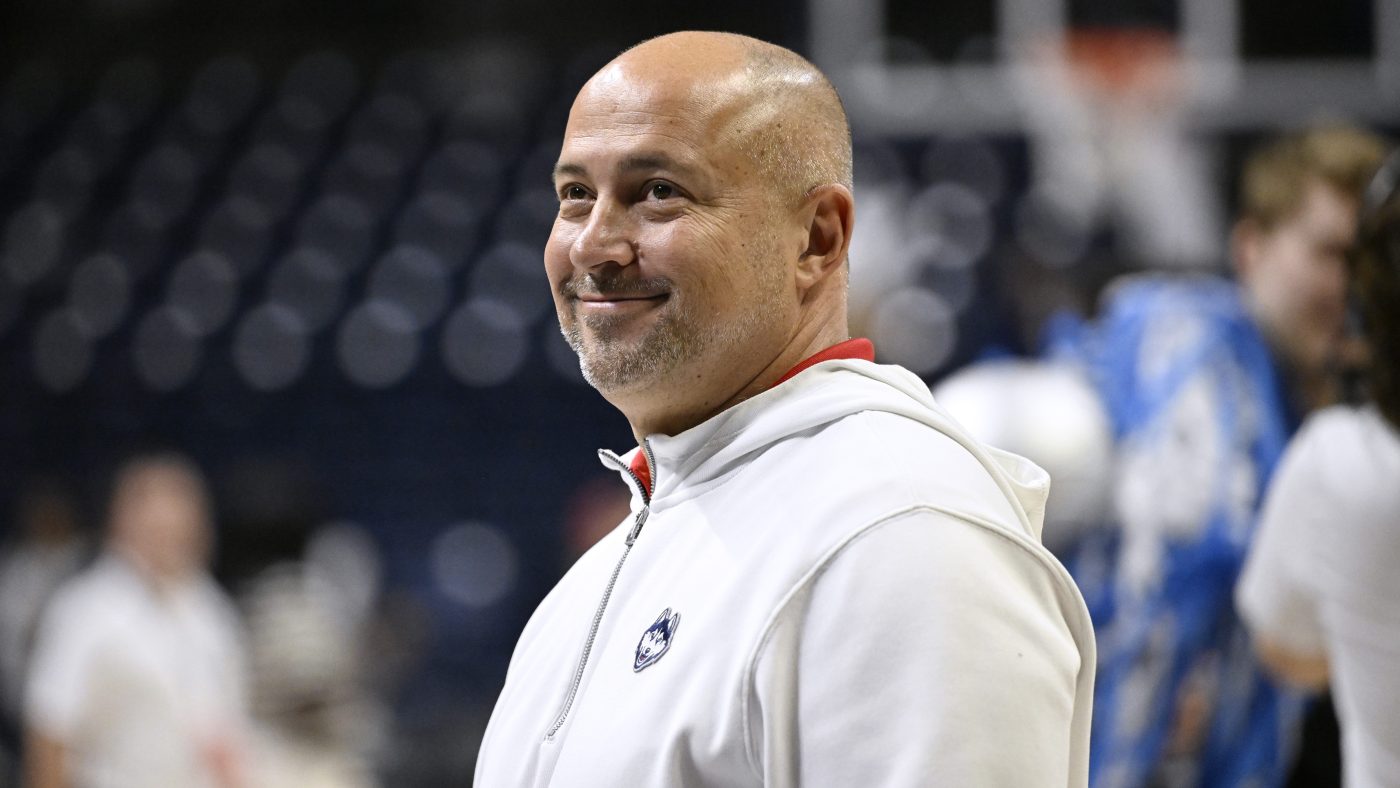
Ten years ago this week, David Benedict arrived at UConn with a promise: “We are going to compete in everything.”
The new AD faced an array of challenges and hazards, some staring him straight on, others that would come from hidden places and could not have been foreseen on March 1, 2016. But ever driven by a fear of seeing UConn’s athletic empire wane on his watch, he has tackled all of it: Conference realignment, coaching changes, program building and rebuilding, rapid, seismic changes in student-athlete recruitment and compensation, a pandemic and budget crises.
“As a first-time AD you have all these dreams and goals and aspirations and think you’re going to conquer the world,” Benedict said at the start of a 90-minute conversation with The Courant this week. “But there is no way you can ever understand what you are walking into. I’m not sure there is not going to be more change in the next five years than there has been in the next 10.”
Maybe Benedict, 54, has not conquered the world, but he has survived, UConn athletics has attained and sustained a level of excellence many have long been suggesting would be unsustainable, and he has reached his 10th anniversary on the job with a degree of calm and confidence, a level of autonomy with which he is comfortable, as another March Madness begins to unfold around him.
Sign up here to get UConn sports news straight to your inbox: UConn Alerts
“Your goal in a position like this is one, you want to leave it better than you found it,” said Benedict, who earns roughly $1.34 million per year, eighth highest among state employees as of 2024. “Two, you want to build on what has already been created. If we were to measure things today, I would say we have achieved success in both of those areas, not to say there isn’t a lot more to do. If you look at where we started in 2016, in March, to where we are today, there has been a lot accomplished.”
The conference upheaval
The ongoing challenge Benedict has faced across 10 years has been UConn’s conference affiliation. After years of relative prosperity in the original Big East, the breakup of that league in the five years before Benedict was hired left the university standing on the platform as the power-conference gravy train pulled away.
UConn was competing in the American Athletic Conference, which included the FBS football-playing remnants of the Big East and scattered additions from other conferences. The football program was in a steady decline and the men’s basketball program, after winning a national championship in 2014, was in a free fall.
“To say that, ‘Hey, the conference situation was responsible for everything that was not going well,’ I’m not suggesting that,” Benedict said, “but things evolved in a way that made it much more difficult for a variety of reasons. Conference affiliation and football were the primary things (then-president Susan Herbst) and I discussed.”
When Benedict arrived, he formally signed contract extensions that had been negotiated by predecessor Warde Manuel before Manuel left for Michigan, including men’s basketball coach Kevin Ollie, who’d won the 2014 championship and had a highly rated recruiting class coming in. There was football coach Bob Diaco, who’d gotten UConn to a bowl game in 2015, his second year.
Former UConn men’s basketball coach Kevin Ollie wins arbitration case, awarded over $11.1 million
“It took maybe six months to a year to understand and appreciate what was happening and some of the things that were deteriorating in a way that I’m not sure, had we stayed (in the AAC) it wouldn’t have continued to deteriorate,” Benedict said.
Most serious was the deterioration in men’s basketball, in the standings, recruiting and attendance.
“For us to build without men’s basketball returning to its status as one of the elite programs in the country was hard for me to fathom,” Benedict said. “It was really important for this university and this state to accomplish everything we wanted to, including getting football where we wanted to, basketball had to be back in a place where it was filling up arenas as opposed to showing up half empty.
“That was a bit of a shock to me when I got here, even though we had just won a national championship n 2014, the interest level was not what I expected and that was impacting us in a lot of different ways. I kept thinking I’m going to be the athletic director running this place when it disappears and people say 20 years later, ‘What happened to UConn?’ It was already happening.”
Without an invitation to join one of the power conferences, Benedict led UConn through a narrow path. The school accepted an opportunity to join the new Big East, with its 10 schools that prioritized basketball, and go independent in FBS football. To save men’s basketball without putting football on a road to extinction was thought to be impossible in June 2018, by which time Dan Hurley was hired to replace Ollie, when UConn joined the Big East.
“I couldn’t stand up in front of everybody at Madison Square Garden when we announced the return to the Big East and people started in on me, ‘You just destroyed football,’ I wasn’t in a position to say I guarantee that’s not going to happen,” Benedict said. “But I don’t know that I would have ever done something where I felt that (destroying football) would eventually be the outcome. In contemplating that, it’s stuff you think about 24 hours a day for a long period of time. I thought it was a calculated risk.
“While we all understand the college environment and the thousand-pound gorilla is college football without a doubt, I truly believed that without the brand and ability to reposition ourselves as a national competitive brand in the sports of men’s and women’s basketball, I truly felt without basketball continuing to place us in the national conversation, everything was going to be much, much harder.”
The move to the Big East, along with Hurley’s arrival, achieved the desired result. The UConn men began selling out arenas for games against old, familiar rivals and won national championships in 2023 and ’24. Football, after a terrible start as an independent, recovered with the surprising hire of Jim Mora in 2021. NCAA changes, including name-image-likeness money and the transfer portal, have changed recruiting and made football success possible.
“Over the last few years people are seeing what we’ve planned and what we hoped for,” Benedict said. “The fact we have Maryland, Syracuse and North Carolina coming to our stadium in East Hartford, and that we beat (Duke) the ACC champion in front of a good crowd, those are all things that indicate we made the right decision. I’m not sure, if we don’t go to the Big East, that Dan Hurley is still here and we win two national championships.”
Coaching carousel
Benedict says despite what happened before his arrival, he “owns” the extensions for Ollie and Diaco that were to cost UConn about $15 million after they were fired.
After back-to-back losing seasons, Benedict fired Ollie citing “just cause” because the school had alleged NCAA violations. After several years of complicated and bitter litigation, an arbitrator awarded Ollie all $11.3 million he was owed, and more for his legal fees.
“The way the whole thing played out with the change with Kevin, I don’t know you could expect that kind of situation to be nonemotional,” Benedict said. “When you add emotion to things, and you add a lot of money, you’re bound to have challenges. Yeah, I think the whole situation was very unfortunate. Kevin’s a part of this family, he’s a part of he history here, I’m sure at some point in time, whenever he is ready, there is going to be an opportunity for him to be re-engaged and welcomed back.
“He won a national championship here, and Kevin was the leader, he owned it, and he won a national championship. He also owns everything else that went along with it, but he’s a part of our history as a student-athlete and a coach. It’s unfortunate that played out the way it did. Could we have handled it differently? Would it have made a difference? I don’t know. I got an education on collective bargaining at UConn and there are things you would have done differently that might’ve generated a different outcome.”
Hurley was hired from Rhode Island to take over men’s basketball in 2018.
“Programs need different things at different times,” Benedict said. “With Dan, the things that stood out: He’s a Hurley, has Northeast ties, is a Big East guy, he coached at the high school level and I have great respect for people who experienced the high school level because my Dad was a high school coach. Whatever the boxes were, there weren’t many things Dan Hurley didn’t check.”
After the football team tanked in the fall of 2016, Benedict made an abrupt decision to fire Diaco and hire Randy Edsall, who had left after leading UConn to the Fiesta Bowl in 2010. He was 6-32 in his second go-around before retiring early in 2021. In November, Benedict spent four days in Idaho to convince veteran NFL and college coach Jim Mora to take the job.
“We had to win,” Benedict said.
Though occasionally volatile, Mora led the football program to three bowl games in four years, back-to-back nine-win seasons. When Mora left for Colorado State, Benedict moved quickly to get Jason Candle from Toledo, which has proven to be a popular choice. He was allowed to make the hire without a committee, autonomy in running the athletics department that not all ADs have.
“I still think the most important thing I can do is hire coaches,” Benedict said. “You have to find people who have to care about the right things, but who are elite competitors. Everyone wants to win, but winning is hard; winning at the level we’re trying to win at is really, really hard. To say its life and death is extreme, but we have to have people who feel that if we’re not achieving at the level we want to, you could walk in and get fired.”
Among the things that make Benedict feel most satisfied is the stability in his coaching ranks, Geno Auriemma staying past his 40th season as women’s basketball coach, Hurley, hockey coach Mike Cavanaugh, baseball coach Jim Penders among those who have resisted the chance to move to potentially more glamorous or higher-paying jobs. Despite what happened with Ollie and Diaco, Benedict has remained proactive in extending contracts and keeping salaries competitive.
“Having someone like Mike Cavanaugh turn down an opportunity to go to BC, Dan blowing off Kentucky without giving it a thought or making the decision not to go to the Lakers. When people choose to stay it says something about how they feel about the place,” Benedict said.

Decisions, decisions
In May of 2020, Benedict was given a mandate to cut the athletic budget and reduce its subsidy. Losses due to the pandemic and the Ollie settlement made that process more difficult, and his decision to cut some sports proved controversial. His attempt to cut the women’s rowing program resulted in litigation that resulted in the program continuing, with upgrades, to comply with Title IX.
For fiscal year 2025, UConn’s self-generated revenues rose to $67.2 million, nearly 60 percent of its total expenditures. Direct institutional support decreased from over $40 million to $31.7 million in 2024, and then rose slightly to $32.3 million for fiscal year 2025.
There will be new pressures, such as the NCAA’s settlement and agreement to provide revenue sharing, in addition to name-image-likeness income for student-athletes.
“I’m going to continue to make what I consider are the best decisions for the institution,” Benedict said. “They may not always feel that way to whoever the affected party is, but ultimately I can be convinced that I don’t make decisions based on whim. I don’t make decisions based on personal preference. It’s ultimately trying to drive and create the organization we need to have to be successful. The wisdom that comes from these decisions, you should be learning all the time, and if you learn from these outcomes, positive or negative, you can be better.
“There is no doubt if faced with similar type decisions moving forward, the things you learn, every experience I’ve been involved with has shaped me. I don’t want to say I would be more thoughtful, because I don’t make decisions without trying to consider all the angles, but there is a measure of cause and effect, upside, downside risk, you’re better informed.”
During Benedict’s decade on the job, money has been raised for new facilities for baseball, softball, soccer, volleyball, lacrosse and hockey. A new facility for men’s golf, another program that was once on the chopping block but was saved by alums, is planned.
Benedict hopes for a day when basketball-driven schools get a bigger piece of the March Madness pie, a game-changer on several levels.
“The Division I schools that play college basketball continue to operate on a model where you’re only getting 25 percent of the revenue associated with your sport where the (football school) gets pretty much 100 percent. … If basketball ever is truly structured in the same way college football is, we become a much more valuable asset.”
Dom Amore: A dash of UConn, a cup of Toledo, mix well and the Jason Candle era is underway
Forward into the unknown
When Benedict came to UConn, the term “dream job” was mentioned, even if his roots are in the west. ADs don’t usually stay this long in one place, and he has survived multiple changes at the university’s presidential level, as well as powerful coaches.
“I think I fit this place really well from the standpoint of culture mentality and trying to overachieve,” Benedict said. “As long as that recipe, which I think has been here for a long time, continues on, I don’t know that there are a lot of better jobs.”
What’s to come?
UConn has been considered, but not yet invited to join one of the four remaining power conferences that includes the SEC, Big Ten, Big 12 and ACC.
“What hasn’t been accomplished is, we are not part of a league that distributes $40, $50, $60 million a year. Private equity is circling college athletics like road kill, but sustainability is always going to be at the forefront of my mind. It requires us to be entrepreneurial, creative, leverage the resources we have.
“I firmly believe we are better than many athletic programs that reside currently in what is referred to as the Power 4, that’s undeniable based on results alone. The frustrating part is you have people sitting around a table that look at you and evaluate you that have no context for what’s been built here.”
College athletics will continue to evolve, Benedict said, so will conference affiliations and so will UConn. His decade here has taken UConn through twists and turns, through dark places and into the spectacular spring sunlight of championship parades. Benedict likens his job to being on a “hamster wheel,” running hard all the time to stay in the same place.
But, by and large, it’s a good place.
“You might want to use the phrase, ‘This is never going to happen,’” Benedict said. “And as soon as you say that, that thing is going to happen. I probably agonize over making decisions or making a hire in a different way than I did when I first got here because of things that have happened. … As long as we can continue to give a return on the investment, it would be a travesty for there to be a change in the mentality of supporting something that is very hard to build and might be even harder to sustain.
“But I would hate to think what this place would be like, as a university and as a state, if we were some also-ran program that wasn’t part of the national conversation. I’m terrified of that happening on my watch, terrified. It drives you in a way that I will do everything I can to make sure that doesn’t happen.”