
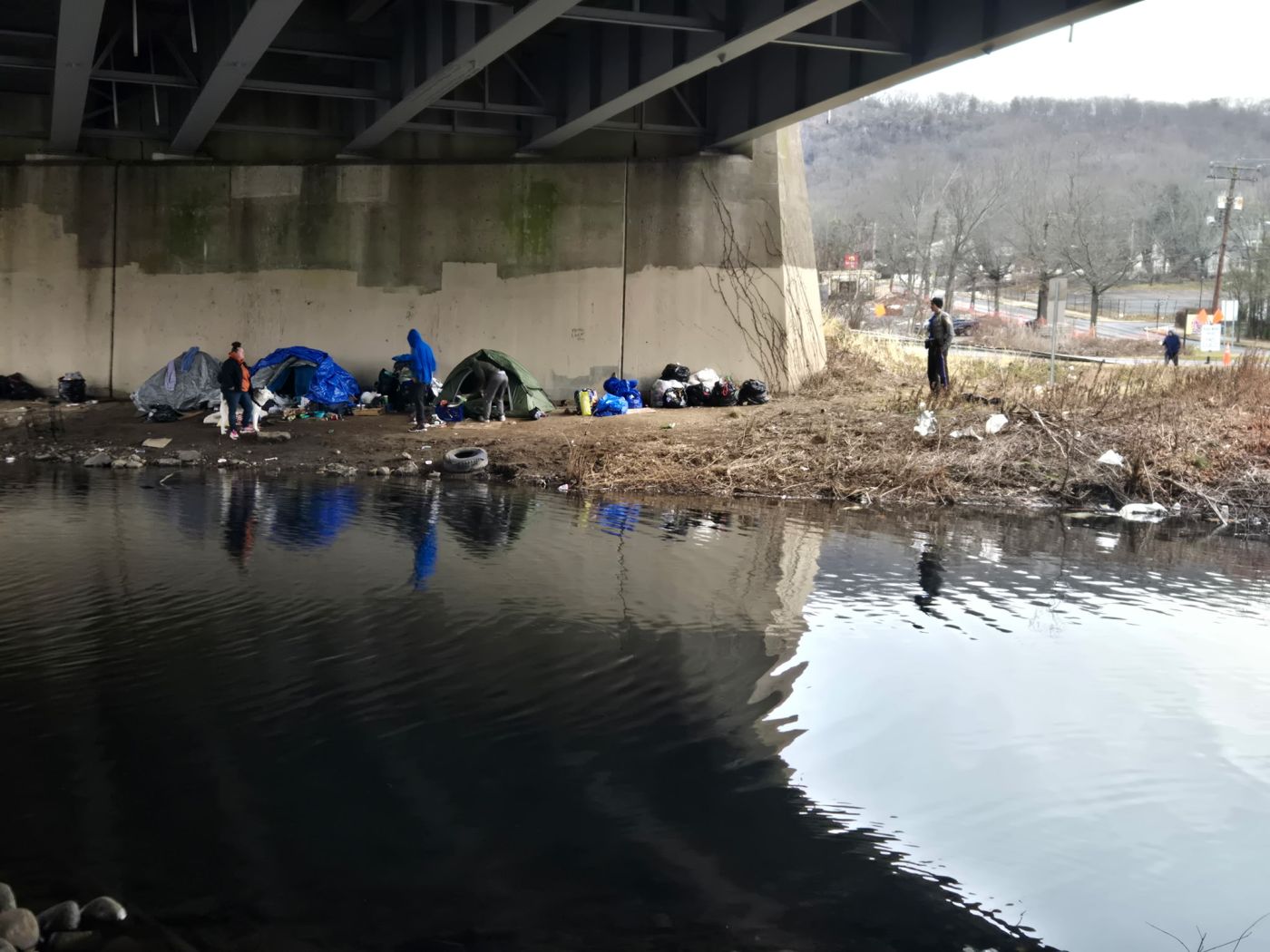
With nowhere else to go, homeless people are increasingly settling on state property, where police are less likely to frequent.
But eventually bulldozers arrive to remove the encampments, often sweeping away medications, personal documents and their owners’ few possessions. Advocates are now asking for a state law to standardize how removals are handled.
The Connecticut General Assembly‘s Transportation Committee recently heard a proposed bill that would standardize the removal of the encampments, giving the unhoused individuals fair notice as well as providing storage and recovery of their belongings.
The bill would require the Connecticut Department of Transportation to “develop a plan to respond to temporary encampments by persons experiencing homelessness on any state highway right-of-way or real property in the custody of the Department of Transportation.
The bill is co-sponsored by Rep. Laurie Sweet, D-Hamden, Rep. Nick Gauthier, D-Waterford, and Rep. Nicholas Menapace, D-East Lyme.
“HB 5235 is one of the priority bills for the bipartisan End Homelessness Caucus. It was brought to us by advocates. This and 5260 were marked as a priority by the caucus because it’s the most critical areas for advocates,” Menapace said in a statement. “The bill requires the Commissioner of Transportation to develop a formal plan for how the state DOT handles homeless encampments on state highway property or on state-owned DOT land.
“The bill is looking to establish timeframes and coordinate efforts as standard practice that currently is nonexistent with the DOT. Sometimes the DOT removes things right away, sometimes it doesn’t. We want to give people time to gather their belongings, and for outreach teams to be contacted to provide assistance,” Menapace added. “The bill explicitly requires a humane, services-first approach from the DOT — it can’t just sweep a camp without first offering shelter and coordinating with social services.”

The CTDOT in 2022 adopted an internal homeless encampment policy aimed at ensuring that “the relocation of individuals experiencing homelessness and related encampments from CTDOT property is carried out in a reasonable, humane and environmentally responsible manner,” said CTDOT commissioner Garrett Eucalitto in written testimony to the Transportation Committee.
According to Eucalitto, unhoused individuals are given at least 72 hours’ notice prior to a site cleanup as well as “reasonable protection” of their personal property and time to relocate that personal property in a new location. Eucalitto said, in most cases individuals were given multiple weeks’ notice.
He said the CTDOT helps to facilitate access to shelter, warming centers, substance use treatment and mental health facilities for the homeless individual through the CTDOT’s Transit Homeless Outreach Program, which includes a partnership with the Department of Mental Health and Addiction Services.
“At CTDOT, we are proud of the dedicated efforts of our staff and the strong collaboration on this issue with Department of Housing, The Connecticut Department of Mental Health and Addiction Services, local government officials, and outreach provider agencies to ensure these cleanups are carried out in the most humane and reasonable manner possible,” Eucalitto said.
“Without additional staffing and resources, we’re not in a position to expand efforts, and generally, we do not seek to clear encampments unless there’s a specific request that comes in from a municipality or from a legislator,” Eucalitto added.
Sarah Fox, chief executive officer of the Connecticut Coalition to End Homelessness, strongly supported the proposed bill.
Fox sounded the alarm for the growing homelessness issues in her written testimony that cites Connecticut’s 2025 Annual Point-in-Time Count numbers that homelessness is up 44% since 2021.
“Over the past two years, the stories I hear from across Connecticut have changed,” Fox said. “More families. More older adults. More children. People who have lived and worked their entire lives are experiencing unsheltered homelessness because of a life event, losing a job, a health crisis, or a rent increase they simply cannot absorb. No one chooses this. This is a math equation. More people are losing housing than our system is currently equipped to absorb.”
Fox noted that 11% of Connecticut adults, which included 320,000 people, are reportedly running out of money for housing in 2024, which doubles the rate from a decade earlier.
“That inflow means more people need outreach, shelter, and housing navigation services. Our system has not been resourced at the scale required, and that gap is now a public health and public safety issue, including transportation property,” Fox stated.
Fox said this bill “moves Connecticut toward a coordinated, humane approach” and that the bill would provide respectful outreach and engagement with trained personnel and coordination with municipalities and service providers to offer assistants before removals.
Fox suggests a 14-day notice for non-imminent threats with some exceptions for immediate hazards. She also suggests requiring “planning for transportation-oriented safe alternatives, including safe parking for individuals living in vehicles.”
“If people have nowhere lawful and safe to sleep, they will continue to end up on Transportation property because it feels like the only option. The National Alliance to End Homelessness is clear that interim strategies do not solve homelessness, but can create temporary, safer alternatives when they are voluntary, low-barrier, and explicitly linked to pathways back to housing,” Fox said.
Billy Bromage, the lead organizer with the Unhoused Activists Community Team, wants to see more help for the unhoused.
“It is U-ACT’s position that evicting people from public land when they have nowhere else that is safe to sleep is a violation of human rights,” Bromage said.
“We have seen the devastation wrought on the lives of our members and other unhoused people when they have been evicted from DOT property over the years,” he said. “Many have lost their belongings, including survival gear, essential medication and identification. They have rarely ended up in a safe, indoor space to stay. Almost all of them have had to set up camp or sleep somewhere else that is less safe than the location on DOT land they were forced to leave.”
Bromage referenced a mid-January DOT “sweep” in the Pond Lily area on the New Haven-Woodbridge line. More than six people were staying in the space and were “forced to relocate” the day before the cold weather emergency was declared by Gov. Ned Lamont.
“No one evicted was offered housing of any kind,” Bromage said, and were “put into vulnerable situations with no regard for their well-being.”
According to Bromage, the DOT crew put boulders on the bridge where the encampment was to make it completely uninhabitable to anyone experiencing a housing emergency.
“I encourage the Transportation Committee to order a suspension of all evictions from DOT-held land until a procedure can be determined in cooperation with the interagency council on homelessness to guarantee housing for all people prior to a DOT-led sweep,” Bromage said.
Officer Christian Bruckhart said the New Haven Police Department was not on the call in the Pond Lily area because the incident occurred on state jurisdiction.
Bruckhart said the department’s COMPASS team has been conducting daily targeted outreach for the past several months in areas known to be hotspots for homeless people congregating, including the Whalley/Pond Lily area. Outreach workers offer care packages and encourage people to connect with services.
“The city overall offers more in terms of housing and ancillary services (such as COMPASS) for the homeless population than any other municipality in the region and probably in the state,” Bruckhart said.
Sweet, a co-sponsor of the bill, said she was alerted to the Pond Lily encampment and would like to see the 72-hour window expanded to two weeks for people to leave encampments.
“I received two photos of folks who had been living beneath the highway and who were there for four to five months and were given 72 hours to move. The first photo shows several tents and folks’ belongings. And then there’s the after photo, and that just shows boulders. Simply said the 72 hours wasn’t enough time,” Sweet said. “Working with street outreach in my hometown of Hamden, I know they visit weekly and 72 hours is not enough time to move people with dignity, coordination, compassion, consistency, and care.”
State Rep. Marcus Brown, D-Bridgeport, the vice chair of the Transportation Committee, said he feels it’s important for unhoused from all communities to have the same rights.
“They live on the streets so anything you take is going to take away a massive amount of their personal life, so we’ve got to do better,” Brown said. “If we’re going to sweep these people without any care in the world about their personal belongings, we’ve got to do a better job.”