
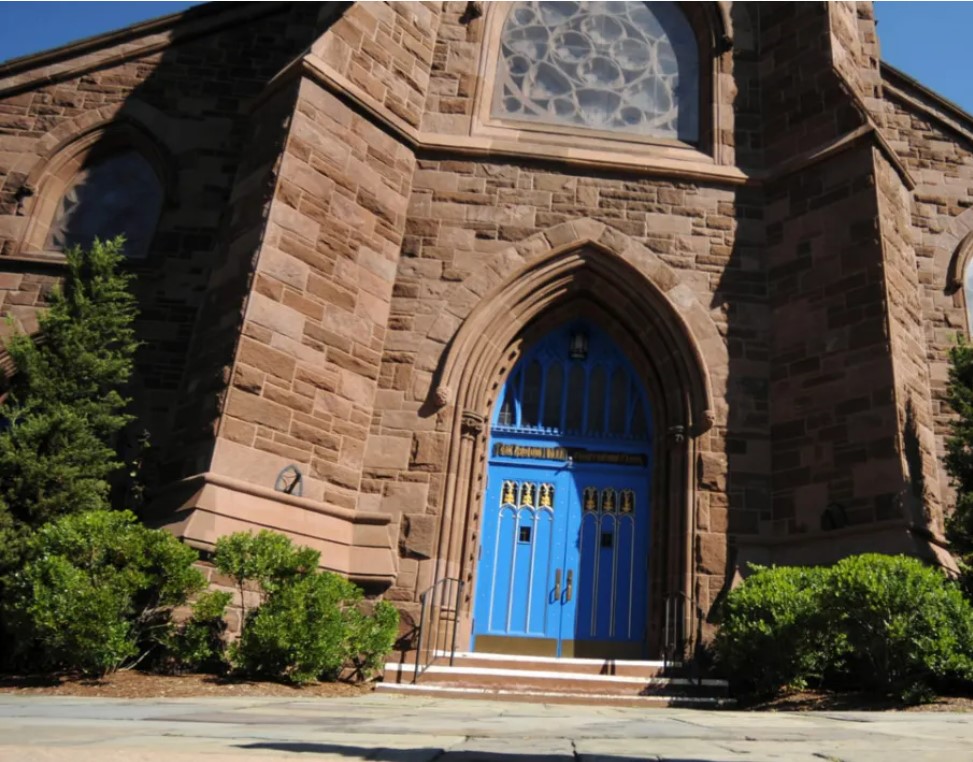
Affordable housing advocates along with dozens of churches across the state are trying to launch the so-called YIGBY campaign in Connecticut this week by supporting a proposed law making it easier to build apartments on church-owned land.
The Yes In God’s Backyard movement bills itself as a creative way to quickly construct affordable housing, even in highly built-out cities or affluent suburbs.
The core principle involves applying a type of 8-30g approach to affordable housing proposals on land alongside churches, temples or mosques, largely making the religious institution and its development partner exempt from local zoning rules.
It’s a strategy already being in California, Florida and elsewhere, with advocates calling it a win-win for communities that get fast-tracked affordable housing as well as the host churches, which are often land-rich but cash-poor.
In the first step toward getting similar legislation in Connecticut, the General Assembly’s Planning and Development Committee on Wednesday is holding a hearing on HB 5396. If passed, that bill would sharply reduce the ability of Connecticut communities to block housing proposals on church land if at least 30% of the units are set aside as affordable.
So far, leaders or parishioners from dozens of Connecticut churches have sent endorsement letters, and more are expected to testify in person at the hearing. But at least one regional planner is calling on lawmakers to be sure there are no unwanted loopholes or unintended consequences, and a Woodbury pastor is calling on the state to reject the idea.
“Nationally, similar YIGBY laws enable declining ‘zombie’ religious denominations to partner with developers for profit-driven projects, often overriding local congregations’ stewardship of cherished historic properties, warned Pastor Jacob Dell of the Woodbury Congregational Church. “These enable asset extraction over faithful community use.”
Francis Pickering, executive director of the Western Connecticut Council of Governments, is urging the committee to clarify vagueness in the proposed bill and directly address potential Constitutional objections about giving religious organizations special treatment -—or extending religious tax-exempt status to housing. Pickering also noted that 8-30g allows communities to reject a project based on substantial public health or safety risks, while the current version of the YIGBY law doesn’t expressly say that.
Still, opposition came from only three people out of more than 100 who offered testimony before the hearing.
“This bill empowers mission-driven institutions to address the state’s severe housing shortage without being blocked by exclusionary local zoning barriers,” wrote Peter Benner, a member of Westminster Presbyterian Church in West Hartford.
“Connecticut’s zoning laws often act as ‘opportunity hoarding’ mechanisms. This bill bypasses regulations used to keep working-class families out of well-resourced neighborhoods, promoting true economic integration,” wrote Benner, who also belongs to the Greater Hartford Interfaith Action Alliance.
The alliance is a social justice coalition of more than 50 Jewish, Muslim, Protestant, Catholic, Quaker, and Unitarian Universalist congregations in central Connecticut, and a major proponent of HB 5396.
“This is both a moral (everyone should have access to housing) and economic development issue – businesses and workers can’t afford to help build Connecticut’s economy because of our state’s lack of affordable housing,” wrote Natasha Koonce Webster of Hamden, a member of Baptist Church in New Haven as well as co-chair of CONECT, a social justice initiative of 42 Connecticut faith-based organizations,
“YIGBY is an innovative approach that empowers faith communities to utilize their underused land for affordable housing. This includes spaces like large parking lots, vacant parcels, and underused buildings,” she wrote.
Like 8-30g, the YIGBY bill would waive many traditional zoning rules that restrict affordable housing, such as caps on height and density as well as large minimum lot sizes. It applies only to land adjacent to an established house of worship, and requires adequate water and sewer service be available.
Proponents argue the bill carries other protections, such as a requirement for 30% of housing to be set aside for 40 years at state-set affordable rates.
“Housing affordability in Branford and the state as a whole is a real problem for ordinary working people who support the local economy. This bill will allow faith communities across the state to play a part in dealing with this problem,” according to Janet Hager, a parishioner at Trinity Episcopal Church in Branford.
“I support this bill because it is the right and just thing to do, incorporating values and the teachings of our
faith,” wrote Gail Gagnon, a parishioner at the First Church of Christ in Glastonbury. “We are called to support our neighbors who need shelter. This bill empowers faith communities to utilize their underused land for affordable housing.”