
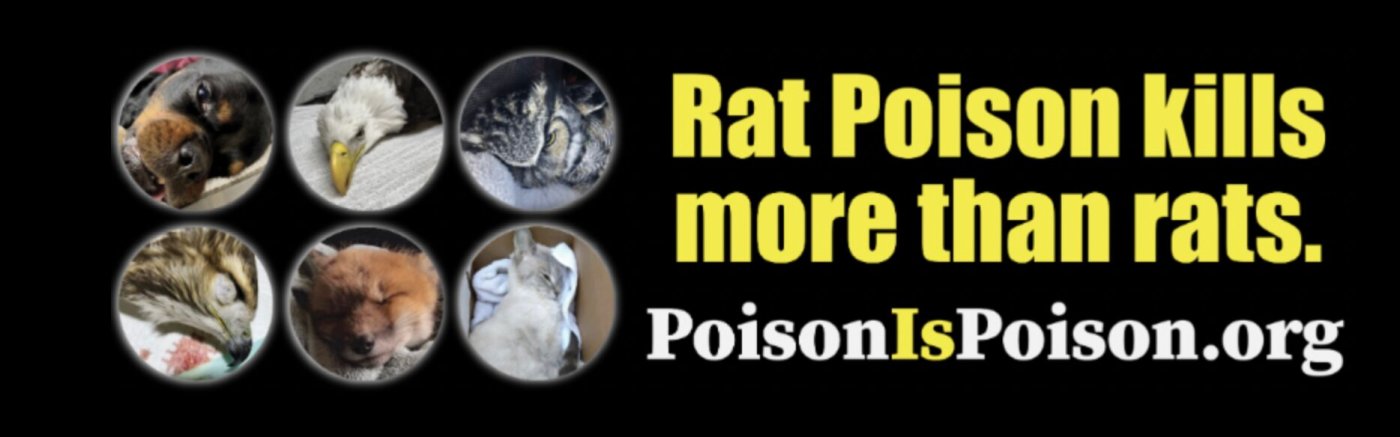
Several new billboards on Interstate 84 in Hartford and West Hartford are sending a not-so-gentile reminder that rat poison kills more than just rats.
The series of seven billboards are part of a campaign to raise awareness of the deadly impact that Second Generation Anticoagulant Rodenticides or SGARs have on wildlife. SGAR’s are a class of highly potent, slow-acting rat poisons that pose significant environmental and ecological risks. They are designed to kill rodents by preventing blood clotting, causing them to bleed to death internally over several days.
A Place Called Hope, a birds of prey rehabilitation center in Killingly, is behind the PoisonIsPoison.org billboard campaign.
“The billboards are meant to raise awareness that rodent poison kills way more than just mice and rats. We are continuing to see an uptick in non-targeted victims at our clinic and by the time they are admitted, there is no reversing the effects of these blood thinning poisons,” said Christine Cummings, president of A Place Called Hope.
“SGARs are so potent, even the U.S. EPA removed them from the public shelves in 2014,” Cummings said. “They are primarily misused by pest management providers who will tell customers that they are safe despite no scientific data to back them up. We have the proof that poison is poison, and there is no such thing as a safe poison and feel it’s time the public knew.”
SGAR’s have already been banned from stores in Connecticut and can only be used by licensed commercial applicators. In recent years, lawmakers have introduced bills to ban the rodenticide altogether, citing its high risks to young children, pets and other animals.
“They show that rodent poison kills more than the intended targets,” Cummings said. “Non-targeted victims include small children, domesticated pets and our wildlife. Secondary poisoning happens when an animal ingests a poisoned victim. Studies prove that 80% of wild animals tested result positive for the most common anticoagulant rodenticide poison being overused today, SGARs. These SGARs are responsible for widespread, indiscriminate, mass killings of any animal who consumes it directly or indirectly.”
The animals depicted on the billboards are all Connecticut cases that died from SGAR poisoning, she said. The billboards feature several animals killed by the rodenticide including a dog, cat, fox, eagle, owl, and hawk. She said that while the billboards may be graphic, they are meant to show the cruel indiscriminate lethality of using SGAR’s.
The referenced website on the billboards, PoisonIsPoison.org, directs members of the public to more information regarding rodenticide poisoning and the safe, non-toxic alternatives proven to solve rodent problems long-term. Another billboard run will follow in April, she said
Some Connecticut towns have already taken steps to eliminate the use of SGAR’s on municipal property. Last year, the town of Fairfield piloted a rodent birth control program to manage the town’s rodent population in a more environmentally responsible way, and animal rights advocates hailed it as an innovative way to combat the use of the deadly rodenticide.
Animal rights advocates like Jack Keller with Friends of Animals, a Darien-based nonprofit animal advocacy group, said that toxins from SGARs can linger in rodents for up to 10 days after ingestion and pose severe risks to predators like hawks and eagles that consume rodents. Other animals including pets are also at risk.
“The problem is that these rodenticides don’t immediately kill rodents. Many times they are still up and moving days after consuming them,” Keller said. “We see a lot of birds of prey like eagles and hawks testing positive for the rodenticide.”
Stephen Underwood can be reached at [email protected].