
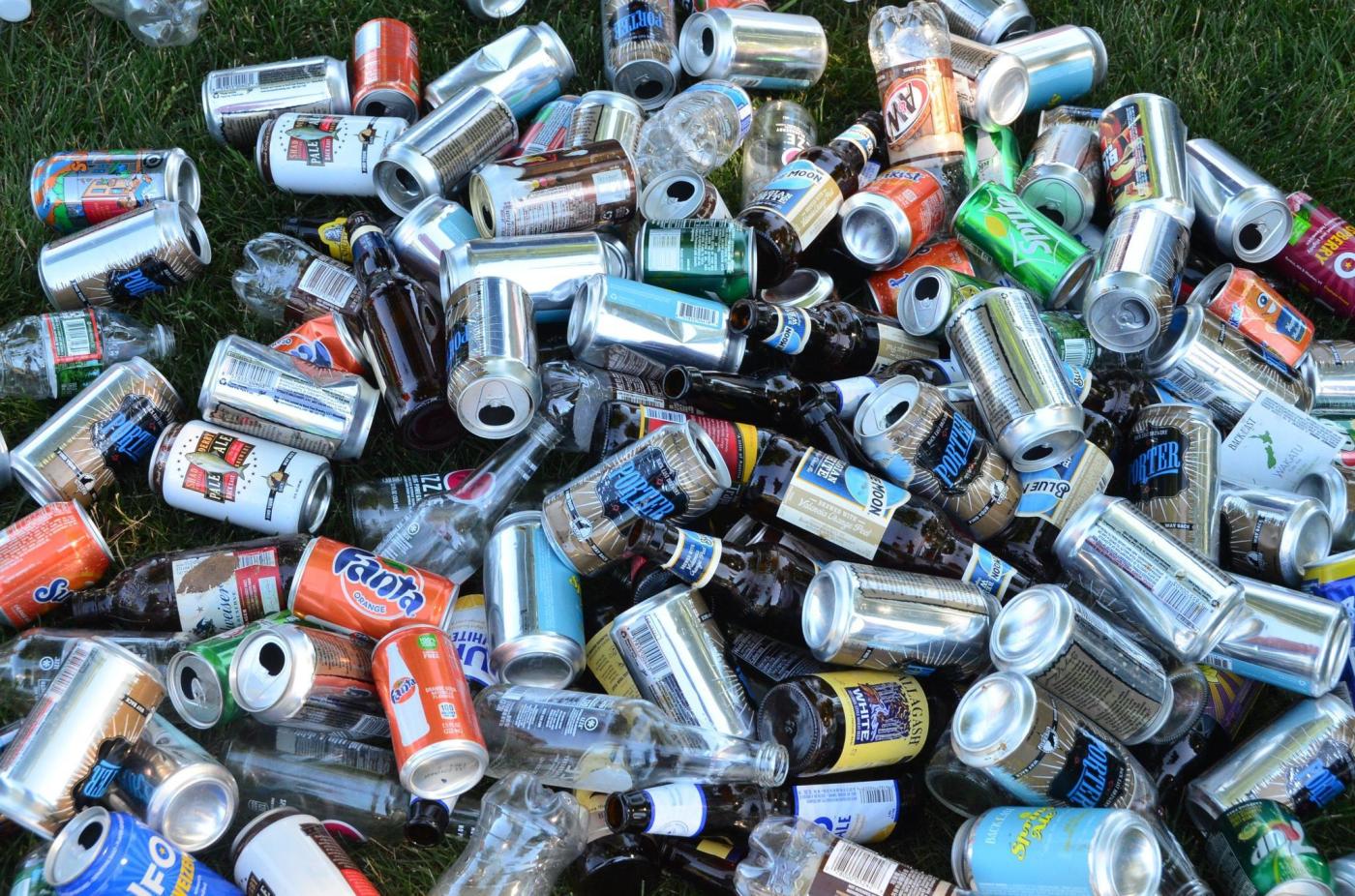
Since a 2024 law doubled Connecticut’s bottle deposit from 5 cents to 10, redemption centers have been inundated.
People in trucks have arrived with thousands of containers from other states where the bottle return fee is 5 cents or nothing at all, costing businesses millions and creating a conundrum for legislators, who are now trying to fix the situation.
Now, legislators passed a bill that aims to deal with the issue while acknowledging it doesn’t solve the problem completely.
“This is an ongoing problem and this bill does not fix the problem. It is a bipartisan attempt by the legislature to put a Band-aid on it for another year to see if we can fix it,” Sen. Rick Lopes, Senate chair of the Environment Committee, said Wednesday night in introducing the bill on the Senate floor.
“We have had an ongoing realization of fraud, where people are bringing in cans and bottles into our state and redeeming them for profit. And the problem this is doing is, we are actually paying out the redemption at 10 cents per bottle fee at a higher rate than we are collecting them.”
Lopes estimated the cost of the fraud at $14 million in fraudulent returns.
“This bill is an attempt to put in enforcement mechanisms and to prevent these things from continuing and expanding. It also sets aside a funding mechanism to help the distributors who have been shorted by the amount of fraud that’s going on, so that they won’t alone bear the burden of the financial responsibility of paying for the illegal cans,” Lopes said.
The modifications, including increased fines for those bringing containers from out of state and lowering the number of containers that can be redeemed by one person are some of the ways lawmakers are hoping to reduce fraud.
The Connecticut Senate voted 35-1 in favor of the bill. The House of Representatives also approved it by a margin of 130-7 with 14 no votes. It now goes to Gov. Ned Lamont‘s desk for his signature.
The bill will also prohibit the use of accepting suspected containers that have come from out of state that have been previously allowed for redemption.
Redemption centers also would now collect the identification for customers who redeem at least 2,000 containers. Previously, that number was 2,500. The maximum number of containers to be redeemed in one day is 4,000 containers, down from 5,000. There are exceptions for nonprofit organizations and fundraising activities. The bill also requires all containers in a single vehicle now be attributed to one individual.
Under the bill, redemption centers would be required to obtain a state license beginning July 1, at a cost of $2,500.
The 2024 law increasing the bottle deposit fee aimed to increase redemption rates and lower the number of containers that are thrown away or littered. Republicans, who opposed the increase then, this week proposed dropping the bottle deposit back to 5 cents. Democrats dismissed the idea.

People in trucks have arrived with thousands of containers from other states where the bottle return fee is 5 cents or nothing at all, costing businesses millions and creating a conundrum for legislators, who are now trying to fix the situation. (File photo)
During the Senate debate, Sen. John Fonfara said there should be more discussion on the issue during this legislative session.
“The arguments for why we went down this road or should not have gone down this road without greater involvement of our neighboring states is a very strong point,” Fonfara said.
“It has been mentioned that we are paying for other states to bring their bottles to our state and not getting the benefit of it at all. It’s wrong, and we need to address it, and I applaud Senator Lopes and those involved in getting us to where we are today.”
Fonfara reiterated that these modifications in the bill are “a step in trying to address the issue.”
“I think the work needs to continue beyond this today and to bring something before us before the session ends,” Fonfara said.
Minority Leader Stephen Harding proposed cutting the bottle deposit back to 5 cents until the surrounding states also increase to 10 cents. That proposal failed 25-11.
“We have individuals that are outright defrauding the system,” Harding said. “We know that, because we had distributors that are paying millions of dollars in excess of the deposits on the 10 cents they’re collecting. We have undisputed data that we have individuals defrauding their system.”
No ‘ increased enforcement’
Primo Brands Corporation, which is dual headquartered in Stamford and Tampa, Florida, released a report this month citing over-redemption in Connecticut and how it has negatively impacted the company.
Primo describes itself as “a leading publicly traded North American branded beverage company” and employed approximately 10,000 associates. Primo beverages are distributed to more than 200,000 retail outlets and more than 3 million homes and office delivery customers.
According to Primo’s report, the first quarter of 2024 redemption in Connecticut was 61.9% of the number of containers sold in the state. Between September and October of 2024, the redemption rate eclipsed 100% and the fourth quarter of the fiscal year finished at 100.9%. The numbers continued to climb last year as the first quarter’s CT redemption rate was 118.17%. Their rate topped out at 122.9% in the third quarter of 2025.
“At Primo Brands, we strongly believe in the value of a convenient bottle deposit system that promotes the efficient collection and recycling of bottles into new bottles. When Connecticut moved to a 10-cent bottle deposit in 2024, it did not provide for increased enforcement to prevent fraudulent cross-border redemptions,” in a statement prepared by a Primo Brands spokesperson.
“NY and MA bottle deposits remain at 5 cents, and NJ has no bottle deposit. Cross-border redemption is driving over-redemption, negatively impacting all bottlers by driving up expenses for many — including Primo Brands — with its 2025 redemption rate exceeding its CT sales by nearly 42 million beverage containers. Furthermore, in a year-over-year comparison, more than 92 million Primo Brands containers were redeemed in 2025 than in 2024,” the statement continued.
“We are appreciative that the Governor and the General Assembly are taking this issue seriously, and we look forward to working with them to mitigate the situation in a meaningful way.”
A Connecticut Department of Energy and Environmental Protection spokesperson said the DEEP does not receive data that would “allow us to assess whether individual deposit initiators are over-redeemed in a given quarter.
“The statewide redemption level rose to over 96% in both Q3 and Q4 of 2025,” the DEEP spokesperson said. “DEEP agrees that this increase in the redemption rate is likely due to both increased redemption by CT residents and some level of fraudulent redemption of containers purchased outside of CT. DEEP does not have access to information we would need to identify what portion of the increase is due to out of state redemption. But DEEP agrees this is an issue that needs to be better addressed.”
‘It’s not a joke here’
Rep. Patrick Callahan, a Republican from New Fairfield, noted the “massive abuse and fraud” regarding bottle returns in the state.
He has posted a video on social media referencing a popular Seinfeld episode when Kramer and Newman drive to Michigan from New York get 10 cents redemption for bottle redemption.
“But that’s happening and it’s not a joke here because it’s happening on a very large scale,” Callahan said. “Trucks coming in full of bottles from as far as Virginia and other states are returning massive amounts of bottles of cans that weren’t bought in Connecticut.”
Callahan said distributors can’t keep taking “massive financial hits quarter after quarter because of bottle redemption.”
Callahan said he also opposes having state law enforcement using its time on bottle fraud.
“I’m not a big fan of that. … the police should be dealing with the big issues, the public safety issues. And now we want to start using law enforcement’s time and the resources we have to enforce a bottle bill?” Callahan said.
Punishments in the bill will increase for those who try to redeem out-of-state bottles in Connecticut. The fines will rise from $50 to between $500-$750.
For a second offense, the fine will range from $750-$1,000. The previous fines for a second offense were $100. A third offense is $2,000 and the person “shall be guilty of a class A misdemeanor.”
Connecticut has not been alone on bottle return fraud. Michigan has had 10 cents deposits for 50 years. In 2021 Governor Gretchen Whitmer signed into law that bottle return fraud, for the most serious violations is a felony and punishable by 5 to 20 years. Large-scale fraud schemes could result in charges for consumers, distributors and retail stores.
Whitmer also put into motion a $1 million fund for state police to investigate and prosecute these violators.
In Connecticut, Robert Hanna is the principal owner of Three Veterans Redemption Center in New Milford, which he said is about five miles from the New York State Border.
Hanna said he prefers the bill to stay as it is and opposes many of the changes.
He said between July of 2024 to February 2026 about 40 people have been asked to leave his redemption center for not having proof of residency.
“We actually verify customers that come in. They have to be a Connecticut resident, or they own property in Connecticut, because we’re also a lake community,” Hanna said. “The first thing we do if we see an out-of-state plate is walk up to them and ask for proof if they are a Connecticut resident. If they don’t have proof, we tell them to leave.”
Once that person is verified, they are given a verified resident card to show each time they come to the redemption center.
“We know our customer base and there is always someone in the redemption room. We’ve had the same employees for almost two years now. If they don’t recognize someone, they ask for proof of residency. Is it 100 percent? You are never going to get 100%, but it was the best process we could come up with and it’s easily enforceable, simple and this is our part of reducing cross-border contamination.”
Hanna said manufacturers and distributors have 100% ability to stop this problem. He added that multiple distributors have a red line on the bar code to differentiate if the bottle is sold out of Connecticut.
“Distributors absolutely have the power to do this and they are leaving it to the small business owners to solve this issue,” Hanna said. “How many distributors have paid out more than 100% of what they have sold in the state of Connecticut. And of those distributors, how many of them are ones who use the supplemental barcodes in the red line boxes? And if the ones who use that technology are not the ones going over 100%, it should be a distributor issue, not a state issue.”
Hanna said that for redemption centers, the only way the center makes money is with volume, so he opposes limiting the number of cans to be redeemed in one day.
“Nobody takes documentation when you purchase them. They have no problem charging you $100 in deposits if that’s what you’re purchasing at the grocery store. But then they don’t want to let you return all of that at one shot without additional documentation for the state and that’s just wild to me,” Hanna said.