
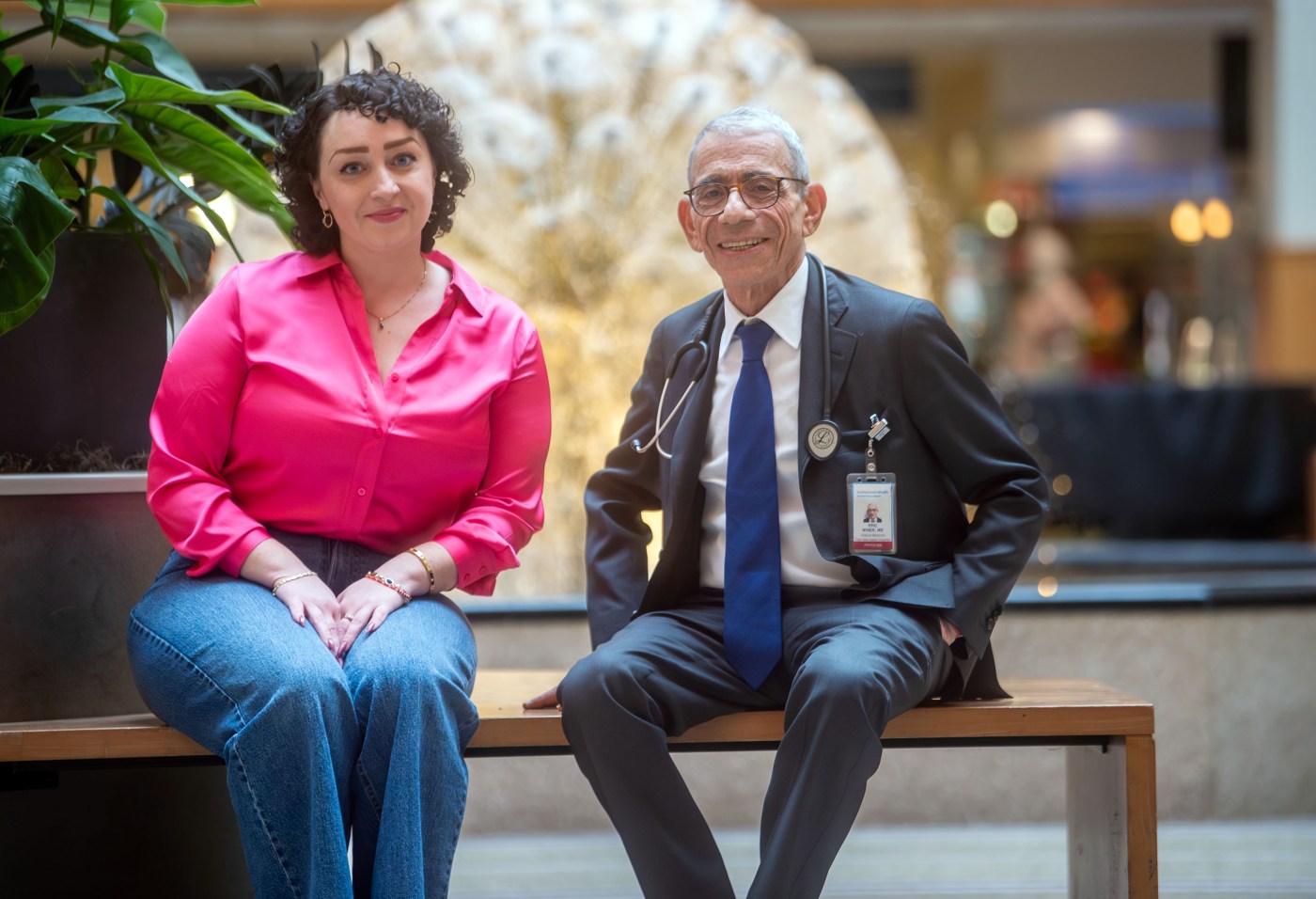
Breta Hasimi struggled to speak when she received the diagnosis of triple-negative breast cancer, one of the most aggressive forms of cancer.
Her worst fears were becoming reality.
Aware that her mother had breast cancer at the age of 40, Hasimi advocated a few months earlier to receive a mammogram but her primary care doctor told her that she was too young.
Then several months later she felt a lump in her breast, and called her gynecologist to schedule a mammogram.
Hasimi was only 33 years old when she was diagnosed in February 2024 and the shock of the diagnosis at such a young age was life changing for the Bridgeport resident.
“I cried a lot,” she said. “I would go to the beach. That was my sanctuary. I would give myself moments. I also lived my life but I also knew when to stop and give myself a break.”
Hasimi’s case is not an isolated one. Cancer rates in young people under the age of 50, specifically breast and colon cancers, are growing at significant rates, according to doctors and the American Cancer Society.
“Colorectal cancer has emerged as the leading cause of cancer-related death among adults under 50 in the U.S., surpassing breast cancer,” said Dr. Joel Levine, UConn Health professor of medicine and founding director of the Colon Cancer Prevention Program.
Doctors at UConn Health and Yale New Haven Health said that at least 10% of cancer cases are occurring in young people under the age of 50.
Dawson Creek’s actor James Van Der Beek, a state native, died from colorectal cancer last week at the age of 48.
‘They don’t think that they could have cancer’
Doctors said obesity rates, diet and lack of exercise may play a role in the higher incidence of cancer in younger people.
Dr. Eric Winer, director of the Yale Cancer Center, said in “younger people in general there’s a higher proportion that have an inherited abnormality or an inherited predisposition.”
Winer said cancers that arise in young people tend to be a little more aggressive in nature.
“Among these concerns are the fact that oftentimes younger people are not diagnosed at a young age because they don’t think that they could have cancer because they are young,” Winer said. “And oftentimes even when they see health care providers, health care providers aren’t thinking about cancer in somebody who’s 30 or 35.”
Self examination for breast cancer, cancer screenings, understanding family risk factors and undergoing a risk assessment are keys to catching it, doctors said.
‘It was one of the worst things to see’
When Hasimi was diagnosed with breast cancer in February 2024 she had just begun a new job. After sharing her diagnosis with her employer, she said she was fired two months later, leaving her to find a new place to work while contemplating her treatment options.
In April of 2024, she began treatment under the care of Dr. Winer, whom she credits with helping her to navigate the rough waters around the disease.
At first, she tried a cancer trial but her cancer tumors tripled in size so she began chemotherapy in June of that year.
Hasimi said the most difficult part about chemotherapy was losing her hair, describing how it is part of who you are.
“It was one of the worst things to see,” she said.
While battling the disease, Hasimi said she learned about herself.
“I found how resilient I am,” she said. “I just want to live. I feel like there is so much more to life. I have not lived to my full capacity.”
After chemotherapy, Hasimi said she had to undergo a double mastectomy in November 2024. Doctors then shared the good news with her that the cancer was in complete remission.
Hasimi credits her friends, family and the doctors at Yale with helping her through the darkest days. She says a positive attitude went a long way.
“There is a reason why I am here,” she said. “I am always smiling and always outgoing. I am very positive throughout the whole entire process even on the sickest days.” But at the same, she gave herself room to grieve.
Dr. Sunny Mitchell, a breast surgeon and director of the breast program at UConn Health, said as of 2016 “we know that 10% of cases of breast cancer are women under 45.”
“Young women are being diagnosed with breast cancer prior to the traditional screening for breast cancer,” Mitchell said, which is the age of 40.
She said incidents of young women diagnosed with breast cancer under 45 are increasing at 1.5% annually, which is faster than those over 45 or 50.
Mitchell said most people who have breast cancer do not have a known or identifiable genetic component.
It is important, she said, for women to do self breast exams every month and when they are 25 or older to undergo a risk assessment for breast cancer with a gynecologist.
She said if young women know they have a family history of breast cancer they should routinely see their doctor.
Symptoms of breast cancer include any changes in an exam, including a new lump, a new bump or changes in the skin, Mitchell said.
In Connecticut there were 148.6 cases of breast cancer per 100,000 from 2018 to 2022, according to the American Cancer Society.

Kimberly Bishop was weaning her youngest son from breastfeeding when she woke up with a massive lump on her left breast in November 2024.
At first doctors thought it was a clogged duct but it wouldn’t go away.
Bishop, a mother of a 5-year-old and 2-year-old, then learned the unthinkable: she had stage 3 breast cancer at the age of 39.
“It was tough,” the mother from Simsbury said, choking up.
Bishop underwent a mastectomy, chemotherapy and 15 rounds of radiation through September 2025. Doctors said her prognosis is curative as she is still in active treatments for the cancer.
She said her children are her “entire reason” to keep going.
The whole experience has changed her, she said.
“Becoming a mom and turning 40 as a woman in this world, I sort of let go,” she said. “I was so much less worried about the little stuff and what anyone thought of me. It has empowered me really to let a lot go and focus on the things that matter most and focus on the things that we can control and look at the ways I want to spend my time. What are the things that are important to me? Am I putting good into this world?”
Change in diet and eating habits
Winer said many cancers arise with no genetic predisposition.
“And the rising rates are thought to be broadly speaking due to environmental factors,” he said, referring to diet.
But he cautioned that the cause had not been absolutely proven.
Winer said research is important “because we can’t start steps to limit risk until we understand what has caused it.”
The American Cancer Society said “dietary factors, such as high consumption of red or processed meats, and/or low intake of calcium, whole-grain, and/or fiber-rich foods” are risk factors for cancer.
Nancy Borstelmann, co-director of the Early Onset Cancer Program at Yale Cancer Center, said there are likely a number of factors that could be causing cancer in young people, including genetics and lifestyles.
“But over time, you know since the last 20 years or so, or even 25 to 30 years there have been changes in the way we as a culture behave,” she said, referring to more of a sedentary lifestyle, alcohol use, smoking, vaping and other environmental exposures like diet.
Veda N. Giri, director of the Early Onset Cancer Program at the Yale Cancer Center, said in looking at different generations, “we notice increases in cancers in younger individuals by successive generations.
“So, for example, Gen Xers, compared to Baby Boomers, have higher rates of early onset cancers,” Giri said.
She said that there were some key changes in foods and exposures in more recent years. Gen X, Millennials, Gen Z, and beyond have been exposed to more ultra processed foods compared to Baby Boomers and generations before.
“One of the leading theories is that prolonged exposure to ultra processed foods can lead to changes in the gut microbiome, which is important for immune regulation and defense against tumor growth,” Giri said. “As the gut microbiome changes, there can be an increased risk for cancer at a younger age.”
Colorectal cancer
The American Cancer Society reported that in Connecticut there were 32.6 per 100,000 cases of colorectal cancers from 2023-2025.
A study in the Journal of the American Medical Association published last month found that “colorectal cancer is now the leading cause of cancer death in young men and second leading cause of cancer death in young women in the U.S.”
The study found that incident rates of metastatic colorectal cancer among young adults increased by “22% between 2010 and 2019.”
Levine said, “the risk factors for young people appear to be lifestyle related, including diet, obesity and early use of alcohol.
“In addition, about 20% have a family history of colon cancer and some younger patients, even without a family history, show an ‘inheritable’ gene mutation,” Levine said. “Clinically, the cancers located close to the end of the colon, present with rectal bleeding. This alarm symptom is often assumed, in young people, to be hemorrhoid related. As a result, the diagnosis is often at a more advanced stage of cancer. The better news is that many cancers in young people respond well to therapy. ”
The American Cancer Society said “in 2026 an estimated 108,860 cases of colon cancer” will be diagnosed.
Dan Hoyland was told when he was 19 that he was at high risk for colorectal cancer.
The father of two and Worcester, Massachusetts, resident said he spent years curing the ulcerative colitis that put him at risk for the disease. He had a brother who also had leukemia and a half brother with throat cancer.
In 2015, his colonoscopy was clear, he said.
He was due to receive a colonoscopy five years later but he said life got in the way with a busy career and starting a family.
Hoyland described being in the best shape of his life and eating a healthy Mediterranean diet.
In 2025, at the age of 40, he went in for his colonoscopy and learned that he had stage 3 colon cancer.
At first, he said he thought he could cure the cancer.
“I should have respected cancer more,” he said. “I saw an opportunity to lead by example and inspire people.”
But within four months his body broke down after starting chemotherapy and it remains challenging, he said.
Since then, he said his cancer has spread to a level 4.
He said routine and surrounding himself with people that love him keep him going.
He spoke to the Courant by phone while getting chemotherapy at Mass General Hospital.
Hoyland said he wished he had gotten screened earlier.
“It is really my fault,” he said. “It doesn’t matter if you feel good. If I had gotten screened, it wouldn’t have spread to my liver and throughout my body.”