
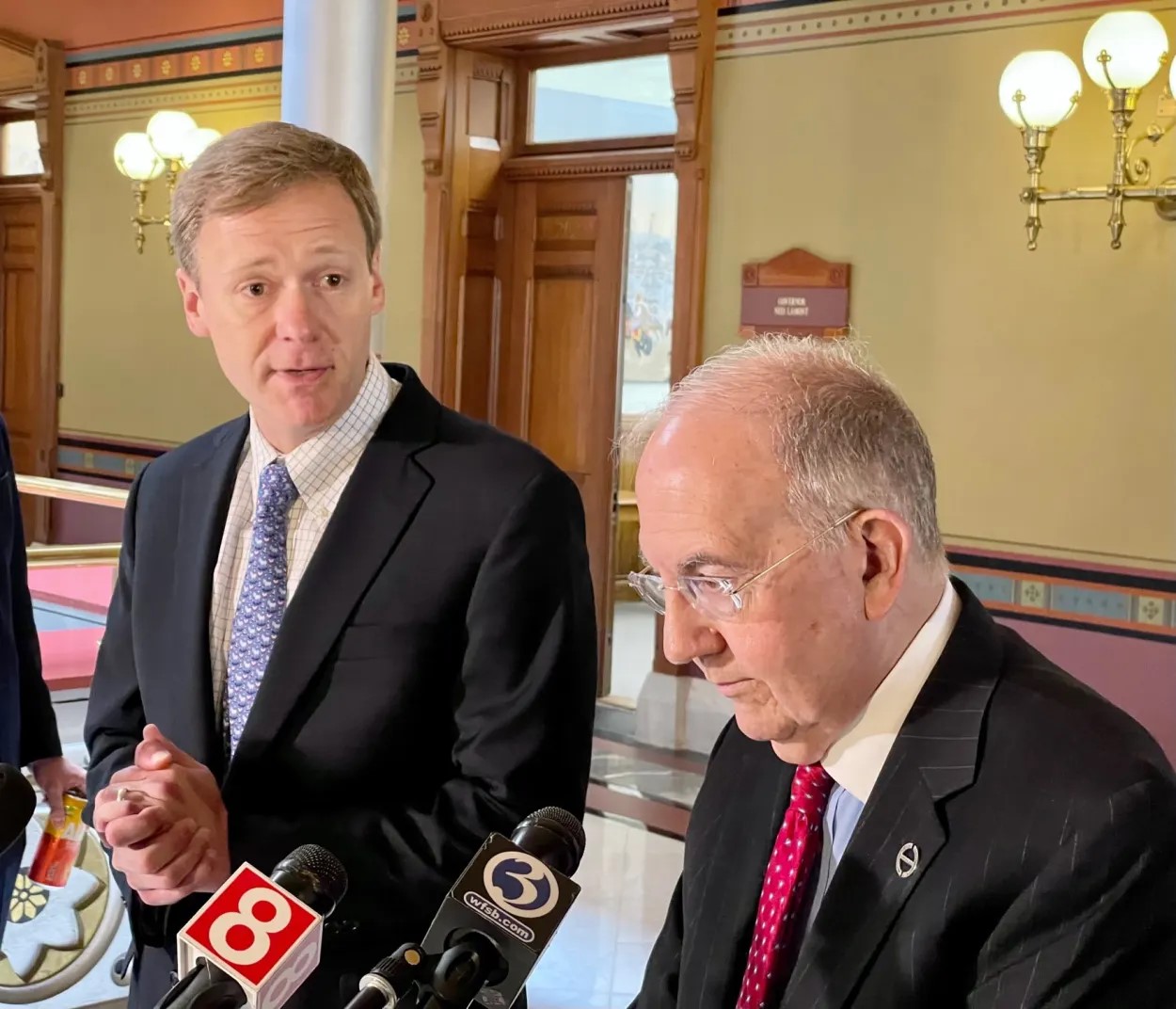
The General Assembly is poised to take an “emergency” shortcut to pass legislation that would, among other things, provide millions in earmarks and other grants to select communities and groups, extend a moratorium on addressing racial imbalances in schools and set worker-friendly standards on warehouses.
By certifying the measure as an emergency, Senate President Pro Tem Martin M. Looney of New Haven and House Speaker Matt Ritter of Hartford can call for votes on the bill Wednesday in the Senate and Thursday in the House with limited vetting by legislative committees.
Many items in the legislation, elements of which still were being tweaked, are drawn from bills that had public hearings or passed one chamber last year, such as House Bill 7009, an omnibus education bill passed overwhelmingly by the House. It would have made dozens of changes in state law, including delaying the enforcement of the racial imbalance law to July 1, 2029. The emergency version would push it another year.
Other portions appear technical in nature or provide clarification of budget items.
One attempts to protect bottle redemption centers from fraudsters returning bottles from states with nickel deposits to Connecticut, which pays a dime. It would impose a tenfold increase in fines for bottle-bill fraud and reduce from 5,000 to 2,500 the number of containers one person could redeem in a day.
“It’s a lot of the bills that we tried to tackle last fall that have been around for a very long time,” Ritter said, referring to a limited special session. “So they’re going to come as no surprise to many people.”
But assembling the varied pieces under the guise of an emergency is an unusual exercise of power by Ritter and Looney, Democrats whose party controls more than two-thirds of the seats in each chamber. Republican minority leaders say it might be unprecedented.
Senate Minority Leader Stephen Harding of Brookfield said none of the items arise from a true emergency. House Minority Leader Vincent J. Candelora of North Branford said any additional action on earmarks without strenuous vetting is inexplicable, given a continuing FBI investigation.
“Democrats just haven’t learned their lesson about the fact that we need to be better stewards of the taxpayers’ dollars,” Candelora said.
The emergency legislation also incorporates proposed revisions to elections law, many of them technical, sought last year by Secretary of the State Stephanie Thomas. A new version, Senate Bill 226, was the subject of a public hearing Monday.
Not everything in the bill is uncontroversial or bipartisan: One section is a revised version of major legislation inspired by labor concerns over Amazon’s use of quotas and biometric surveillance to manage its warehouse workers. It passed the House on a largely party-line vote last year but never came to a vote in the Senate.
The revised version includes a private right of action allowing workers to sue for damages if the new standards are not met.
There is no unifying theme in the bill.
It would provide municipalities relief from school construction deadlines or conditions. A portion of the bill sought by Republicans allows Cheshire, for example, to be reimbursed for what otherwise were deemed ineligible costs for energy or infrastructure improvements.
Another section would instruct the Department of Social Services to provide $2.5 million over two years to Newington, Wethersfield, Cromwell, Rocky Hill and Middletown for the establishment of mental health programing.
A VFW in New London would get $174,000 from the state Department of Education. Our Piece of the Pie, a nonprofit in Hartford that received an average of $1.2 million annually from 2016 until its state funding was nearly halved in 2025, would get $330,000 from the Department of Economic and Community Development.
The two Democratic leaders defended the legislation as an efficiency measure that will make time available for passage of other bills in the short session. The first month of the three-month session otherwise is dominated by committee work, with few bills ready for floor votes until April.
Unlike in Congress, where bills have two years to be passed, every bill awaiting action on the House or Senate calendar dies at the end of every annual session.
“I’ve always been in favor of being able to actually carry over certain legislation that has passed at least one chamber in the prior session,” Looney said. “We obviously have a lack of subject matter ready for session action early in the even-year session, and we only have three months to do things. So I think this will allow for a more efficient use of our time.”
Ritter blamed Senate Republicans for blocking final actions on some of the measures in the emergency bill by taking advantage of the legislature’s tradition of unlimited debate. Blocking a Senate vote on the education bill, which passed the House with bipartisan support, was obstructionist, he said.
One consequence of that is the Democrats’ assembling an emergency bill that is certain to pass, he said.
Harding said the Democrats are abusing the process.
“I find it inexcusable for the speaker or the president of the Senate to say that, basically, we’re doing this because we have a limited amount of session days,” Harding said. “That’s not an emergency.”
Mark Pazniokas is a reporter for the Connecticut Mirror. Copyright 2026 @ CT Mirror (ctmirror.org).