
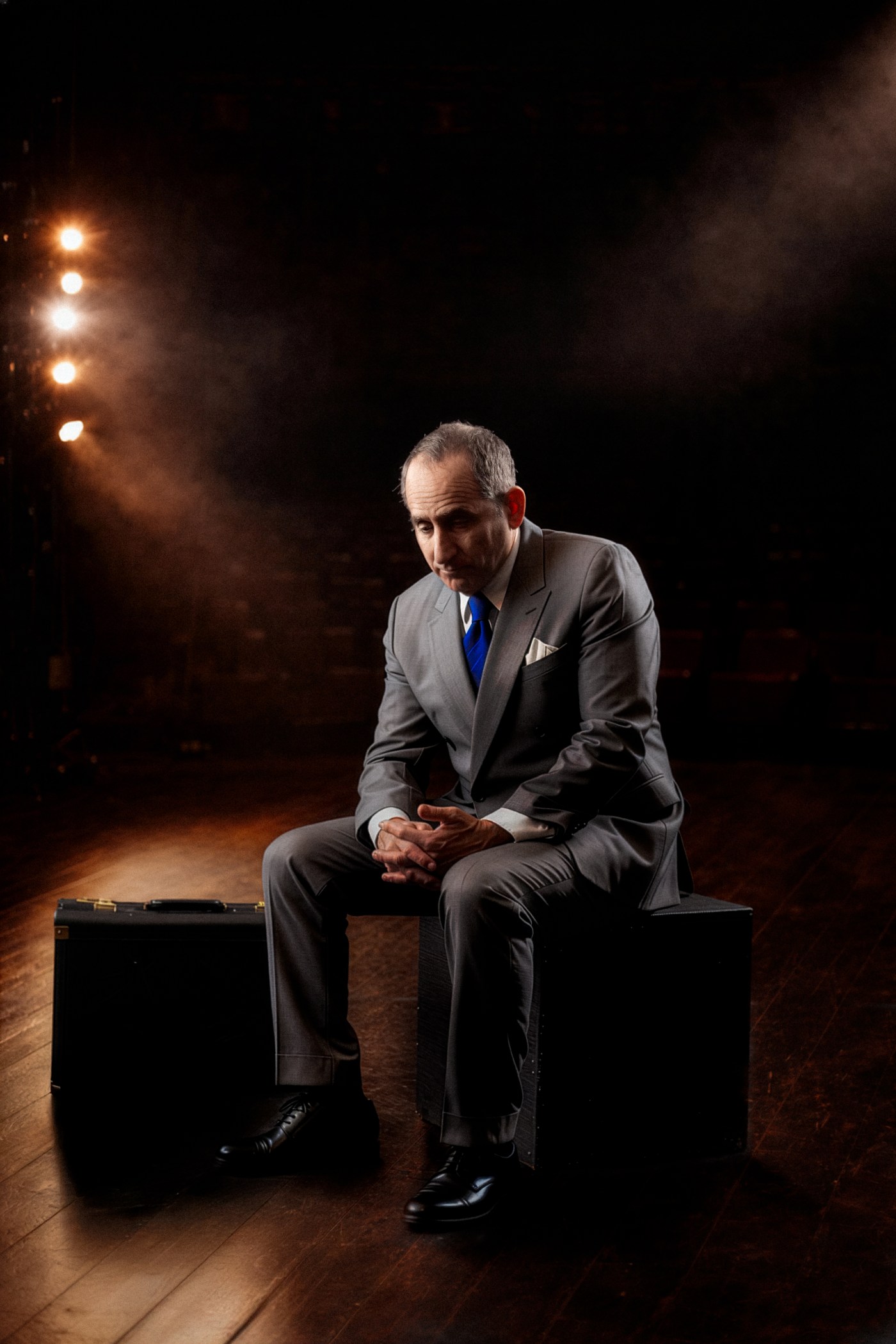
The new Hartford Stage production of Arthur Miller’s classic American tragedy “Death of a Salesman,” onstage Feb. 27 through March 29, promises to feel both familiar and freeing, taking on the monumental American drama from some new directions, according to its director and star.
“Death of a Salesman” is one of the most famous and most important plays in theater history. When it debuted in 1949, it won six Tony Awards, including for Best Play and Best Author of a Play, the New York Drama Critic’s Circle Award for Best New American Play and the Pulitzer Prize for Drama.
Longtime Connecticut resident Arthur Miller wrote the play in the small writing studio he’d built for himself on the grounds of his Roxbury home.
The play hit a cultural nerve at the time in large part because Miller captured the demise of a certain type of personable, hands-on business model that had been a big part of American life for most of the 20th century: the traveling salesman. Miller showed the struggles of a man who often has to mask his difficulties with a smiling face. He humanized a type of salesman who had become stereotyped in movies and comic strips since the Great Depression as a charlatan or a grifter or a bumbling sap.
“Death of a Salesman” has now been around for over 75 years, and something else has become clear about Miller’s work. The play spoke eloquently to its own time but continued to provoke and inform in subsequent generations. For decades, its original production, directed by Elia Kazan and starring Lee J. Cobb, seemed untouchable, and most tours and regional productions replicated it. But over time very different actors and directors chose to tackle it and found intriguing new aspects of the script to explore. Some considered the work abstract and dreamlike, while others went for high realism.
Hartford Stage’s production is directed by Melia Bensussen, who went in a realist direction when she did Miller’s “All My Sons” at the theater just two years ago. She argues that “Death of a Salesman” is more abstract and that’s how she is presenting it on a basically bare stage.
“With ‘All My Sons,’ Miller was trying to write an American Ibsen play,” Bensussen said. “That play is meant to be naturalistic. ‘Salesman’ is not. One of its original titles, when Miller was first writing it, was ‘Inside His Head,’”

Director Melia Bensussen actor Samuel H. Levine (who plays Biff in the play) in rehearsal for the Hartford Stage production of “Death of a Salesman.” (Lucas Clopton)
Bensussen describes parts of the play as “hallucinatory and freeform, an emotional intuitive journey.” She sees other paths of expression in Miller’s complex drama. “Yes, it’s about Capitalism. Yes, it’s about mid-20th century life. But it’s also about family. In some ways it’s an American ‘King Lear,’” she said.
The Hartford Stage production stars Peter Jacobson as the troubled Willy Loman, Adrianne Krstansky as his wife Linda, Samuel H. Levine and Max Katz as their sons Biff and Happy, with Stephen Cefalu Jr., Michael Cullen, Nora Eschenheimer, Mike Houston, Rebecca Strimaitis and Patrick Zeller also in the cast.
Bensussen has a long working relationship with Krstansky, including every phase of “The Art of Burning,” which had its world premiere at Hartford Stage in 2023. Like Jacobson, Krstansky was one of the first actors she thought of when casting this production. “Adrianne has many gifts. She has the ability to see beyond stereotypes. Marriages are complicated, and she can show that,” Bensussen said.
Bensussen and Jacobson have known each other since they both attended Brown University in the 1980s, but this is their first time working together. Bensussen was a couple of years ahead of Jacobson at Brown, and he recalls her as “one of the bigshots in theater there.”
Bensussen remembered him from Brown but also said “Peter was close friends with some of my closest friends at Juilliard. We’d been brainstorming about ‘Death of a Salesman’ and I suddenly thought of him. It was instinctual.”
When he was approached for “Death of a Salesman,” he said “I hadn’t seen her in forever, but the theater can be such a family.” He hasn’t worked before with anyone in the cast either, though he has an odd connection to Krstansky, who reminded him that she had once been asked to babysit his half-sister when both actors were working in Chicago years ago.
When she announced last year that she’d be doing “Death of a Salesman,” Bensussen said she wanted to bring out the Jewish themes in the work. While it is not mentioned in the script that Loman is Jewish, the playwright, director and star of the original 1949 production all shared Jewish heritage (Miller was an avowed atheist who’d grown up in a Jewish household) and Jewish themes have been part of critical analysis of the play since it was written.
“The Jewish themes were part of our initial conversation,” Jacobson said. “For me, there’s a fit there. It feels recognizable. At the same time we’re not trying to make this overtly Jewish. This play can go a million different ways.”

Peter Jacobson and Adrianne Krstansky as Willy and Linda Loman in the Hartford Stage production of “Death of a Salesman.” (Miceli Productions)
Jacobson’s never had the opportunity to appear in “Death of a Salesman” before, whether as Willy or one of his sons. “I’d read it, of course. I admired it from afar.” Likewise, he’s never been to Hartford Stage. Most of his theater work has been in New York and California (where he’s done everything from new plays to American classics like “Waiting for Lefty” and “Once in a Lifetime” to lots of Shakespeare) rather than in regional theaters.
Jacobson may be best known for his five seasons on the TV medical mystery drama “House” or as Alan Snyder in the sociopolitical science fiction series “Colony.” His film roles are as diverse as the Scarlett Johansson/Channing Tatum rom-com “Fly Me to the Moon,” the dark comedy “Better Living Through Chemistry,” last year’s horror sequel “Smile 2” and the “Haul Out the Holly” Christmas movie.
Jacobson said he feels “so comfortable” in this role, after first “realizing that I was old enough to play the part.” (In the play, Willy Loman says he is 60.) “I can bring my own neuroses and sadnesses and drama to it. I knew it was something I wanted to try.”
Jacobson noted that while “Death of a Salesman” lives up to its title and is properly branded a tragedy, another oft-buried aspect of the play is that it has some comedy and bright spots in it. “Any play that has zero humor, I’d be afraid of. Miller’s too good a playwright for it to be devoid of humor. Some moments are silly or soft or light. You need that when there’s a tragedy,” he said.
Bensussen has made a point of bringing out the joyous moments in this dark drama. “The start of Act 2 is the happiest scene. We do some shtick with Linda and Willy. They are so charming, so joyous together. Willy’s not a depressive — he’s at a low time in his life.”
In terms of “Death of a Salesman”’s period setting, Jacobson said “We’re doing it as if it was 1949 Brooklyn, taking it as written. It feels so real. Melia says we have reverence for the script, but we’re not being precious with it. The set is more abstract than most you see. A lot is suggested by lighting. Miller has written a dream. We are in a dream.”
Bensussen said the show’s sound designer, who has also composed original music for the production, has been attending rehearsals and is deeply involved with the collaborative creative process. “The lights and sound are essential to this,” she said. “When you say it’s an empty stage, it’s never an empty stage. Sound and memory is how this play works.”
“Death of a Salesman” runs Feb. 27 through March 29 at Hartford Stage, 50 Church St., Hartford. Performances are Wednesday through Friday at 7:30 p.m., Saturday at 2 and 7:30 p.m. and Sunday at 2 p.m. There are also 7:30 p.m. performances on May 3 and 17. The May 18 performance is at 2 p.m. not 7:30 p.m. $20-$105. hartfordstage.org.