
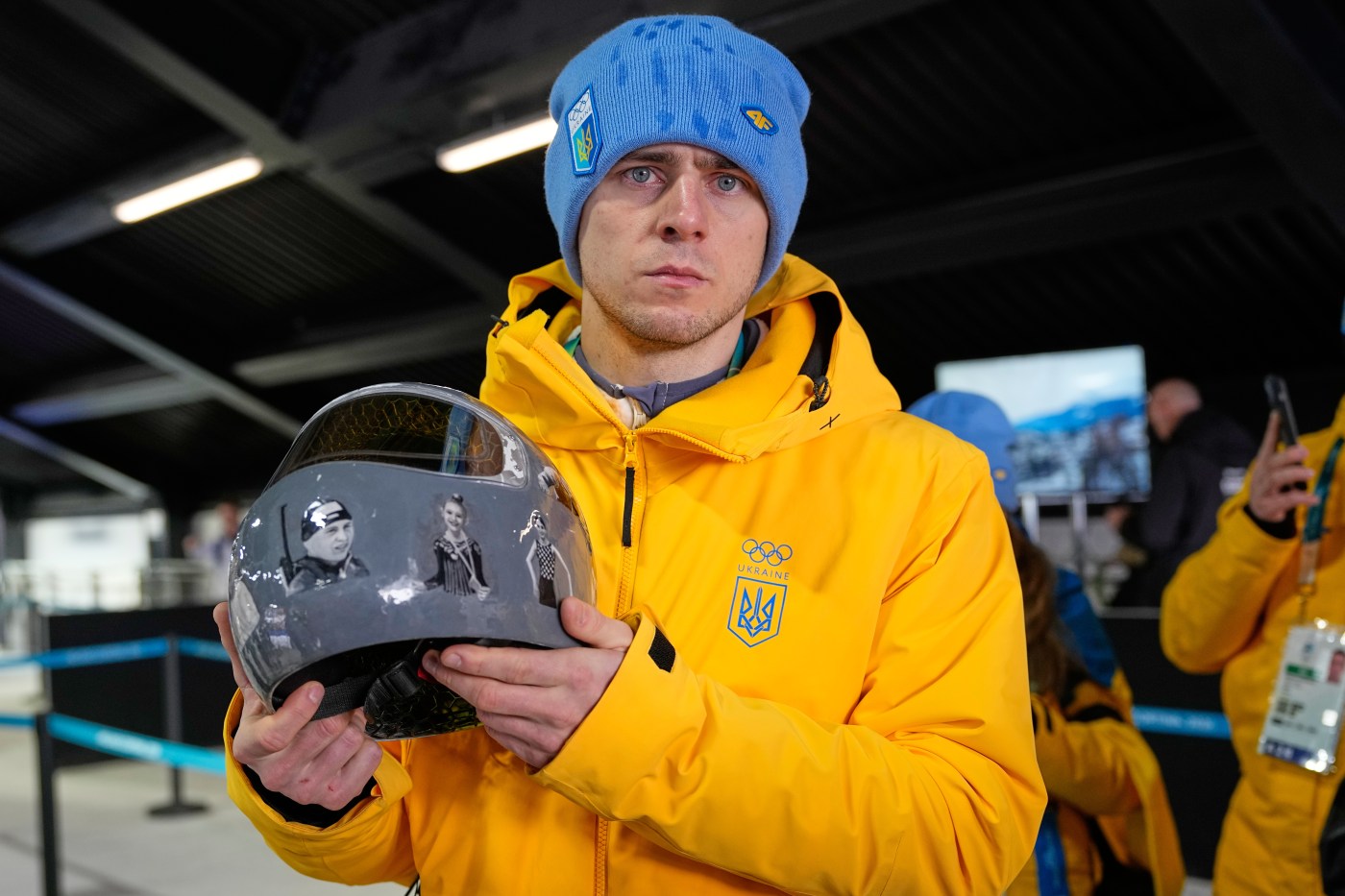
Olympism is defined as using sport as a means of promoting the development of humanity and preserving human dignity. That was not the case this month, when the International Olympic Committee disqualified Ukrainian skeleton racer Vladyslav Heraskevych from competing in the 2026 Olympic Games.
Heraskevych wanted to pay tribute to 23 Ukrainian athletes and coaches whose lives were cut short by Russian forces in the four-year war started by Vladimir Putin in February 2022. He wanted to honor them by wearing a “helmet of memory” which bore the faces of these fallen Ukrainians.
The IOC said no, telling Heraskevych it was not about the message, but its placement, arguing that it was not allowed on the “field of play.” They offered compromises of a black armband or ribbon and to let him display the helmet after the race in mixed zones.
This Ukrainian athlete tested Olympic rules on free speech — and here’s what happened
Heraskevych refused, stating that the “helmet deserves to be here” and that “the world must see our athletes.”
He understood the risk involved, knew a disqualification was possible. He also understood that compromise can mean eradication, that moving remembrance out of sight means grief itself is troublesome.

The IOC’s decision was based on adherence to guidelines governing athlete expression. However, the Olympic Charter speaks of human dignity, promoting peace in the world while preserving that dignity. How is dignity preserved by ignoring the faces of the fallen? How is peace advanced by asserting that remembrance be limited to the sidelines?
Ukrainian officials were correct in labeling the ruling a major blemish. Ukraine’s President Volodymyr Zelenskyy reminded the world that “sport does not mean forgetfulness,” and awarded Heraskevych the Order of Freedom for his civic courage. “To have courage is more than to have medals,” he wrote on social media.
The lasting image after the 2026 Winter Games conclude will be of a 27-year-old athlete staying resolute in his convictions. All he did was wear a helmet to honor the deceased. He took a stance of powerful defiance and accepted the consequences.
Subsequently, other Ukrainian Olympians wrote on the palms of their gloves the phrase, “Remembrance is not a violation.” Those words now carry a tremendous amount of weight.
This is about much more than one competitor or a piece of equipment. It is about whether the Olympic setting has room for truth in a time of war or if neutrality becomes moral blindness. It is about whether the demand for silence unduly burdens those who have already sacrificed so much.
The IOC states that uniform rules have to apply to all. However, historians may pose another question: When confronted with a war that has killed hundreds of athletes (President Zelenskyy says 660 Ukrainian athletes and coaches have been killed since Russia’s invasion), did the protectors of Olympism find room for compassion, or did they withdraw into cronyism? The IOC’s response definitely showed the latter.
Vladyslav Heraskevych and his team appealed the International Olympic Committee’s decision to the Court of Arbitration for Sport where it was denied, citing Athlete Expression Guidelines. The arbitrator noted that the goal of the guidelines is to maintain the focus of the Olympic Games on performances and sport.
No matter the outcome, something remarkable happened. An athlete prioritized memory over medals. He reminded the world that the Olympic movement is found not only in records, but also in character. A willingness to stand strong and alone, while refusing to allow the fallen to be forgotten.
When sports historians recall these 2026 Winter Games they might not recollect the skeleton racers atop the medal podium, but they are likely to remember the young Ukrainian who refused to remove the faces of his murdered countrymen form his helmet. They will remember that he described his disqualification “the price of our dignity,” which he paid in full. On that occasion, deprived of racing in the Olympics but not of his morality, Vladyslav Heraskevych personified the exact principles the Olympic movement pretends to defend.
Ihor N. Stelmach is a former principal and history teacher at St. Michael’s Ukrainian Parochial School in Hartford.